BLOG OF RSI CONCEPTS

world map

AI Agents in Manufacturing: Customized Solutions for Operational Efficiency

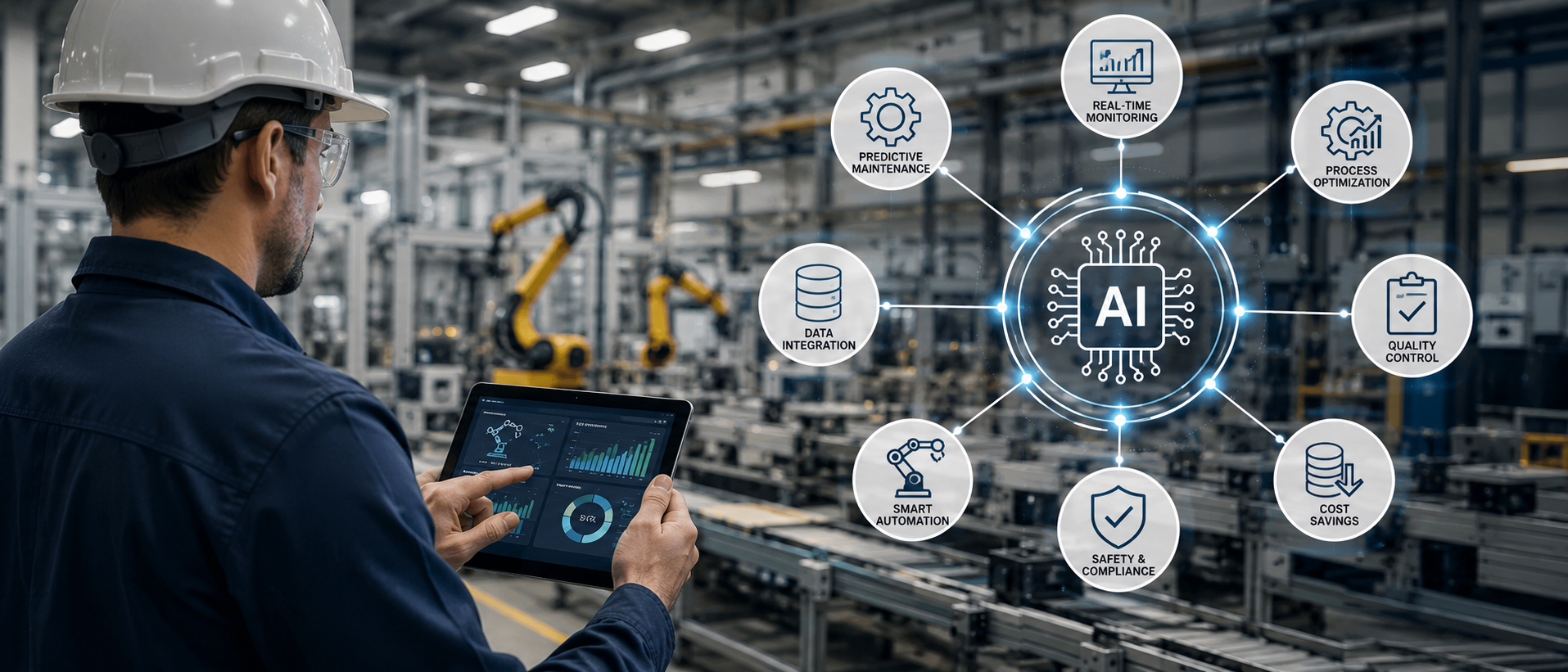
The businesses who are involved in production knows very well that a manufacturing facility doesn’t only depends on operating large machinery or traditional assembly lines, in fact, it depends on leveraging smart technologies, maximizing efficiency, boosting performance and ensuring a safe work environment. Manufacturing businesses already realized the fast-changing technology landscape and are eagerly seeking ways to leverage technology advancement such as AI or Artificial Intelligence. When it comes to integrating AI in manufacturing operations, the Custom AI Agents are an ideal solution to solve many problems undermining operational efficiency. The custom AI Agents are not like ordinary software applications, but they are very efficient and highly powerful tools, which are specifically designed to deal with very specific and unique tasks to solve problems and to boost operational efficiency.

What is a Custom AI Agent and Why a Manufacturing Plant Needs It?

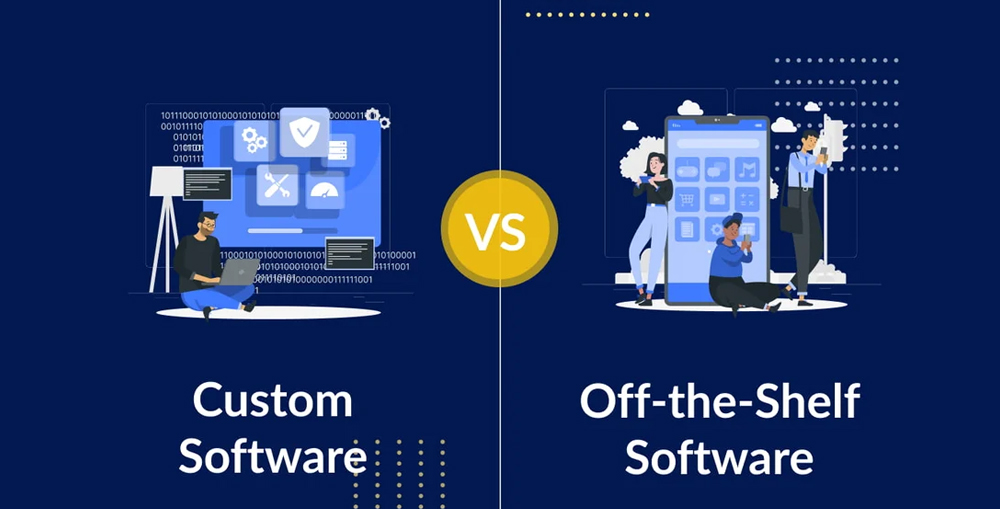
Every business evolves differently and over the time builds very unique ways to effectively execute a process. This means installing an out-of-the-box or off-the-shelf solution might not fully synchronize with your internal processes. That is why businesses prefer customized software applications and a Custom AI Agent is just like that. A customized AI Agent is designed to fully fit in your existing business processes, adopt to your internal practices and methodologies. This enables your Custom AI Agent to solve the very unique problems you are facing and deliver most value. A Custom AI Agent can seamlessly connect with your sensors such as PLC, SCADA, MES, CMMS and business management tools such as ERP, Inventory Management or Facility Management tools. Your Custom AI Agent operates like a digital worker, who have capability to absorb all your policies, processes, and doesn’t make mistakes and doesn’t require a break.

A custom AI Agent is built on AI Platform, which is capable of processing large volume of data in both structured and unstructured form. It can tap-in to any other digital solution or system, which enable them to gain access to a vast amount of real-time data. At any factory floor, everything is happening so fast, but a Custom AI Agent can easily process all that data. The human staff too monitor the entire operation with help of various analytical tools, which are empowered by the same data, but the biggest difference is that the customized AI Agents are much more effective and efficiency in sensing any minor change or pattern, which is extremely important for preventing any issue before it happens. That is why businesses leader are moving towards agentic AI automation. A custom AI Agent can greatly boost operational efficiency and help businesses save a lot of expenses and on top of that generate more profit with higher productivity.

See Also: How Customized AI Agents Can Streamline Business Operations
What is a Custom AI Agent and Why a Manufacturing Plant Needs It?

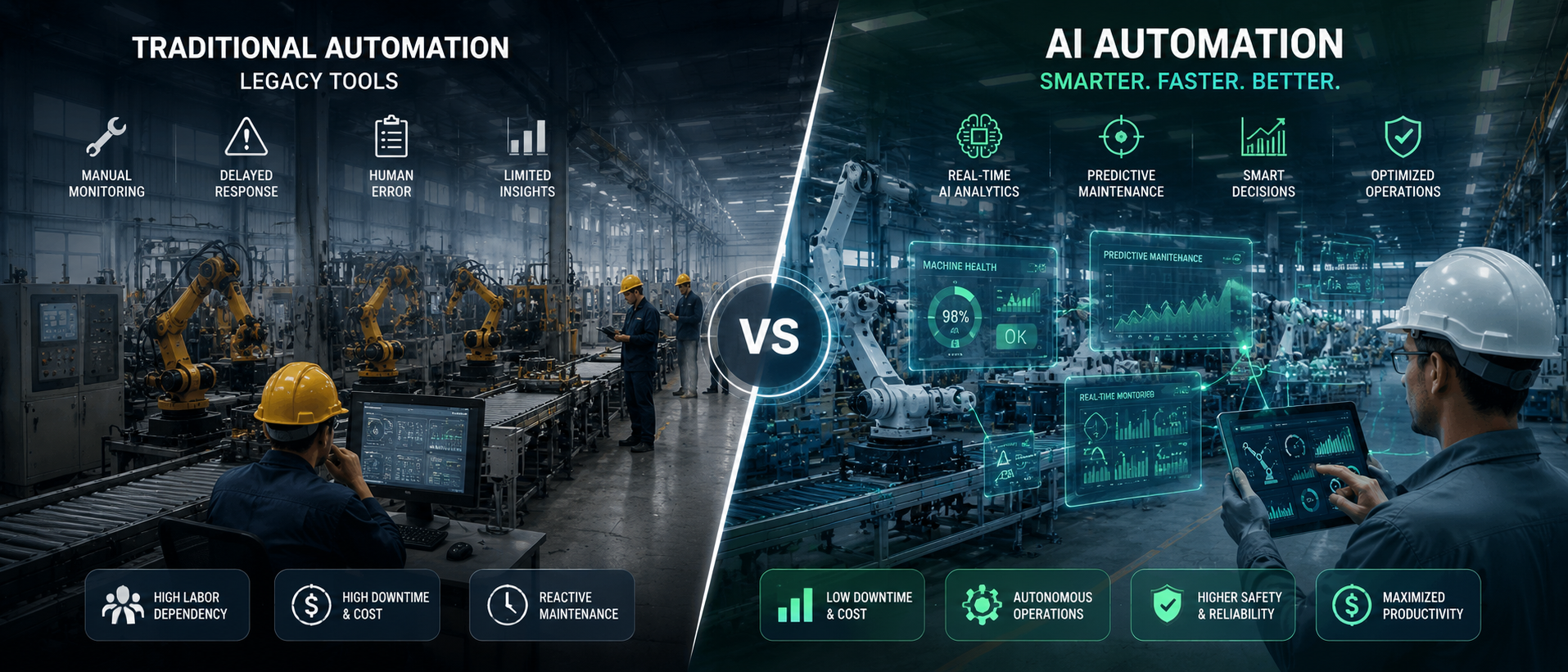
1.   From Traditional to AI Automation: Smart Tech Outperforms Legacy Tools

At any standard factory floor there could be millions of moving part, heavy machinery, sensors and high-value tools. This means that any factory machine, gearbox, or motor must require regular maintenance and are subjected to wear and tear. This further adds to complexity of operations. Thus, businesses can’t only rely on human monitoring, instead, they use multiple smart technology and automated tools which can not only enhance the operational efficiency but also make the operations safer and more cost-effective. A traditional automation involves large-scale machinery, conveyer belts, robotic arms and countless types of sensors and motors. However, despite all that, the manufacturing process still needs a lot many human staff to keep an eye on everything and take timely actions to avoid costly errors and ensure smooth operations. But the system still remains prone to human errors and limitation of the machines.

These limitations compelled manufacturers to look toward modern technologies such as AI. In past few years, the adoption of AI automation technologies has gained a lot of traction all around the world. Especially here in UAE manufacturers operating in Dubai, Abu Dhabi, Sharjah and other Emirates are known for their tradition of early adoption of the new technologies. This is the reason the AI-based automation is a hot topic among the manufacturing leaders in the country. One of the biggest advantages of integrating Custom AI Agent in manufacturing is their ability to analyze and process large volume of data from multiple different data streams. This enables them to scan real-time data form thousands of different sensors and data sources, and instead of relying on the data dashboards, they can directly process the feeds, which is not even possible for any human operator. That is what makes Custom AI Agent so important for manufacturing.

See Also: How Customized AI Agents Can Streamline Business Operations
From Traditional to AI Automation: Smart Tech Outperforms Legacy Tools

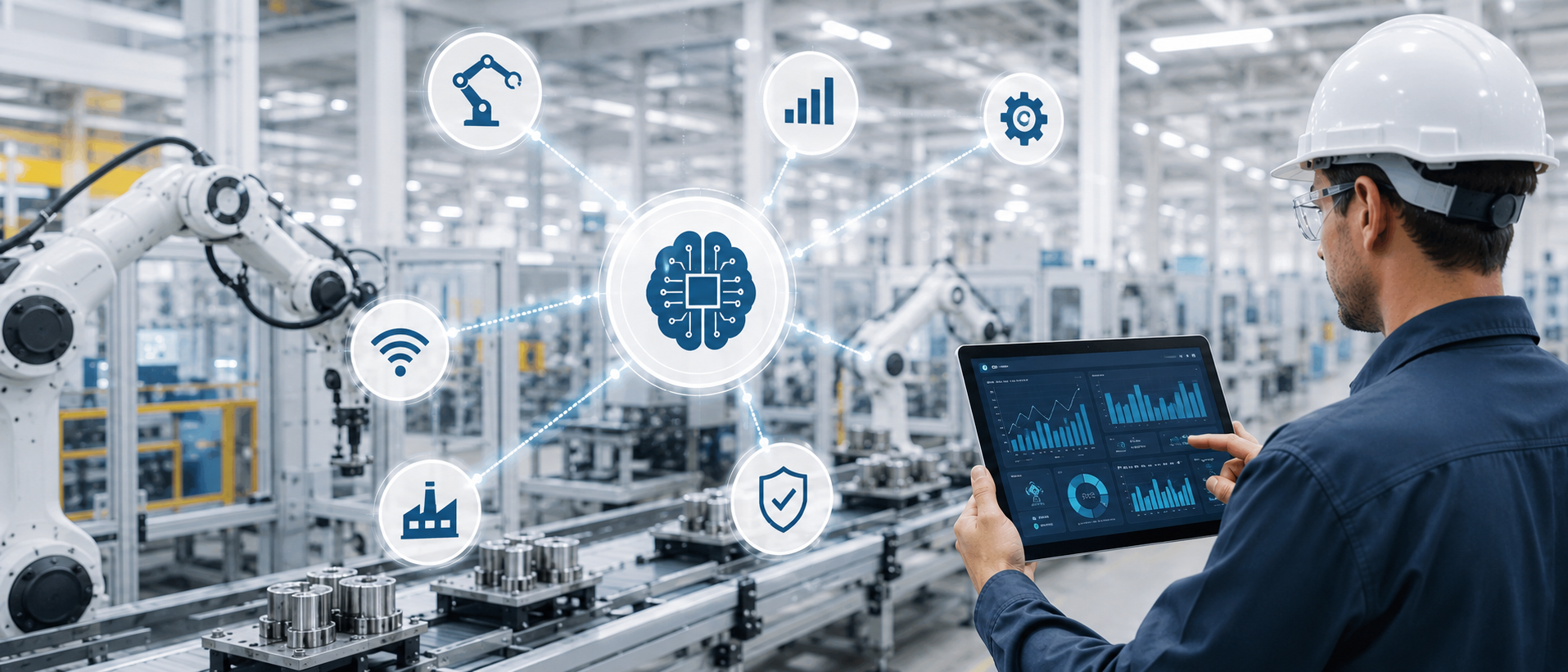
2.    Boosting Productivity with Custom AI Agents: More Outcome with Less Efforts

Productivity is something that every business owner and manufacturing leader thinks about every single day. For manufacturing businesses, the productivity can be gauge simply by measuring the outcome or how much a production unit can produce successfully in a given amount of time and resources. Every business wants to boost their outcome or increase the volume of produce without investing more, allocation more resourcing or pushing their workforce to work longer. The Custom AI Agents are the ideal solution to this problem. Contrary to common misconception that the AI can replace humans, the Custom AI Agents doesn’t replace them, but empower them and make their life easier. The customized AI Agents work alongside with human staff hand in hand to find out the best way to execute a task with utmost accuracy, efficiency and speed. This way businesses can greatly boost productivity by simply incorporating Custom AI Agents.

One of the biggest advantages of a customized AI Agent is that it knows each and everything about your manufacturing facility. It can integrate directly with the secondary inputs, management tools, logic controls, and even to the high-level business management tools such as ERP, Logistics, Facility Management Tools, Inventory Management, and literally anything else. This gives them a wider overview and understanding of the entire operation and relevant business processes. That is not all, the custom AI Agents not only capable of processing large volume of data but it can also take appropriate actions. The customized AI Agents not only boost operational efficiency, but also help streamlining daily routines and tasks, which results in smoother process, less workload for employees, less waste material, and enable employees to focus more on complex tasks eventually raising the operational efficiency and productivity of the business.

See Also: Step-by-step Guide to Develop Custom Enterprise Software
Boosting Productivity with Custom AI Agents: More Outcome with Less Efforts

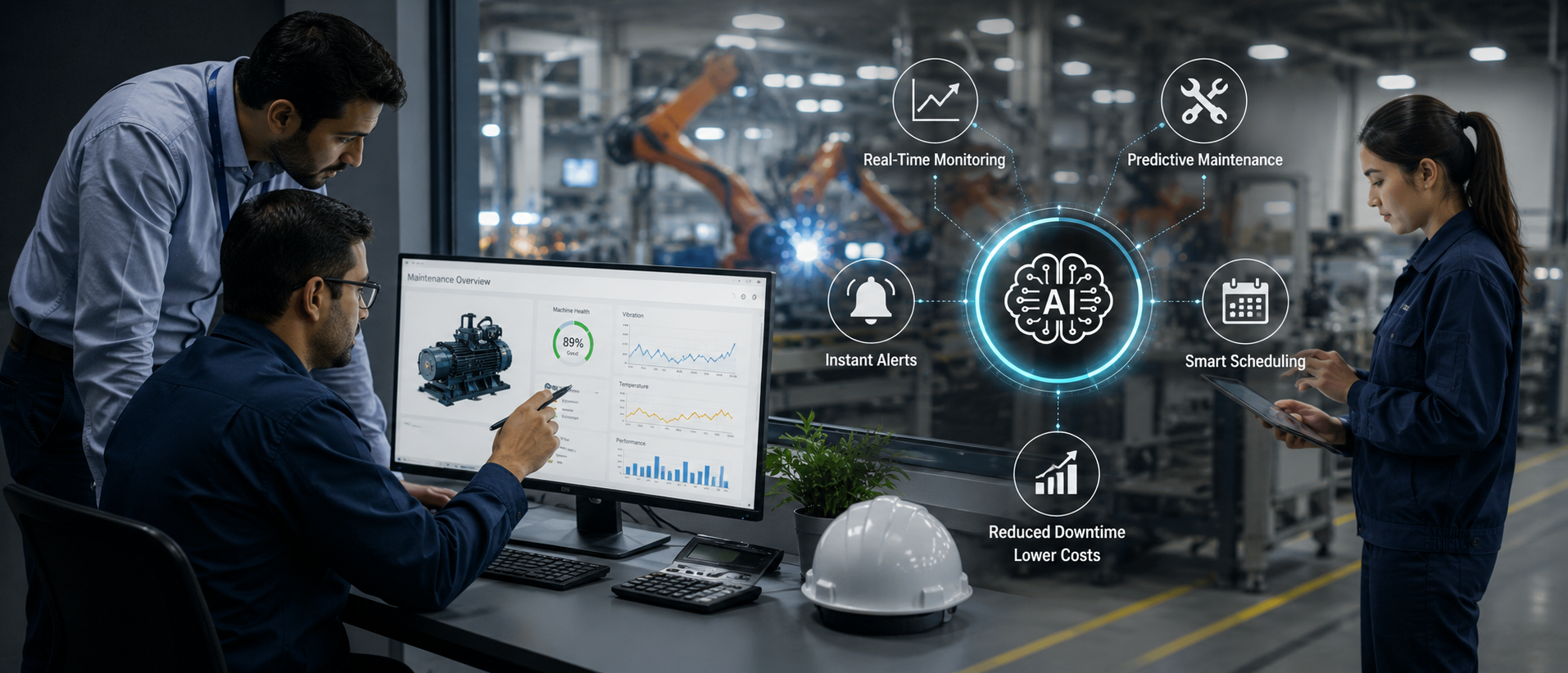
3.    Predictive Maintenance: Preventing Expensive Breakdowns

One of the biggest problems in manufacturing business is the breakdown of a large machine. Any machine breakdown can turn into a scariest nightmare if not handled with attention and care. Traditional manufacturing businesses follow a standard and fixed time-based maintenance and most of their measures are reactive not preventive. Thus, when a large machine breaks down, it halts the entire production plant. The time it takes to repair or fix that machine will not only stop production but also add to the delivery time, which results in customer unhappiness. Businesses typically call it unplanned downtime, and it is very harmful for the entire business. Typically, the workers rely on guess work to determine if any machine or part requires unplanned maintenance, or they simply wait helplessly until something broke. However, today, Custom AI Agents can deal such scenarios seamlessly with their predictive maintenance features.

In simple words, the predictive maintenance feature of a Custom AI Agent is like having an expert doctor continuously monitoring the health of highly sophisticated large machinery running the production plant. The Custom AI Agents have incredible ability to process large volume of data and then analyze it to draw actionable conclusions. In manufacturing plants, the AI Agents listen to all available sensors carefully, they can capture and relate any vibration, change in voltage pattern or spike in heat with the plausible cause. A custom AI Agent inherent incredible analytical capability and they can identify even the micro change in the patterns to predict any maintenance for any part of the machine. Moreover, the Custom AI Agents can also trigger the maintenance request and setup effective schedules for that to minimize the impact on ongoing deadlines.

Preventive maintenance is a gamechanger, as businesses can prevent lengthy downtimes, they can prevent replacing large parts by repairing them before they break down. Repairing small parts or replacing them doesn’t take much time, in fact it can be done during the lunch breaks. The Custom AI Agents not only save large and expensive parts but also reduce the downtime. Which help businesses save a lot of maintenance expense. The Custom AI Agents not only perform the analytics, and predict maintenance needs, but they also help human staff in identifying problems. The AI Agents alert human staff for every minor event which can result in critical failure, they can also plan and schedule the maintenance by alerting engineers and maintenance teams beforehand to expedite the entire process. This ensures, less downtime, proactive maintenance strategy and a huge cost saving.

See Also: Revolutionizing Customer Service with AI Agents: Personalized Support Solutions
Predictive Maintenance: Preventing Expensive Breakdowns

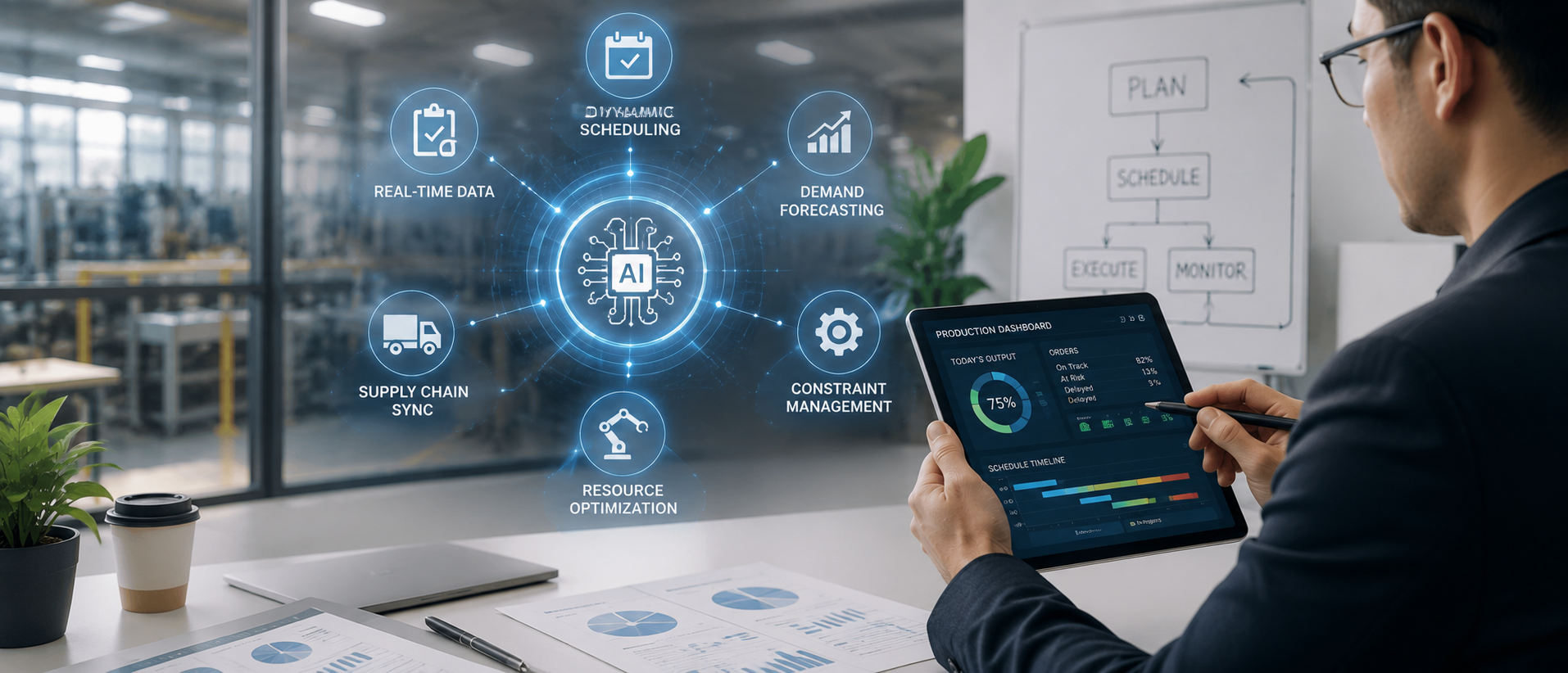
4.    Optimizing Production Scheduling: Enhance Production Planning

The production planning is one of the most complex and challenging tasks in production operations. At a factory floor there are many variables and things happen unplanned such as order urgency, labor shortage, unexpected delays in the supply of raw materials, machine status and unplanned maintenance needs, etc. Such variables compel operation managers to change schedules daily, and that requires a lot of manual efforts and data inputs. This is where a Custom AI Agent can save the day. It can process data feeds, status and work-in-progress in real-time and can dynamically recalculate the work remaining and it automatically plans accordingly. That is not all, in fact the Custom AI Agents can also consider various other factors such as energy consumption, maintenance delays, additional over-times and various other factors to ensure the product is delivered in time and as per planned budgets.

Remember, a busy manufacturing facility can’t deliver on-time if the essential raw materials, repairs, machine parts and workforce is not made available whenever needed. Where your Custom AI Agent can help improve the daily planning processes it can also handle the complex tasks at a broader scope such as ordering, shipping, and storing, etc. of the raw materials and essential machine components. Thanks to its machine learning (ML) algorithms and preventive maintenance approach via predictive analytical algorithms, a Custom AI Agent can transform highly complex processes such as supply chain management into a simple semi-autonomous process. With the ability to processes large volume of data inputs, a Custom AI Agent can precisely predict the supply chain and logistic needs. These incredible features ensure the factory floor remains stocked and operational all the time.

See Also: The Role of AI in Custom Software Solutions
Optimizing Production Scheduling: Enhance Production Planning

5.    Operational Excellence: Enhancing Quality and Increasing Safety

While optimizing operational efficiency and quality is important for profitability the human safety is extremely important to achieve the operational excellence. Business must ensure quality if they want to satisfy their customers. While mostly inspection is done by a mixture of human and machine-based processes, a Custom AI Agent with Computer Vision enabled can do the job with much more accuracy and at a lightening speed. A Custom AI Agent can be trained to precisely identify the acceptable and unacceptable flaws and anomalies. Beyond computer vision your customized AI Agents can be trained to consider multiple data inputs for quality assurance, such as if the raw material’s batch is changed or machine’s setting is slightly drifted, etc.  Furthermore, a Custom AI Agent can immediately halt the production line or inform a human inspector. A custom AI Agent doesn’t only identify flaw but it also proposes solution and fixes to save time.

Unfortunately, factories and manufacturing plants can be very dangerous places with large machinery parts, fast-moving forklifts, and bulky cranes and even hazardous chemicals, materials and extreme heat, etc. Thanks to the Computer Vision technology and connectivity with hundreds of sensors and real-time data, a Custom AI Agent can accurately prevent an incident before it happens. Mostly incidents happen due to overlooking safety protocols, forgetting a safety equipment, or poor training which can be further amplified with the faulty machinery. A custom AI Agent can be trained to rectify all such issues. For example, it can easily detect if an employee forgets to put the helmet on, if they forget any safety gear or if a machine is about to break or if a boiler’s inner pressure exceeds the safety threshold, etc. A customized AI Agent can immediately stop the machines, it can ring an alarm, or it can inform the safety inspector or supervisor.

See Also: Leveraging Tailored AI Agents to Elevate Customer Support Experiences
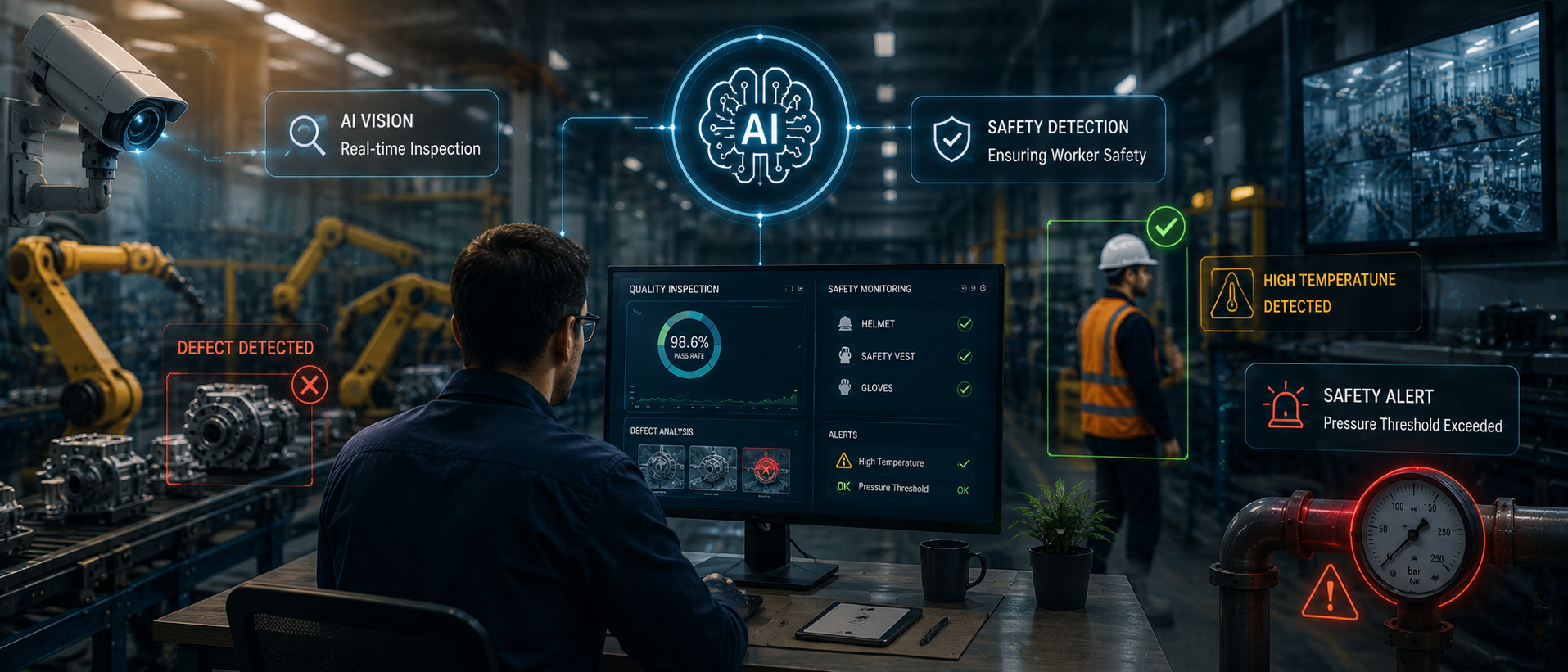
Operational Excellence: Enhancing Quality and Increasing Safety

6.    Maximize ROI: Solution to Your Unique Challenges and Very Specific Needs

A manufacturing business has a very complex and challenging operations as it is a combination of high-performing machines and a productive workforce. As in the case of workforce, every individual has its own strengths and weaknesses, the same is true for the machines and hardware. Every business has multiple machines and mostly from multiple vendors who has multiple operators and many line-managers, both machines and workforce must have to work in harmony to ensure highest levels of operational efficiency and maximum possible profitability for the business. Where the diversity is crucial for efficiency and productivity it also results in some very unique and very exclusive challenges that every manufacturing business must overcome. All off-the-shelf solutions are designed for the entire industry needs, and couldn’t fully fit-in to your unique business needs.

The out-of-the-box and legacy solutions also lack the level of intelligence required in modern times to survive and thrive in highly competitive markets such as Dubai, Sharjah, Abu Dhabi, and other regions of UAE. A customized AI Agent is carefully crafted from ground up considering all your unique challenges and very specific business needs. Which make them ideal for modern day’s manufacturing businesses. That is not all, the in-built machine learning (ML) algorithms and ability to course-correct makes them ideal solution for changing business needs and goals. Moreover, your Custom AI Agents can easily be retrained if a new safety compliance is required, or a new machine is included in the production line or a new policy has been implemented. This enables your Custom AI Agent to completely understand the unique challenges, needs and problems your workforce faces in daily operations, ensuring highest possible productivity.

See Also: AI Agents Revolutionizing Finance: Tailored Solutions for Investment and Risk Management
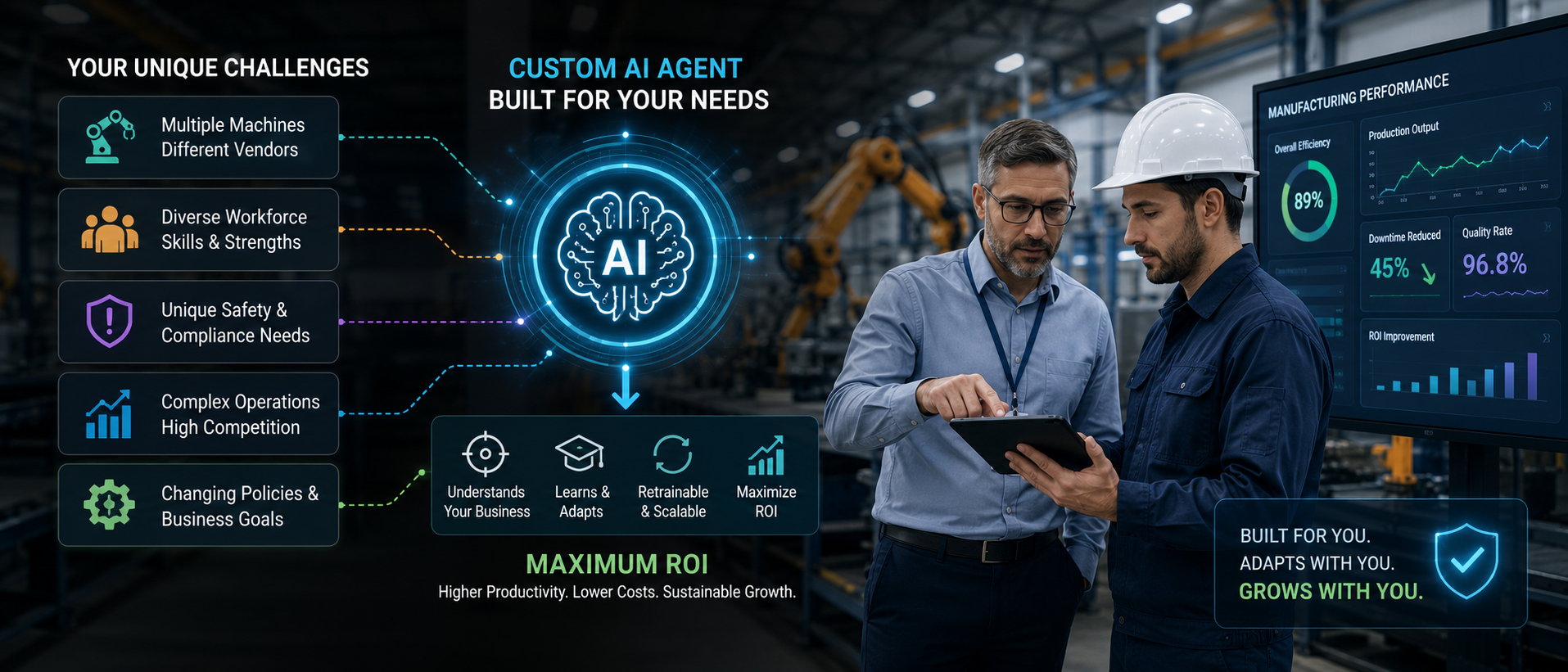
Maximize ROI: Solution to Your Unique Challenges and Very Specific Needs

Conclusion

The evolution of a modern manufacturing unit or a factory floor is not just installing high-tech heavy machinery and hiring skilled workforce, but it is about completely modernizing and revolutionizing the way those machines and your workforce work together in a perfect harmony. For any business utilizing their available resources at maximum potential is crucial to sustain and thrive in a competitive market landscape such as in Dubai, Sharjah, Abu Dhabi and other regions of UAE. Business leaders are now realizing that rather making big investments in acquiring new equipment and operators, instead they can still achieve their goals by simply unlocking hidden potentials to maximize their operational efficiency, productivity and eventually profitability. As discussed in this blog post, a Custom AI Agent is can offer an exclusive solution that is exclusively crafted to deal with the unique challenges and problems your business faces. This ability makes them ideal solution for modern manufacturing units and factories.

A modern manufacturing business needs agility, accuracy, foresight and ability to effectively tackle unprecedented problems, which the legacy software solutions or out-of-the-box applications simply can not offer. A Custom AI Agent is built of highly advanced AI platforms, equipped with LLM (Large Language Models), ML (Machine Learning) and superior analytical tools. Moreover, an AI Agent has incredible ability to processes large volumes of data in real-time, whether it is structured or unstructured data or whether it is coming form a single or so many different data streams. This means that your Custom AI Agent can directly integrate with countless sensors, different machines, software applications, ERPs, Logistics & Warehousing, and virtually any other software application you might be using at your factory floor. These abilities make a Custom AI Agents an ideal solution for manufacturing units and factories.

Custom AI Agents are completely redefining the productivity and efficiency for not only manufacturing businesses but countless many other sectors and industries. At any manufacturing unit or factory floor there are always so many moving parts, even a minor change in sound or a negligible vibration could end-up in a catastrophic downtime. Traditionally manufacturers rely on regular service schedules or reactive maintenance. Whereas a Custom AI Agent focuses on predictive maintenance and stopping any incident before it ever occurs. It can integrate with virtually any digital solution, IoTs and data dashboards. Moreover, a Custom AI Agent can also be trained for Computer Vision analysis which makes them more effective and accurate. Businesses can easily retrain them for changing needs and have a virtual worker which never forgets, never get tired and works 24/7 at a persistent efficiency and accuracy. If you want to learn more about Custom AI Agents or if you want our help to design and deploy one for you, please feel free to contact us through our Contact Us page or leave a comment in the comment box below and we will get in touch with you soon.

See Also: Customized AI Agents in Real Estate: Enhancing Property Management and Client Engagement

Implementing Custom Trained AI Agents: A Step Towards Service Excellence

The modern business technologies all around the world are transforming rapidly. Businesses keep improving their digital arsenal to find better ways to serve and satisfy their customers. The customer demands are ever-increasing and the operational efficiency is becoming more challenging day by day. In competitive markets such as in Dubai, Abu Dhabi, Sharjah and other regions of UAE, businesses heavily rely on technology and digital solutions. These days businesses regularly utilize digital channels to communicate and offer self-services. Where these digital assets are helping businesses optimize their operational efficiency, gain a competitive edge and deliver satisfactory customer experience, a new era of modern technology is emerging, which is Artificial Intelligence or AI. The AI Agents are customizable digital workers, who can either do the tasks or help human staff in carrying out their duties with utmost efficiency and ease.

Various surveys and market studies (PwC AI Agent Survey) have reported that businesses all around the world are rapidly adopting and integrating AI in both internal processes as well as customer facing tools. According to another market study conducted by Salesforce, the 85% businesses in service sector are already utilizing AI with 78% use of Generative AI, 71% Predictive AI and 66% Agentic AI or AI Agents. The Agentic AI use is expected to explode to 88% by the end of the year 2026. These stats show how rapid the adaptation is and there is a strong reason for that, businesses who are leveraging AI have witnessed significant improvement in their communication, problem solving mechanisms, sales growth and overall customer satisfaction. In this blog we will explore how you can implement custom trained AI Agents to achieve the service excellence.

Implementing Custom Trained AI Agents: A Step Towards Service Excellence

What Exactly are Customized AI Agents?

People often think that the AI Agents are smart chatbots, but they are much more than a simple chatbot. Traditional chatbots might be helpful in some basic scenarios, but often you end up getting robotic and very unhelpful response. The AI Agents are not like that, they in fact have a complete learning and thinking algorithm, which not only help them understand the customer needs, but they can also handle unique and unexpected scenarios with great efficiency and accuracy. The word customized in Customized AI Agents represents the fact that the AI Agent is trained on your own company data sets. It fully understands your tone, your products, services, the solutions you offer to your customers and with added ability to regularly learn and refine its response. These abilities make them totally different from the traditional chatbots.

Above all, a Customized AI Agent doesn’t only remember your company’s playbook, but it can also take action and make decisions in real-time. For example, instead of reciting the entire menu, they can take your customized food order, get delivery information, process payments and refunds and much more. The customized AI Agents are directly integrated with your business’s core operating system, ERP, CRM, Payment Solution, and databases, records of past interactions etc. This enables them to take real actions instead of just talking to the customers. Businesses can setup the persona of their customized AI Agent which aligns with business’s communication tone, this elevates the customer experience and they feel like talking to a most knowledgeable employee instead of limited robotic chatbot with limited/predefined response.

See Also: The Future of ERP: Leveraging AI for Smarter Enterprise Management

Implementing Customized AI Agents for Modern Customer Service Strategies

Why Customized AI Agents Matters so Much for Service Excellence?

The customer satisfaction can easily be gauge on two important factors, one instant gratification, and second personalized customer experience. For instant gratification businesses must improve internal processes to decrease response time. And for personalized experience and support businesses need to build a mechanism which can understand customer persona, their needs, preference and details of customers past interaction. This means that even for routine tasks, businesses need smart tools and the support agents must also have to work harder. The rising customer expectations, and complexity of the service deliver mechanisms end up overburdening the support staff. A customized AI Agent is an ideal tool to seamlessly handle such tasks, it can handle routine enquiries with extreme efficiency and accuracy.

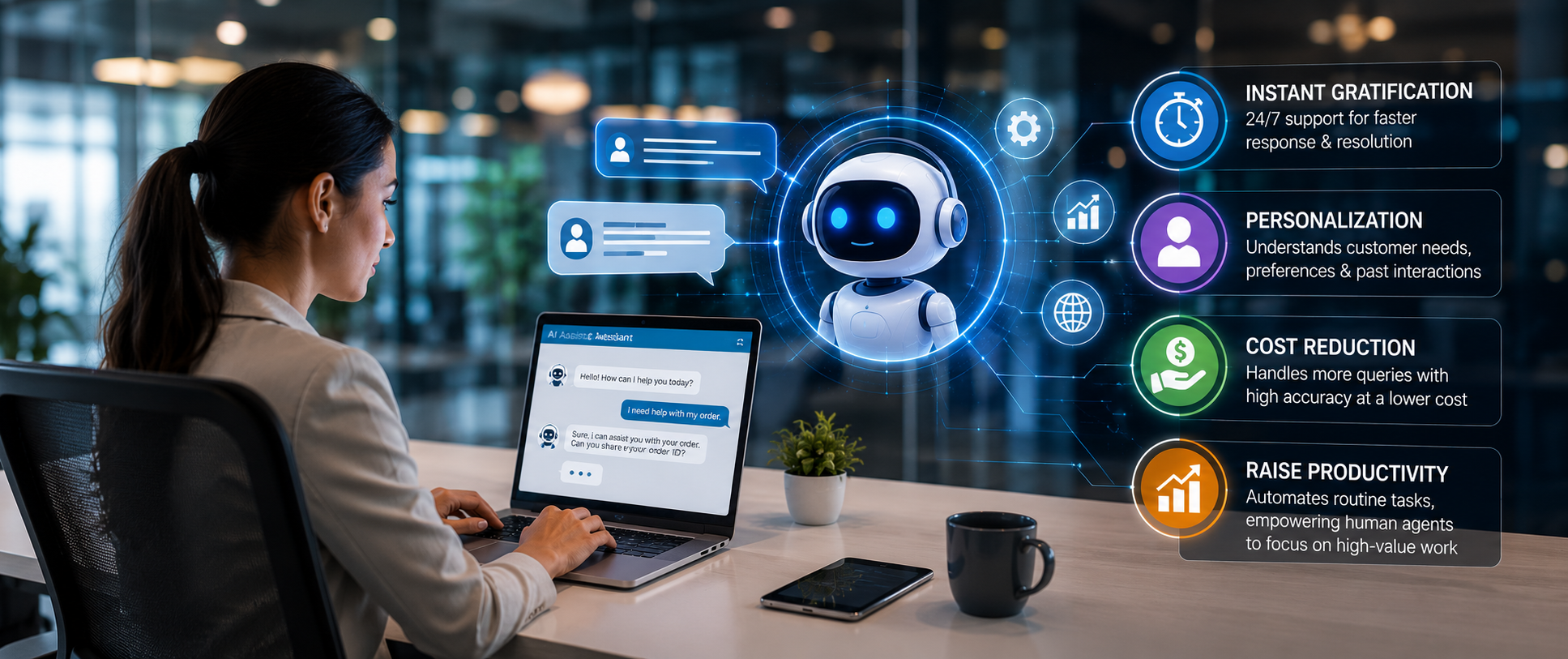
There are four major areas which can be exceptionally improved by integrating a customized AI Agent in the customer service and support processes:

  • Instant Gratification: A customized AI Agent runs 24/7 and every day of the week, which enable businesses to quickly and instantly respond to the customer enquiries. Most of the enquires are regular, hence not only the response time decreased but the resolution time can also be reduced form hours to minutes.
  • Personalization: The personalization means that the business not only ensure their communication and response is as per the customer’s need, expectations and preferences, but it also means that it is aligned with organization’s unique tone and identity. The Customized AI Agents hold ability to execute large computing algorithms, which enables them to instantly identify their customers and personalize their responses.
  • Cost Reduction: One of the biggest advantages of the Customized AI Agent is their ability to exhibit incredibly fast speed and in-built machine learning. This enables them to serve more customers than any other human agent. This means that per service cost with AI Agent is much less than the human agent, in fact in some cases it is 90% less.
  • Raise Productivity: The customized AI Agents take up maximum routine tasks, freeing human agents to focus only on complex and critical tasks. Which can greatly improve the overall productivity and efficiency of the service & support team. When employee have balanced workload, they tend to perform well, and raise customer satisfaction.

The customized AI Agents are trained on the company’s own data, which enable them to adopt the brand’s tone and identity. Furthermore, the customized AI Agents fully comply with your business’s polices and rules which reduce the chance of error or repetitive work. The customized AI Agents can process a large volume of data with lightening speed, which enable them to deliver highly personalized customer experience. These features raise customer satisfaction, optimize operational efficiency and help human staff to focus more on high-value tasks.

See Also: Implementing AI Agents for Seamless Customer Service Automation

Why Customized AI Agents Matters so Much for Service Excellence?

How to Implement Customized AI Agents for Service Excellence?

Businesses operating in Dubai, Abu Dhabi, Sharjah and all around the UAE are eagerly seeking ways to integrate the AI technology into their existing IT infrastructure and solutions. However, there is a common misconception that the AI is very complex and expensive. However, that is not true at all. Just like any other technology the AI is also a new technology. Businesses don’t have to install large servers or hire AI experts to be able to leverage the AI in their day-to-day operations. In fact, modern AI Agents mostly run on cloud and they can also be deployed to on-prem data centers. However, the AI Agents has a slightly different approach to build and operate. Here are a few steps which can be followed to build and deploy a custom AI Agent or multiple agents right into your existing IT infrastructure and digital echo-system:

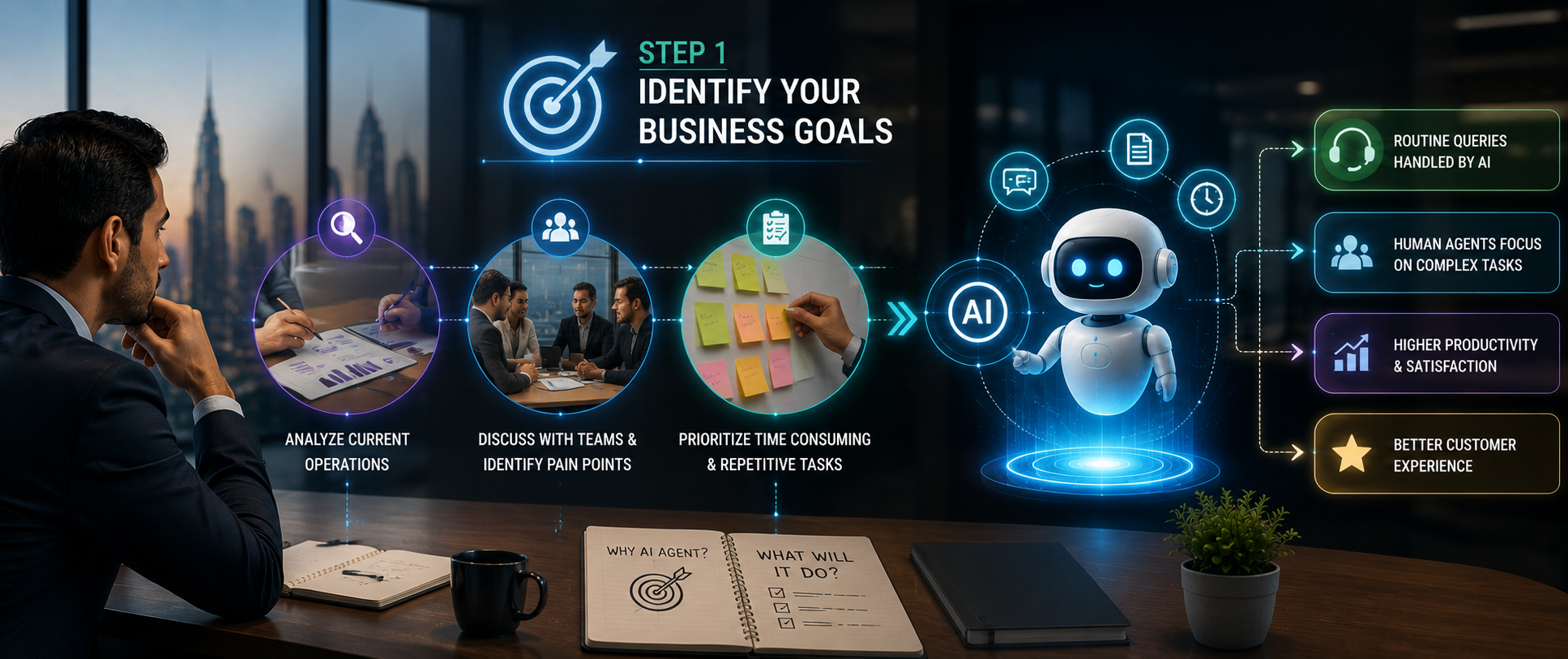
Step 1: Identify your Business Goals: Mapping Out the Perfect Strategy

Same like any other digital solution you must first have to have a clear goal. You can not simply build a customized AI Agent without a clear plan. Before you begin ask yourself:

  • Why do you need the custom AI Agent?
  • What does this custom AI Agent will do?

These two simple questions will help you build a strong foundation at which your business will eventually stand and strengthen. For that the first step is to start looking at your current daily operation. Then sit with the relevant managers and teams and identify their biggest pain points. Now ask them what can be taken off the plate to maximize their performance? In our case, the customer support and service team can answer your questions. Moreover, you should also consider customers feedbacks and suggestion to accurately identify the areas that truly need improvements.

Moreover, you should also identify what are the most time consuming and repetitive tasks. Such as in customer service, most of the enquiries are very simple, basic and require a simple answer. These are the areas which can truly make a big difference. For example, if a customer service agent is getting 60% of just a simple enquiry about the tracking number, delivery time, or any other simple information. That means that such enquiries can easily be handled by the custom AI Agent as they are very simple and straight forward. However, there are always some complex enquires which require a more in-depth analysis and a human-touch. Such can be forwarded to the human staff. When the service agents will get 60% less enquiries than usual, their performance will automatically improve. They will be more satisfied, productive and creative and they can focus more on more productive tasks.

See Also: The Role of Customized AI Agents in Modern Customer Service Strategies

Identify your Business Goals: Mapping Out the Perfect Strategy

Step 2: Preparing Your Data for the Training: The Fuel for Your AI Engine

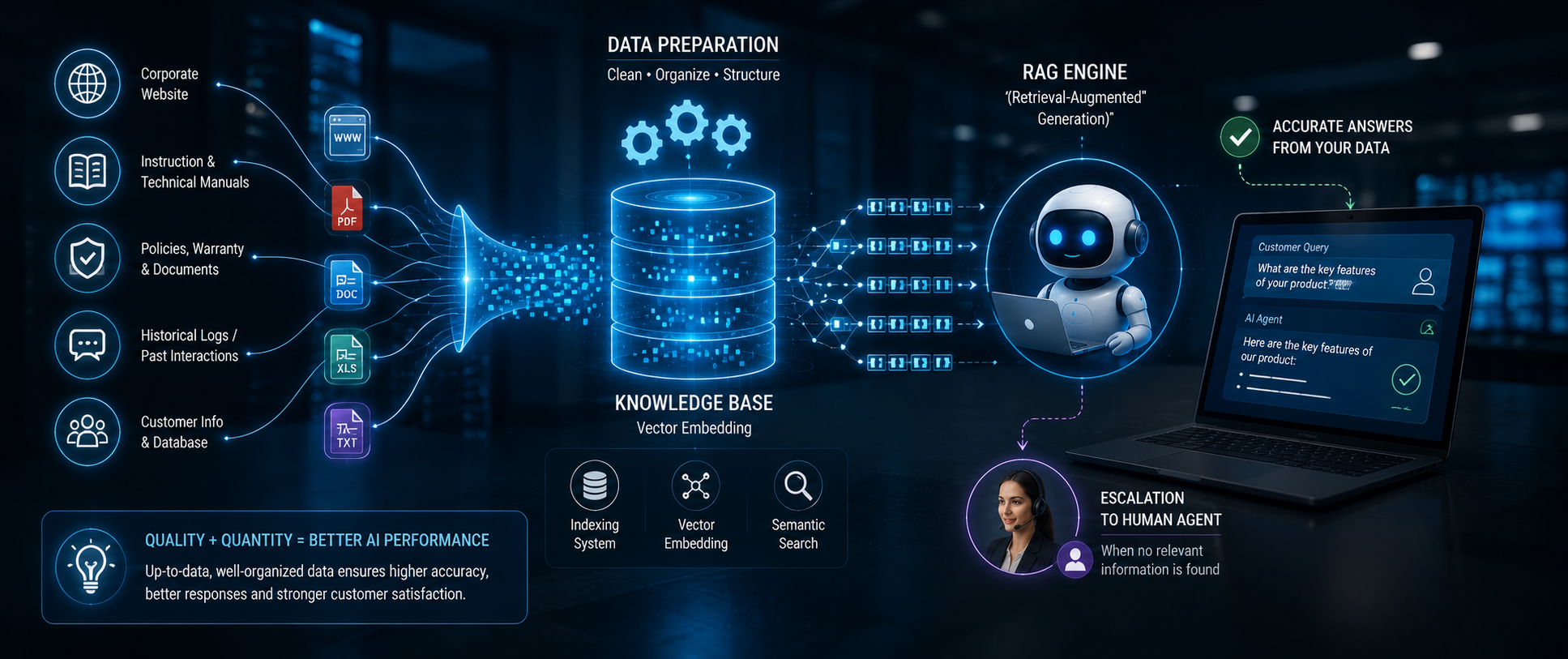
Remember! A custom AI Agent is as good as the information fed to it. If you want to achieve the higher accuracy and performance, you must fed right knowledgebase to your AI Agent. Usually, an indexing system with vector embedding is used along with RAG (Retrieval-Augmented Generative) to setup a knowledgebase. Following documents and information are commonly used to build up a knowledgebase for your Custom AI Agent:

  • All the information at your Corporate Website
  • Both Instruction and Technical Manuals
  • Warrantee and other Policies Documents
  • Historical Logs/Transcripts of Past Interactions
  • Customer Information & Database

Moreover, all of the information should be latest and up-to-date. The information & data must be well-organized so the AI algorithms can read and understand them. When it comes to the knowledgebase for a Customized AI Agent, both the quality and quantity matters. You should feed as much as you could to give your AI Agent better understanding of your company’s operational workflows, SOPs, and methodologies. This is the most crucial step in developing your customized AI Agent. As whenever it will receive an enquiry from the customer the first this an AI Agent does is to include this knowledgebase as the context of the query.

Only then the customized AI Agent can accurately answer to the customer enquiries. For example, if a customer wants to know about a specific feature of a particular product, your custom AI Agent must have the features of that product in its database, else it will either give incorrect answer or no answer at all. In order to make the custom AI Agent robust, the development team divide all this knowledgebase into suitable chunks which are called vectors. The AI Agents are equipped with LLMs (Large Language Models) which enable them to understand the language, but they entirely rely on these vectors and depend on a semantic search to find the match for the customer’s question. Furthermore, your custom AI Agent should also be programmed for the escalation mechanisms, which enable them to refer to a human staff if the AI Agent couldn’t find anything in their vector database.

See Also: Leveraging Tailored AI Agents to Elevate Customer Support Experiences

Preparing Your Data for the Training: The Fuel for Your AI Engine

Step 3: Choosing the Best AI Platform: Selecting the Right Tools and Tech

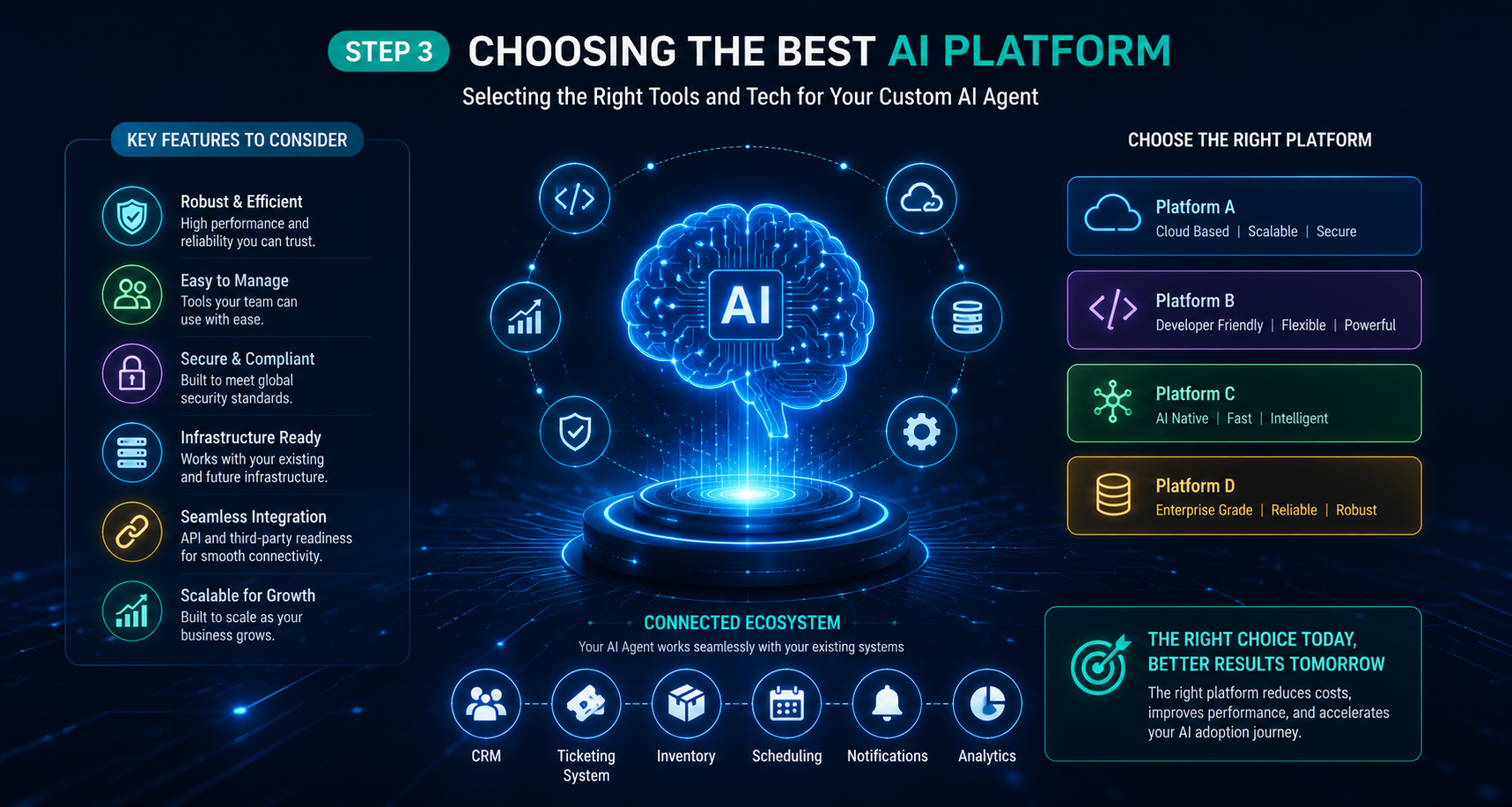
Now that we already have a well-organized and clean knowledgebase, we are ready to move on with the next step, which is choosing the right software platform which will serve as the brain of your Customized AI Agent. The AI market landscape is flooded with tons of different options, and navigating through endless options, models, versions, & tools could feel like crossing a complex maze. Since this would be the actual brain of computing engine behind your Custom AI Agent, it requires some patience, research and technical understanding. Here are some key features that are must to have in your choice:

  • The platform must be robust and efficient
  • The software & tools should be manageable by your team
  • The platform should comply with security benchmarks
  • Requirements for Existing and New IT Infrastructure
  • Third-Party or API Integration with Existing Digital Echo-system
  • Ability to Scale for Future Growth

Your Custom AI Agent is not an isolated solution, in fact, it connected to other existing systems in many ways and it can update several systems autonomously. For example, if a customer ordered for a technical support on-site the Custom AI Agent will automatically update internal ticketing system and all other relevant system to ensure scheduling of the visit on time and updating both the customers and the internal team as well.

Choosing the right platform and tools not only improve the quality of the customized AI Agent but it will also have a huge impact on the management, maintenance and operational cost.

See Also: The Role of AI in Custom Software Solutions

Choosing the Best AI Platform: Selecting the Right Tools and Tech

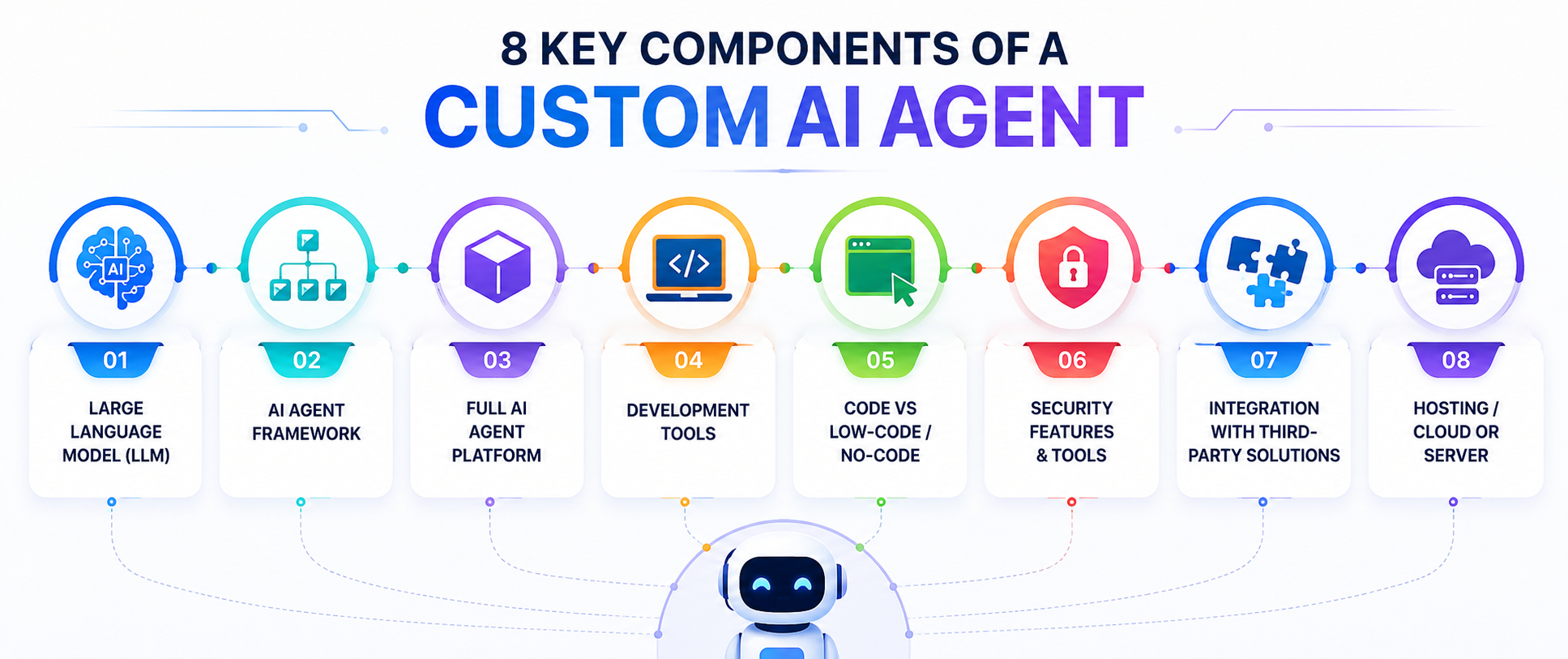
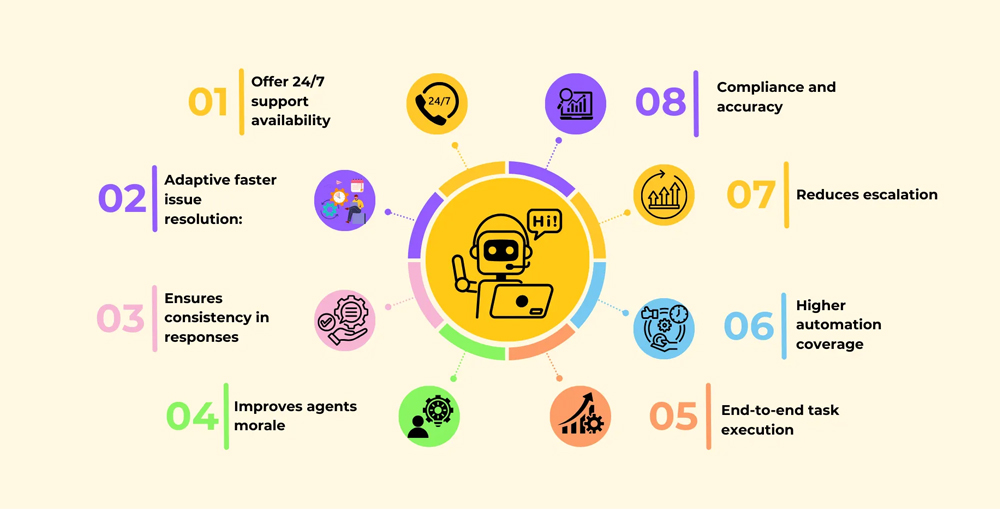
Here are some key components of a Custom AI Agent:

  1. Large Language Model (LLM): There are many popular and market proven LLM models that you can utilize. Some are paid and some are open-source. For example, the leading AI platforms are Chat GPT, Claude, OpenAI, Hugging Face and Google Cloud. These platforms also provide APIs and fine-tuning services to personalize your AI Agent.
  2. AI Agent Framework: Some of the most popular AI Agent frameworks are LangChain, LlamaIndex, and Microsoft’s Semantic Kernel. Such tools help you connect your custom AI Agent to your knowledgebase (vector database) and you can also easily create multi-step workflows using these popular platforms.
  3. Full AI Agent Platform: Some of the market leaders such as Watson Orchestrate, Microsoft Copilot & Google Gemini offer ready-made or out-of-the-box AI Agents with very reliable RAG features, tools, memory access, and customization. Choosing such platform can greatly reduce the development time and cost.
  4. Development Tools: Choosing an out-of-the-box solution has several benefits but also some limitations as well. Thus if you decide to build your custom AI Agent from scratch, there are several tools you can utilize, such as available Python Libraries, Transformer/Faiss/Chroma for search purposes.
  5. Code Vs Low-Code/No-Code Platforms: Obviously coding or programming is time consuming and requires a proper team of programmer, developer, and LLM engineers to complete the process. Moreover, there are several Low-Code or No-Code platforms which provide a drag-and-drop type GUI to build your Custom AI Agent.
  6. Security Features & Tools: Unlike traditional digital solutions, the security is in fact one of the most critical features since your Custom AI Agent would have access to a vast amount of sensitive data and information. Including data encryption, compliance with GDPR, CCPA, SOC or HIPAA standards, role-based access control & secure programing can greatly improve the security profile of your Custom AI Agent.
  7. Integration with Third-Party Solutions: The custom AI Agents doesn’t operate in isolation, but require multiple integration and abilities to communicate with other solutions. Thus, your Customized AI Agents should be able to talk to other solutions such as CRM, ERP, Helpdesk, Internal Databases, Financial System, etc.
  8. Hosting/Cloud or Server: Your customized AI Agent should be deployed on an IT infrastructure, such as hosting, cloud platform, or on-prem server. Whichever the case is, you should choose it wisely as a Custom AI Agent requires computing power to run algorithms and in order to communicate with hundreds of customers.

Choosing the best AI Platform and right tech can make or break your Custom AI Agent. Right tools help you not only optimize the development efforts, but also help you optimize the cost. The accuracy, efficiency and performance of your Custom AI Agent depend on the technology used to build it. A poor selection of technology will undermine your AI Agent’s performance as well as it will have lasting effects on customer happiness and satisfaction.

See Also: How Customized AI Agents Can Streamline Business Operations

8 Key Components of a Custom AI Agent

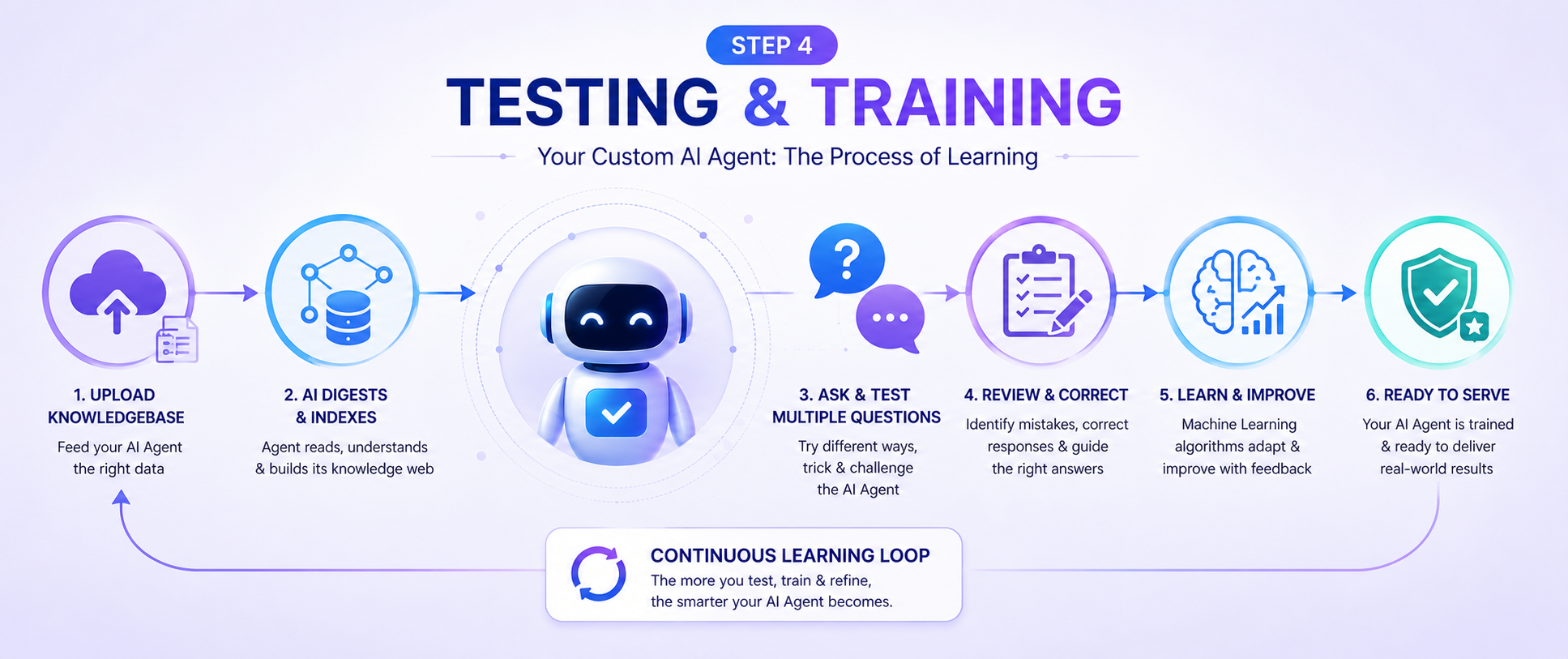
Step 4: Testing and Training Your Custom AI Agent: The Process of Learning

Once the development work is complete and everything is setup in order, now is the time to perform an actual test and start training your Custom AI Agent before going live. Training a newly developed Custom AI Agent is a lot like training a new pet. You can’t just give a command once and expect it to behave exactly the way you want. You have to do multiple rounds and you have to have patience and consistency. The first step is to upload the knowledgebase data that you have prepared earlier. Once the data is uploaded, your Custom AI Agent read it in its entirety and build its own web of information. Once the data is uploaded, the real work begins. You should start asking as many different questions as you think your customer can ask. You should try to ask a similar thing in multiple different manners to trick the AI Agent and to confuse it and then see how does it respond.

During the initial testing you will definitely get many mistakes, sometimes your Custom AI Agent responds differently when you trick it or try with a changed statement query. Thus, you will have to correct the response by telling your Custom AI Agent that this is not the correct answer, instead you should answer this question in this way. This is completely normal, in fact, this is part of the development itself. This will trigger the machine learning (ML) algorithms and will help your customized AI Agent to learn and improve its response or actions. You can engage multiple team members form the customer service team in the testing process and with each test your custom AI Agent will become smarter and accurate. At the end of the training, your Custom AI Agent will be ready to face the customers in the real world.

See Also: Custom Software Development for Enhanced User Experience

Testing and Training Your Custom AI Agent: The Process of Learning

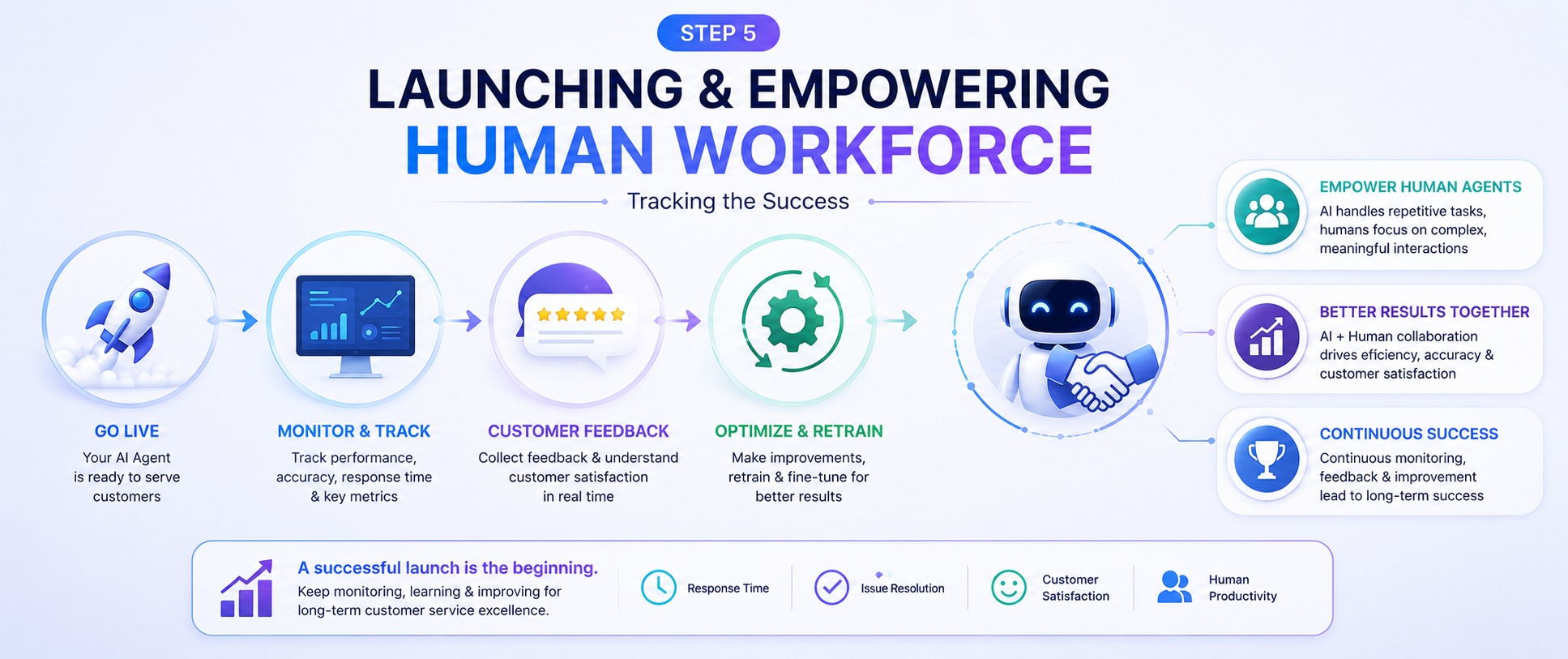
Step 5: Launching & Empowering Human Workforce: Tracking the Success

Now that we have completed our training, it is tome to go live. Remember, a successful launch is not just the end of the journey, but it is a new beginning. After the launch you should keep monitoring your Custom AI Agent and see how accurately it is responding to the customers enquires. Furthermore, you should integrate a customer feedback management system to understand what your customers think about your new digital worker. How much the response time is decreased, how quickly customers’ problems are getting solved, and how your human service agents are behaving toward your Custom AI Agent. Monitoring everything enable you to take timely actions and make correction in time. Making minor tweaks and retraining your custom AI Agent can greatly improve its accuracy and efficacy.

Remember, your customized AI Agent is not to replace humans, but it is an incredibly potent tool designed to empower the human workforce. While your custom AI Agent handles the boring and repetitive tasks such as checking status or pulling up features of a product, the human staff get to the more productive, engaging and interesting tasks. Humans are great at solving complex problems and understanding emotions, the custom AI Agents are great at handling simple and repetitive tasks without altering their efficiency or speed. Human agents tend to get slower or tired when given repetitive tasks, the AI Agent doesn’t. Your Custom AI Agent goes hand in hand with your human workforce. The combination of two can take your businesses to the new heights of customer service excellence.

See Also: Developing Secure Custom Software in a Cyber Threat Landscape

Launching & Empowering Human Workforce Tracking the Success

Conclusion

The technology is transforming the way businesses communicate with their customers, the traditional methods rendered completely inefficient. Thus, businesses adopted to the digital solutions and modern technologies. The AI or Artificial Intelligence has emerged as a revolutionary technology with incredible potential, efficiency, and accuracy it is completely transforming traditional businesses processes. In this blog we have walked through the fascinating journey of understanding the basics of Customized AI Agents, a little bit of technical details and more importantly a complete process of planning to launch of your Custom AI Agent. Implementing a customized AI Agent in customer services is not just another upgrade, but it is a complete transformation that can take your customer excellence to new heights. Rather optimizing the customer service cost, the Custom AI Agents could be one of the best steps you ever took to boost your profitability.

The AI market in general and specifically the Custom AI Agents’ market is growing rapidly. Which indicates the success and potential of the technology. Businesses who have invested in Custom AI Agents have witnessed massive return on their investments within the just a few months. A Custom AI Agent has power to inject the deep knowledge and your unique brand identity in each and every customer interaction. Moreover, they can operate 24/7 ensuring customers can always reach you any time they want. The additional value the customized AI Agents can provide is essential for a long-term success in competitive markets such as in Dubai, Abu Dhabi, Sharjah and broader UAE. In this blog we have discussed a simple 5 step process to design, develop and launch your Custom AI Agent. If you want to learn more or if you want our help with your customized AI Agent project, please feel free to contact us through our Contact Us page or leave a comment in the comment box below and we will get in touch with you soon.

See Also: Step-by-Step Guide to Planning Your Custom Software Development Project


How Customized AI Agents Can Streamline Business Operations

Every business acquire technological solutions to improve their operational efficiency and to minimize the cost. We have recently witnessed the explosive growth in the AI (Artificial Intelligence) and AI Agents. The AI Agents are specialized software tools which are designed to mimic human-like behavior and possess advanced intelligence and analytical capabilities. Different business functions require different kinds of software and digital solutions which help the teams or employees in those departments to be more productive and efficient at whatever they do. For example, if we take an example of a HR Team, the employee information system, ATS, HRMS, etc. and such applications are used to automate routine tasks and to drive efficiency and accuracy.

Similarly in inventory management, production units, customer relationship management and various other business functions different enterprise solutions are used. All these different business applications are somehow linked to a core business application which serves as a digital operating system for a business. This is where the senior management, decision makers and business leaders monitor everything. In short, a typical business can have several independent software application to support different business functions. Having multiple software solutions and systems also means that the information is also scattered in various systems. Sometime this cause information silos which undermine the visibility of the management.

Moreover it is not these systems who are running the operation, in fact these all are tools for the employees who are the real deal. Every employee have appropriate access to their corresponding system. Whether they are serving a customer or involved in an internal workflow or business process, these employees tend to interact with all these different systems to perform their job roles efficiently.

Now imagine all these different systems are seamlessly converged to a single system! Where the employees doesn’t have to go through multiple steps to perform a basic task, in fact more than 90% of the tasks can be automated and the employees can talk to the system or give it instructions to perform the tasks at super-lightning speed on their behalf? Imagine how this could boost the operational performance? That is what exactly an AI Agent does. The AI Agents have advanced intelligence and capabilities which enables them to be the most effective and efficient automation tool. In this blog we will discuss how AI Agents can breathe new life in your legacy software solutions to boost your operational efficiency to many folds.

See Also: The Role of AI in Modern Performance Management Systems

How Customized AI Agents Can Streamline Business Operations

What is an AI Agent and why it Matters a Lot?

Technically an AI Agent is a highly sophisticated software solution capable of perceiving its environment/conditions with ability to reasoning and planning tasks and taking actions to achieve pre-defined goals without requiring any human intervention. The AI Agents are built on advanced AI platforms such as LLM/ML and offer advanced adoptability to changing conditions and environment. The AI Agents are advanced automation tools, which can take up to very complex tasks and are capable of mimicking human-like behavior. Unlike traditional automation in business processes these tools offer much greater accuracy, efficiency and cost-cutting. In certain scenarios an AI Agent can take up to 70% of tasks performed by human staff, which can greatly boost operational efficiency and overall performance.

On top of that the AI Agents can integrate and interact with legacy software solutions which distinguishes them from traditional enterprise applications. The AI Agents are fully autonomous application thus have superior efficiency and can perform repetitive tasks with lightning speed. Moreover the AI Agents can also interact with other AI Agents and inform human staff whenever required, which greatly increase their reliability and accuracy. Moreover the AI Agents are fully customizable and when tailored to unique organizational needs, these AI Agents offer superior performance, better customer and employee experience, enhanced operational efficiency, reduced operational cost and a great competitive edge. On top of that the AI Agents can serve your customers 24/7 without any interruption.

See Also: The Future of CRM: Leveraging AI Agents for Enhanced Customer Engagement
What is an AI Agent and why it Matters a Lot?

Why Businesses Need a Customized AI Agents?

The AI Agents work in both ways, whether it is dealing with the customer or as a supportive platform for the employee, the AI Agents tend to exhibit remarkable levels of efficiency, accuracy and speed. We all have witnessed the explosive popularity of ChatGPT and others like that, it was completely unprecedented. However, that still is a generic AI application. In a competitive market and tough business conditions like in Dubai, Sharjah, Abu Dhabi and broader UAE, the efficiency and personalization are the two most crucial aspects in customer satisfaction.

That is something the general purpose AIs or generic chat agents are incapable of providing. That is why business need customized AI Agents, which are trained on your own company’s data, fine-tuned to adopt, understand and use your terminologies, integrated deep in your IT and offer features that help solving the unique challenges your organization is facing. The customized AI Agents fulfill your customers’ expectations, effectively and seamlessly integrate within your existing workflows, business processes, core business applications and entire IT infrastructure. This makes them superior and much more effective and productive than any general purpose AI solution.

This also means that a customized AI Agents doesn’t require much human oversight, it can operate autonomously. Another great thing about customized AI Agents is that they always keep on improving and learning new things and keep aligning them with the growing business needs and changing business goals. The in-built machine learning (ML) algorithms are very sophisticated piece of technology, which enables them to be more adoptable. These traits results in much higher ROI and keep your AI infrastructure aligned with your business goals even when the market conditions and customer demands are rapidly changing. This is what makes them an invaluable asset in your arsenal.

See Also: Custom Software Development vs. Off-the-Shelf Solutions: Which is Right for You?

Why Businesses Need a Customized AI Agents?

AI Agents Increase Business Efficiency through Task Automation

Business in UAE and all around the world are intensively adopting AI Agents to automate a wide array of tasks and workflows which are traditionally taken care by humans with some aid from specialized software applications. Important tasks in crucial business functions such as customer support and service, business intelligence data collection and analysis, HR, Finance and various administrative and managerial business processes. The customized AI Agents automate these tasks with superior efficiency and accuracy which also tend to reduce the operational cost to a great extent. Moreover the automation offered by customized AI Agents free up the employees and give them more time and energy to focus on strategically important tasks which lead to improved decision-making and enhanced business operations. Businesses adopting AI Agents have witnessed huge increase in productivity and significant reduction in cost.

AI Agents can operate in various business functions, such as in customer support. The chatbots and virtual assistants are also customized AI Agents, these agents can instantly respond to customer query, they can mitigate small issues, solve problems that are in their FAQs, and even escalate the matter to human agents if necessary. Similarly The AI Agents can eliminate repetitive data entry tasks, enhance business intelligence collection tools, and offer superior analytical tools. The AI Agents are very effective in HR and payroll management processes. Whether it is supply chain management, maintenance and logistics, and even in social media and email management, all workflows and processes can be automated using specialized AI Agents. By identifying and automating repetitive tasks, rule-based workflows and frequently occurring needs can be met with the customized AI Agents at superior efficiency and accuracy.

See Also: AI-Powered Customer Feedback: Revolutionizing Customer Experience Management

AI Agents Increase Business Efficiency through Task Automation

AI Agents Empower Data-Driven Decision Making

One of the core application of AI is in handling data. As we know in this digital era the data is the bloodline of any organization’s operation. The AI (artificial intelligence) distinguishes from traditional software is because of its incredible ability to process and analyze large volume of data. In fact the data that can be processed by the AI is impractical to process by legacy software applications. The legacy software applications require a lot of resources comparing to AI-based software applications. The neural network of AI is built by keeping in mind human brain’s natural mechanisms which makes them very efficient. That is why the AI Agents are ideal for data-driven decision making. In order to make a decision sound, accurate and impactful businesses need to collect sufficient amount of data. This data is then analyzed and processed to produce actionable insights which are them integrated into data-driven decision making.

The AI Agents improve data collection mechanisms, perform data cleaning processes, identify and eliminate noise in data, then categorize and store data according to the goals and objectives. The AI Agents doesn’t only structure and refine the data but it also offer very advanced analytical tools with remarkable ability to perform predictive analytics. The AI Agents can be integrated seamlessly with ERP, CRM, HRMS, Customer Feedback System, Queue Management System, Property Management System, Databases, Document Files, and APIs, etc. This integration offer access to vast amount of data in different forms and types. The AI Agents can easily analyze and interpret this data into actionable insights which are then plugged-in into decision making processes to make informed and improved data-driven decisions. This results in great improvement in business operations and productivity.

See Also: The Benefits of Custom Software Development for Growing Businesses

AI Agents Empower Data-Driven Decision Making

AI Agents Increase Engagement through Personalized User Experience
For any software solution whether it is aid staff in their day-to-day tasks or whether it is a customer facing touch point, the engagement is very important. If the system failed to engage the users, the desired goals can never be met. That is why it is crucial that your AI Agents respond as per users’ expectations. In case of customers, the AI Agents are already trained on company-data sets, they can understand the internal business processes, workflows and even the terminologies used within the organizational culture. This help delivering good customer experience. The customers hardly find any difference in response of human agent and AI Agent. However, personalized user experience is not only limited to this, it also require businesses to consider various aspects such as customer’s age, gender, geographical location, their purchase patterns, their preferences and various other aspects.
The AI Agents are very efficient and effective in identifying customer persona and then they can deliver the expected experience which is not just personalized but hyper-personalized. Similarly when the AI Agents are deployed for the employees and staff, they can understand various aspects of their job role, persona and needs. Which help AI Agents to reshape their responses and align their outcomes with the employee’s expectations. This alignment results in superior efficiency and higher employee satisfaction. Furthermore the AI Agents are trained and fine-tuned on the company data, which enables them to accurately interpret employees need and provide them information or functionality they need. On top of that the AI Agents are integrated with almost all internal tools, systems, software and information management databases, which enables them to eliminate any repetitive work, or inefficiency in retrieving or updating the information. These features results in higher engagements and enhanced operations.

See Also: The Cost of Custom Software Development: Factors to Consider

AI Agents Increase Engagement through Personalized User Experience

Seamless Integration with the Third-Party Solutions and Existing Systems

The biggest advantage of AI Agents is their ability to seamlessly integrate with third-party solutions and existing systems. The AI Agents are goal-oriented and autonomous system which leverage third-party system integration to automate and perform complex tasks with minimum human or manual inputs. The AI Agents typically use RAG pipelines, Webhooks, and APIs or application programing interfaces to facilitate interaction between core business applications, third-party software tools, databases and end-users. Moreover the AI Agents can also be integrated with other analytical tools, social media platforms, communication channels and IoT to collect a wide variety of data and information. These features enable AI Agents to effectively automate various tasks across multiple business functions such as customer service, IT management, supply chain and inventory management, production units, facility management, HR services and countless more.

There are two main advantages of this automation, one is obvious that the AI Agents free up human staff from various repetitive tasks and enable them to focus on strategically crucial and more productive tasks. The other advantage of this automation is the cost saving. Since the AI Agents can operate 24/7 without any interruption, they can learn, adopt and evolve as time passed, this enable businesses to free up a lot of human resource which can greatly reduce operational cost. Moreover the automation driven by AI Agents also reduce the response time and boost operational efficiency which also result in cost saving and help businesses establish a strong relationship with their customers. The AI Agents can be connected to data streams which keeps them up-to-date and in response the AI Agents produce the most accurate and actionable insights. The business intelligence data produced by the AI Agents can be plugged-in in decision making which make decisions more effective, impactful and quick.

See Also: Why Custom Software Development is Essential for Digital Transformation

Seamless Integration with the Third-Party Solutions and Existing Systems

AI Agents Offer Superior Scalability and Flexibility

The AI Agents are build using advanced AI platforms. Typically an AI Agents is built around a modular structure with advanced capabilities of real-time adoptability, and machine learning tools, unparalleled customization, scalability and flexibility. This structure enable AI Agents to easily adopt to changing conditions with very less time and efforts, which can never be achieved in legacy software solutions. The AI Agents are task-specific solutions with advanced customization abilities and intensive configurability. This enable businesses to effectively handle short-term peak in usage to expansion in new markets and regions. The AI Agents are capable of supporting virtually any language and can be easily reconfigured and repurposed with very less cost and effort. Moreover the AI Agents can easily be re-trained, the datasets can be refreshed or upgraded easily and new skillsets can be added to align with emerging needs.

The ability to retrain the AI Agents or flexible approach to add new services and skillset makes them very cost-effective too. In multi-agent setups the AI Agents can automatically scale up or down the instances as per the service needs. In case if one AI Agents fails due to any reason, the second AI Agents can instantly steps-in to take the responsibility of the tasks without interrupting the customer service. The modular structure of AI Agents enable businesses to immediately swap any particular module such as data collectors or fetchers, data interpreters, data evaluators, NLP modules, data executioner, etc. This enable businesses to upgrade certain aspects of the AI Agents without overhauling the entire AI infrastructure. Which not only save costs, but expedite the customization and upgrade processes. The level of scalability and flexibility offered by AI Agents turn them into a most reliable and effective business asset.

See Also: Step-by-Step Guide to Planning Your Custom Software Development Project

AI Agents Offer Superior Scalability and Flexibility

Conclusion

Businesses are struggling with the rapid advancements on the technology front and rapidly changing market conditions. Businesses operating in Dubai, Sharjah, Abu Dhabi and all around the UAE knows the value of customer satisfaction and efficient business operations. For that businesses tend to adopt and implement various technologies, however, the AI Agents stand out to be the most effective digital transformation tools exhibiting remarkable capabilities to automate several internal processes and workflows. The AI Agents comes with a plethora of benefits and technological advancements with a potential to revolutionize business operations for superior efficiency, accuracy and cost-reduction. The AI Agents integrate with existing IT infrastructure, business tools, core business applications, databases and different technology solutions.

The AI Agents are equipped with LLM, NLP, ML and advanced analytical algorithms which makes them ideal for optimizing the operational efficiency and cost. The true power of AI Agents lies in the customization, a customized AI Agent is trained on your company’s unique datasets, it is fine-tuned to adopt your organizational culture even the terminologies common within your organization can be adopted flawlessly. The incredible ability of AI Agent to mimic human like behavior distinguishes them from the legacy software automation. Business operating in Dubai, Sharjah, Abu Dhabi and broader UAE knows how quickly the market conditions shift. This require a swift response at scale.

See Also: Custom Software Development for Enhanced User Experience

The AI Agents offer remarkable scalability and flexibility with their ability to easily and quickly retrained and upgraded without ballooning the cost or requiring to replace the entire AI infrastructure. This makes them ideal for modern businesses. In this blog we have briefly discussed the key advantages of AI Agents with context to their impact on business operations. If you want to learn more about the subject or if you want our help to design and deploy customized AI Agents for your business or organization, please feel free to contact us through our Contact Us page or leave a comment in the comment box below and we will get in touch with you soon.


The Future of CRM: Leveraging AI Agents for Enhanced Customer Engagement
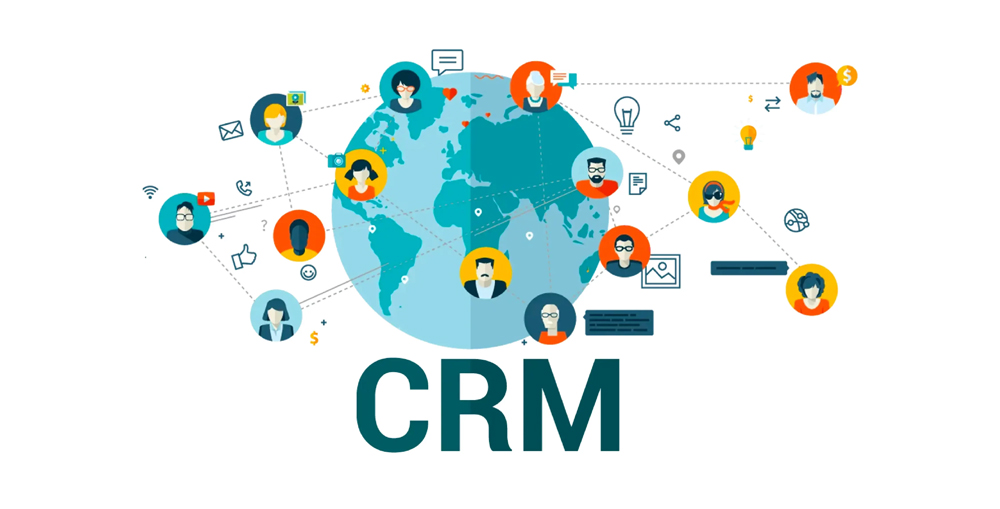
The Customer Relationship Management or CRM has evolved a lot over the time. The integration of new technologies and adoption of modern methodologies, have completely transform the customer-business relationship management. Especially the rapid rise of AI and the development of customized AI Agents. In highly competitive market landscapes the importance of customer loyalty is paramount. That is why businesses use modern software-based customer relationship management systems. By definition a CRM software is a well-structured application that help managing and enhancing the interactions between brand and its customers or prospects. The customer journey management is a very complex process and required a lot of resources and manpower. The development of a software-based customer relationship management (CRM) system was not less than revolutionary.


However, the technology have advanced rapidly, the markets kept changing on unprecedented pace, and the customer demands are skyrocketing. Although the customer relationship management tools or CRM software are excellent at streamlining internal processes and customer journey, they fell short when it comes to the present day’s needs of personalization and responsiveness. Businesses operating in Dubai, Sharjah, Abu Dhabi and broader UAE are well aware of current market trends. Now a days, customer wants instant resolution of their problems, they want instant service delivery, and they preferred a personalized interaction which is more intuitive, simplified and quick.

This is where the AI or artificial intelligence comes to play. The advent of AI have completely revolutionized the software development industry. The AI is not just another smart technology, but its capabilities are unbelievably amazing. The AI Agents is the area where the AI is exhibiting its true potential. The AI Agents are AI powered smart software-based virtual assistant which have ability to mimic human-like behavior. This means they are more aware of their environment, have incredible ability to process historical data and analyze real-time data and on top that the AI Agents are capable of making decisions. In this blog we will discuss how CRM systems will be completely transformed with the integration of AI Agents.

The Future of CRM: Leveraging AI Agents for Enhanced Customer Engagement

The Evolution of CRM Systems form Spreadsheets to AI Agents

The customer relationship management or CRM systems are always considered the backbone of a customer-centric business. But just imagine, your CRM software not only collect and store customer data, but have ability to analyze, interpret, understand, think, learn, adopt and take instant actions on its own. This might sound very futuristic, but this is our present day’s reality. Where the AI is rapidly transforming the custom software development industry, the AI Agents are also breathing new life into legacy systems. The traditional CRM systems and software tool rely heavily on manual inputs and the ability of the operator who operates them. The involvement of human staff itself lead to several problems created by human errors, incorrect inputs, missed opportunities or delays in actions, etc.

The integration of AI Agents enable your CRM to analyze and understand data in real-time, capture and input data fully or semi-autonomously, connect to all integrated communication channels, and take actions on its own. That is not all, the AI Agents have remarkable analytical tools and incredible predictive analysis which enable them to predict future demands and customer behavior which help in personalization and higher customer happiness. The CRM systems started as a humble spreadsheet, just collecting contact and basic purchase history, then the software-based CRMs came, but the AI Agents now a days can transform your CRM systems into a fully working partner.

See Also: Why customized CRM Software is better than Off-the-shelf Solution?

The Evolution of CRM Systems form Spreadsheets to AI Agents

How AI Agent Integration Supercharge CRM Systems?

One of the biggest drawback of any legacy software application including CRM software is their limited ability to handle the data. The AI however, are based on smart algorithms and neural networks, which enable them to handle very large volumes of data. That is not all, the traditional CRM software applications rely on third-party integration to collect and analyze data from all other relevant systems and business processes. This makes information flow very complicated, as a business relies on multiple software applications which operate or various different data types. This make bridging much more complicated and undermine the efficiency.

The AI Agents on the other hand are capable of seamlessly collecting data from multiple channels, multiple software and databases connected to central information system. The AI Agents are extremely capable of handling both structured and unstructured data. This ability enable them to detect even smallest change in trends or customer behavior. Moreover the AI Agents can account real-time data inputs along with the historic data which gives them ability to make decisions at their own as per company’s policy and take actions without requiring human intervention. The incredible automation driven by AI Agents can greatly boost the efficiency of a CRM system and elevate customer experience.

See Also: What is CXM (Customer Experience Management)?

The level of accuracy and efficiency AI Agents offer is unmatched.

Here are the key areas of CRM which can drastically improve by the integration of AI Agents:

  • AI Agents Operate 24/7: One of the biggest advantage of the AI Agent is their ability to operate 24/7 and that is not all, a single AI Agent can handle 100s of customer simultaneously. Unlike traditional Chabots, they AI Agents can adopt to customer preference, offer more personalized interaction and learn from their interaction which help them to further improve customer experience. One of the biggest advantage of AI Agents in CRM is that they can efficiently and accurately take care of repetitive tasks, letting your staff focus on more productive and strategically important tasks which help enhancing customer experience.
  • Advanced Data Analysis Capabilities: The advanced data analytical capabilities of AI Agents help businesses turn data into actionable insights. The AI Agents are very complex tools, they have ability to analyze and interpret large volumes of data. Moreover the NLP or natural language processing help AI Agents to interpret customer communications effectively. All these feature help streamlining the crucial tasks. The AI Agents can identify even the most minor and hidden pattern which is impossible for human to spot on. For example, the AI Agents can accurately identify the high-value prospects, or customers being on verge of leaving you, etc.
  • Hyper-Personalized Customer Experience: Think of a sales agent who happen to know and remember everything about your high-value customers! For sure they will be able to deliver the most personalized customer experience as they know what customers like, dislike, when their birthday is coming, what was their last issue highlighted to support team, etc. The AI Agents can just do the same but on a much larger scale and they can remember the same for each and every customer. This ability coupled with LLM, NLP and machine learning enable AI Agents to deliver hyper-personalized customer experience and every customer is treated like a VIP.
  • Superior Predictive Analysis: The AI Agents have incredible ability to analyze and process vast amount of data coming from multiple channels and in multiple different forms. The AI Agents can leverage their internal AI algorithms and smart tools to interpret this data into actionable insights. The level of accuracy and efficiency AI Agents offer in predictive analysis is impossible to match with legacy software solutions and systems. For example, the AI Agents can monitor every interaction and predict if a customer is about to make a purchase decision or if the customer is unhappy and is about to quit, etc. All these analysis help taking right actions and at right time.
  • Cost Effectiveness: The AI Agents are very cost-effective solutions, it is not that they will replace human, but they have incredible ability to empower your staff and boost their productivity. The precious human resource can be managed more effectively and efficiently with AI Agents in place. Furthermore the AI Agents can operate 24/7 and they can effectively reduce the per-service cost which reduce operational cost. The AI Agents not only reduce cost, but also ensure you don’t miss any opportunity and help generating more business. These incredible features help businesses yield much higher ROI than any other conventional software solution.

These are some of the key benefits of AI Agents when integrated with a CRM system. The AI Agents have ability to mimic human behavior. A well-trained AI Agents can effectively take care of the tasks performed by a human service agent or staff. They key here is that the AI Agents are not generic, they trained specifically on company’s data and they are trained to perform very specific tasks only. This is what makes them very good at whatever they do. Integrating AI Agents in a customer relationship management system or CRM can greatly improve the customer experience. AI Agents can improve staff performance, boost operational efficiency and empower data-driven decisions with their very accurate insights and predictive analysis. These features make AI Agents an indispensable asset to survive and thrive in future.

See Also: Key Features of an Enterprise Application Software (EAS)

How AI Agent Integration Supercharge CRM Systems?

Conclusion

The integration and implementation of AI Agents to customer relationship management (CRM) systems can be a great strategic move. Businesses operating in competitive markets such as in Dubai, Sharjah, Abu Dhabi and broader UAE, knows how crucial it is to stand out of the crowd. This AI Agents have potential to offer you a competitive advantage that none of your competitor can replicate. Whether it is serving customers 24/7 non-stop, launching hyper-personalized marketing campaigns, streamlining internal business processes and boosting staff performance or taking crucial strategic decisions, the AI Agents can empower a businesses in every aspect. The AI Agents leverage the LLM (large language models), NLP (natural language processing), ML (machine learning) and their incredible ability to process and analyze large volumes of both structured and unstructured data makes them ideal for modern CRM needs.

With the explosive adaptation of AI in each and every aspect of our lives, most of the people think that the AI might going to replace humans completely. However, that is not true at all, the AI Agents are not designed to replace human but to optimize their performance and empower them to improve the overall business outcome. A CRM system or customer relationship management is considered the backbone for business success. The AI Agents can not only have potential to revolutionize CRM but they have incredible ability to drive automation across various business functions.

In this blog we have discussed a few key aspect to understand why AI Agents are called the future of CRM. At RSI Concepts our experienced team is pioneering the advanced software solutions empowered by AI and AI agents. If you want to learn more of if you want our help to implement customized AI Agents for your organization, please feel free to contact us through our Contact Us page or leave a comment in the comment box below and we will get in touch with you soon.


Integrating Performance Management Systems with HR Tech Stack

For every business the superior operational efficiency, highly productive workforce and employee satisfaction are the most crucial ingredients for a long-term sustainable success. For that businesses invest heavily in their HR. The investments in HR comprises of two parts, one is hiring the HR experts and professionals and the other part is investing in HR tech stack. Technology is everywhere these days, any present day business can’t even function for a single day without utilizing any kind of digital tool or software solution. The HR is no exception, in fact the HR usually require comprehensive software solutions to collect, analyze and manage employee performance data.

Whether it is hiring, performance management and performance appraisal, every HR function requires in-depth data, which is majorly managed by software solutions and modern digital tools. The integration of performance management system with HR tech stack not only offer better efficiency, but it streamlines various HR processes as well. This integration streamline HR functions, processes and workflows and it also offer in-depth actionable analytical insights which empower smart business decisions. Integrating performance management system with HR tech stack also guarantees effective execution of employee evaluation, feedbacks, training and development plans and overall performance management strategies.

The HR team can greatly improve their performance by leveraging this integration and help businesses building a highly engaged, productive and efficient workforce. This integration will also help HR to adopt and implement performance management best practices and modern methodologies. In this blog we will discuss briefly how businesses can leverage this integration to achieve their high-level organizational goals and objectives.

Integrating Performance Management Systems with HR Tech Stack

What is a Digital Performance Management System?

A digital performance management system is a modern performance management approach and framework powered by a comprehensive software application. This software-backed performance management framework provide a multitude of tools and solutions to systematically measure, monitor, and improve employee performance. A digital performance management system eliminates the inefficiency of traditional performance management, foster a culture of transparent evaluation and help building effective mechanisms to ensure employee excellence.

The primary goal of a performance management system is to align the individual employee goals with broader high-level organization goals and objectives while ensuring highest possible employee satisfaction. A modern digital performance management system often includes advanced tools for KPIs and OKRs management, real-time performance monitoring, advanced feedback mechanisms, SMART Goal setup tools, and continuous alignment and improvement processes. Therefore choosing a right performance management system is also very important. A customized performance management system help HR team to deal with their unique challenges and personalized goals.

By integrating a digital performance management system with HR tech stack businesses can drive efficiency, productivity and optimize cost by leveraging the automation and digitalization. Both the employees and managers get dedicated dashboards and real-time performance monitoring tools, keeping managers informed and up-to-date. The in-depth analysis and accurate actionable insights led to more informed and impactful decisions. Adopting integrated solutions also help minimizing administrative burden of HR, resulting in higher productivity.

What is a Digital Performance Management System

What is HR Tech Stack?

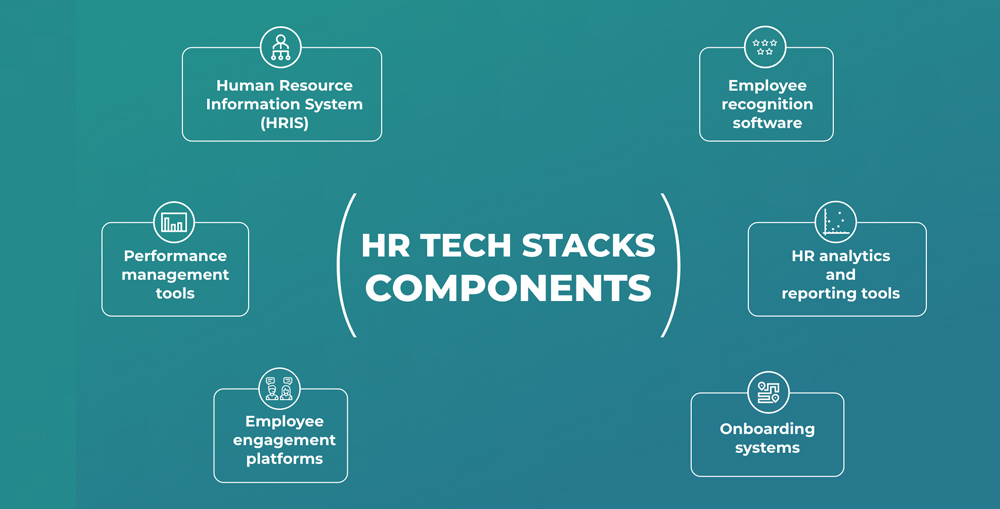
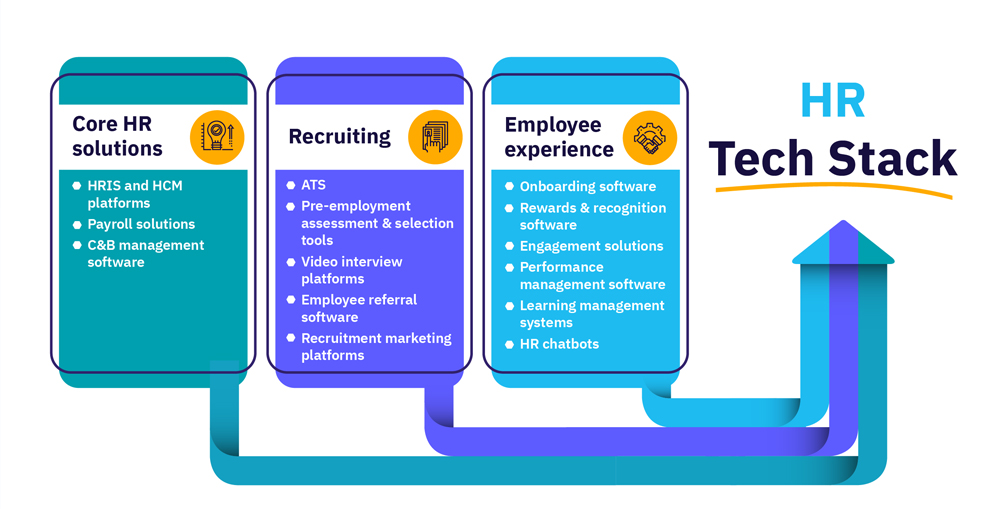
The HR Tech Stack as name suggest is the combination of all technology-oriented tools and solutions HR department uses for different functions. The HR tech stack majorly refers to exclusive software solutions which are designed to facilitate certain HR function. For example, the HR teams widely use following technology-based solution:

  • HRIS – Human Resource Information System
  • HRMS – Human Resource Management System
  • ATS – Applicant Tracking System
  • LMS – Learning Management System
  • EPAS – Employee Performance Appraisal System
  • PMS – Performance Management System
  • Integrated Communication Channels
  • Mobile Apps and Web Portals
  • Interactive Self-Service HR Kiosks
  • Training and Onboarding Tools

All these digital tools form the HR tech stack. Businesses in Dubai, Sharjah, Abu Dhabi and broader UAE usually utilize multiple such tools to streamline their entire HR operations. However, when all these tools are interconnected or the HR tech stack is integrated, it provides a much more accurate and in-depth overview of the entire workforce and their performance.

The biggest advantage of an integrated HR tech stack is its incredible ability to simplify complex tasks and processes. When the employee information and data is centralized and up-to-date across all systems, the HR team can minimize the administrative workload. The integration also help building innovative features and it drives automation. When most of the repetitive tasks are done autonomously by the HR tech stack, the HR team is free to focus on more productive and strategically important tasks.

How convenient it would be if you have all your HR functions like payroll, benefits, performance reviews, feedbacks, talent acquisition, training and development programs, etc. in a single unified platform. The integration between HR tech stacks eliminate latency, inefficiencies, errors, and information siloes and significantly improve HR team’s efficiency and productivity.

See Also: The Future of Performance Appraisals: 6 Innovations and Changes [Quick Guide]

What is HR Tech Stack?

Key Advantages of Integrating a Performance Management System with HR Tech Stack

The integration of a customized performance management system with the HR tech stack enables bringing all HR functions under one consolidated platform. This enable seamless information flow and it synchronizes data across all systems and solutions. Here are key advantages of integrating a digital performance management system with HR Tech Stack:

  • Improved Data Accuracy: The integration enables all HR systems and solution to exchange data autonomously which eliminates any human intervention, thus remove errors and ensure real-time data updates across entire HR tech stack.
  • Centralized Management: The integration of HR tech stack and performance management system provides a consolidated administrative panel. This drives efficiency by preventing employees to go to multiple systems, instead they can find everything in one dashboard.
  • Streamline HR Processes: The integration of HR tech stack enable businesses to streamline all HR functions. As the data flows seamlessly between all systems in real-time, this helps improving various internal HR processes and drive efficiency and accuracy.
  • Higher Employee Satisfaction: The integration provides centralized management and enable employees to get access to everything such as performance data, goals and objectives, feedbacks, etc. in a single unified dashboard adding value to employees’ convenience and satisfaction. Which raise employee engagement and satisfaction.
  • Enhance Performance Management: Since all the HR tech stack is interconnected, it helps driving automation and building innovative tools. The integration also simplify adopting to modern performance management practices.
  • Improve HR Team’s Efficiency: The integration automates various processes which were done manually. This frees up the HR team to focus more on productive and strategically important tasks and it also minimize their administrative workload raising HR team’s efficiency by many folds.
  • Empower Data-Driven Decisions: The consolidated data and centralized management enable advanced analysis and help extracting actionable insights. This empower data-driven decisions by providing comprehensive overview and timely information.
  • Improve Goal Alignment: For any performance management system the primary goals is to ensure a perfect alignment between individual goals and performance with high-level organization goals. Integration provide real-time performance data for course correction.
  • Enhance Development Programs: The integration provide a consolidated and in-depth performance analysis. It helps highlighting strengths and weaknesses and skill gaps, ensuring more effective personalized and targeted training and development programs.
  • Transparency and Trust: The integration of performance management system and HR tech stack help HR to foster a culture of transparency and trust. The accountability and evaluation is based on actual performance data which is available for everyone, this build employee trust.
  • Scalability and Flexibility: The integrated HR tech stack is a vital asset, it helps businesses to incorporate growing needs and respond of emerging changes and challenges. Which lead to continuous performance improvements and drive efficiency.
  • Cost Saving: The integration of performance management system and HR tech stack help driving automation and digitalization, which reduce human efforts, traditional inefficiencies, information silos, and errors which greatly help reducing operational cost and yield higher ROI.

Businesses often doesn’t realize how information silos are undermining their efficiency. The integration not only eliminate data silos but it also ensures all the connected systems remain up-to-date. Automated data synchronization and efficient flow of information led to better staff efficiency and boost HR’s performance. Efficient HR team foster a high performing organizational culture which has long lasting impact on business’s growth and success.

Key Advantages of Integrating a Performance Management System with HR Tech Stack

Common Challenges in Integrating Performance Management System with HR Tech Stack

It is crucial to understand that this integration might not be as that simple. There could be various challenges, hence a proper planning and systematic approach could help you solve many problems. There are two major types of challenges, one is technical and the other is resistance form the employees who are accustomed to using the legacy systems. After some times, people tend to get used to of whatever they do and however they do. Whenever people encounter a huge change like integration of performance management system with HR tech stack, they tend to resist it. This resistance can be countered by simple training and educating your HR teams. Education and encouragement can help greatly in gaining employees trust, support and cooperation.

The other part of the challenges is purely technical. Usually an HR Tech Stack is a combination of multiple software and application, some of them are operating independently and some might be collaborating at some extent. It is crucial to study and understand your HR tech stack thoroughly, map all the processes, work-flows and data points that you are intended to integrate and then identify the problems or limitations. Sometimes some HR tools might be built on different software stack, which can complicate the integration and data sharing. Therefore the intermediary applications should be built to translate and interpret data between such systems. The data migration and data security should be considered and planned carefully to ensure a seamless integration.

Furthermore when you are consolidating various tools and solutions into a single platform, the UIs and use experience become one of the most crucial factor to make or break your project. Therefore customizing UIs and even trying to adopt the previous UIs in a new dashboards is ideal to eliminate confusion among the employees. All the familiar and most commonly used functions either should operate the same way they were operating in previous systems or they should be replaced by altogether new tools. This will prevent human errors, reduce confusion and help improving user experience. The integration of performance management system and HR Tech Stack involves a large volume of data, however, with careful planning you can make this process seamless and hustle free.

See Also: 5 Challenges in implementing Performance Management System

Common Challenges in Integrating Performance Management System with HR Tech Stack

Conclusion

Businesses are always perusing ways to maximize their operational efficiency and productivity. Businesses leverage various HR Tech Stack in order to improve their recruitment, training, and performance management processes. However, most of the time different teams utilize different tools and solutions which results in isolated information/data pools. Hence the required information is passed manually to the relevant personals or managers. In order to avoid the same, businesses tend to turn towards integration. The integration is an automated way to synchronize data between different HR tech stacks, not only that it helps connecting any type of different, standalone software applications, databases, and business processes.

When it comes to performance management system, it is a modern software-backed solution that the HR uses to enhance their internal processes such as monitoring, measuring and improving employee performance. This made performance management system one of the vital component of HR. Thus integration the rest of the HR tech stack with a digital performance management system is not just a technological upgrade, but it is a great strategic need. When businesses plan to integrate different HR tech stacks including performance management system, they face many challenges. Some of these challenges are of technical nature and some relate to employee behavior. But with careful planning, thorough understanding of technology and efficient software development these the integration become seamless and hustle free.

This integration offer great many advantages and one of the biggest advantage of integration a performance management system with the HR tech stack is the to consolidate all crucial HR processes into a single platform. This is very significant in order to improve the HR processes and it also help minimizing the HR cost. The integration greatly improve the outcome and impact of the HR team as well. In this blog we have briefly discussed the key advantage of integrating a performance management system with the HR Tech Stack, if you want to learn more about the subject or if you want our help to integrate your performance management with HR tech stack, please feel free to contact us through our Contact Us page or leave a comment in the comment box below and we will get in touch with you soon.


The Future of Custom Software Development: Trends to Watch in 2025

Businesses tend to adopt to various software solutions and tools to digitalize manual processes for superior efficiency and quality of outcome. Any software that is used by any type of business is designed to streamline business processes and to empower communication mechanisms. For modern businesses the data is the bloodline, the efficient flow of data between relevant teams, personals and managers ensures effective strategies and impactful decisions.

However, when it comes to software, businesses has to decide whether they need a custom software development or a commercial off-the-shelf software (COTS) solution. Both approaches are different and have their own unique benefits, however, the COTS has a few inherent shortcomings which are not there in custom software development. In this blog we will discuss the future trends of custom software development to offer a better understanding of tailor-made solutions and the benefits businesses can reap from this approach.

Custom Software Development vs. Commercial Off-the-Shelf Software (COTS) Solutions

Before we discuss the emerging trends in custom software development, it is important to have a quick comparison of commercial off-the-shelf software solutions vs. custom software development. The biggest difference between COTS and custom software is that the COTS are standardized and built for a particular industry or a large number of audience. The custom software development on the other hand is tailor-made to fully align with your unique business needs and is typically meant for only a single business, team or small sets of users.

Custom Software Development vs. Commercial Off-the-Shelf Software (COTS) Solutions

Here is a quick comparison of COTS and custom software development:

Custom Software Development

Commercial Off-the-Shelf Software (COTS)

Customization & Flexibility

Fully aligned with business needsRarely fits all requirements

Competitive Advantage

Help addressing unique challenges and rapid adaptation for new featuresStandardized solutions, slow development and innovation, expensive & limited features

Scalability & Flexibility

Very flexible, easy to scale and adopt to changes as your business growsLimited flexibility, limited customization and expensive to scale and adopt to changes

System Integration

Highly flexible and cost-effective with third-party system integrationCostly and very limited scope of third-party system integration, often incompatible

Cost & ROI

High upfront cost, but superb ROI due to elimination of inefficiencies and high performanceLow upfront cost, but very expensive in terms of customization, integration and upgrades

Maintenance & Control

Easy & low-cost maintenance, in-house management, full ownership and control over data and applicationRelies only on vendor support and updates, the vendor owns the application and have full or partial control over data

Security

Enable businesses to embed advanced security features, well-protected structure and full complianceExposed architecture of the application, fully rely on vendor for security, have limited compatibility with compliance

That is just a quick comparison, obviously there are many aspects that I haven’t accounted for. For example, the commercial off-the-shelf software (COTS) solutions are quicker to deploy, in fact can be deployed within hours. However, the custom software development had to go through a comprehensive and lengthy development cycle. It majorly depends on your business needs, if you need instant solution then the COTS is the only way, but if you want to develop a long term and more reliable solution, then the custom software development is the right way to do it.

See Also: The Benefits of Custom Software Development for Growing Businesses

The Future of Custom Software Development Trends to Watch in 2025

Stay Ahead of the Competition by Early Adoption to Emerging Custom Software Development Trends

Customized software and applications come long way from being a luxury for large corporation and industries to be reachable for even startups. The evolution in software development technology and the large number of computer programmers and software developers completely revolutionize this industry. The custom software development is not only reachable but is advanced to an extent that it emerged as the ideal option for small businesses and startups.

However, it is crucial for businesses to keep an eye on emerging trends and new advancements in the software development industry. Familiarity with latest market trend position you in a great advantage form all of your competitors. Adopting to innovative solutions tends to be a game-changer for early adopters. Here are a few emerging trends, that you should keep an eye on in 2025 and coming years:

  • Enhanced User Experience: The demand for intuitive user experience is raising rapidly leading to personalized user interface and digital experience. Increasing competition requires maximum efficiency, and satisfactory user experience is a key to higher efficiency and productivity. That is why businesses started focusing more on enhancing user experience and making their software more intuitive and accessible leading to incredible efficiency and higher productivity.
  • Increasing Role of AI and ML: The AI or artificial intelligence and ML or machine learning are among the two most transformative technologies ever developed. Both technologies and super-charge the efficiency and productivity of any software application. The AI and ML enable advanced software tools to processes large volumes of data, learn and adopt to changes, and maximize automation to reduce human efforts while ensuring maximum performance and efficiency.
  • Cyber-Security and Privacy: The cyber-security and data privacy has emerged as the top concern for both businesses and customers alike. A minor data breach could completely ruin the reputation of the business. The cyber-criminals are known for their notorious approaches to commit harm, this requires an out-of-the box approach to mitigate the risk. Therefore adopting to security best practices such as advanced encryption, authentication and access control features, secure programing, etc. in your software is crucial.
  • Cloud-Native Development: The demand for cloud-native software application is rapidly rising due to the fact that cloud is very cost-effective, offers advanced security and resource management and tons of other benefits. The cloud-native development is also a modern form of custom software development, where software are exclusively developed for cloud environment such as AWS, MS Azure, Google Cloud, etc. offering unmatched scalability, security and flexibility.
  • DevOps and CI/CD: The DevOps and CI/CD or continuous integration/continuous development is not only a new trend but an emerging need. The modern business landscape is subjected to rapid changes, technological advancement, digital transformation, innovation and emerging business needs. The DevOps ensure continuous collaboration between the development and operations teams ensuring the software are developed and deployed with utmost quality and unmatched efficiency.
  • Progressive Web Apps (PWAs): The progressive web apps or PWAs are software applications that are designed to deliver a native app-like user experience but are not native apps. Instead the PWAs are developed suing modern web-technologies such as HTML5, CSS3, and JavaScript. These apps are easy to develop, customize and deploy offering cost-saving and better efficiency. These apps are super-efficient and can quickly modify or update to align with changing needs.
  • Blockchain Technology: The blockchain is an emerging technology, we all know the Bitcoin (BTC) and crypto, but the blockchain has a lot more to offer. Especially in customer software development the blockchain technology can greatly enhance cyber-security, transparency, and traceability, ideal for healthcare, supply chain, finance and many other industries. The transparency and accountability are the key components to elevate user trust and satisfaction.
  • IoT Integration: The IoT or internet of things is another modern technology that essentially connect different devices to achieve superior efficiency, management, monitoring and control mechanisms. These smart devices are simplifying operations whether it is a connecting thousands of sensors and motors at a production plant or connecting smart home devices. The IoT integration will surely going to dominate the software development industry in coming years.
  • AR/VR and XR: The AR or Augmented Reality, the VR or Virtual Reality and the XR or Extended Reality are the most modern and very sophisticated technologies. Businesses can leverage these technologies via custom software development to enhance the user experience. Whether you are building a software for your employees or for your customers, whoever the user is the AR/VR and XR have potential to super-charge the efficiency, convenience and productivity.
  • Advanced Data Analysis Tools: The data-driven decisions can make or break a business. Businesses need data for not only decision making but to drive efficiency in operations and resource optimization which directly impact operational cost. Leveraging big data and integrating advanced data analysis tools has emerged as an essential need, especially AI-powered predictive analysis, data collection tools, and actionable insights would be the focus for custom software development in future.
  • Remote Work and Collaboration: The remote work has become a new reality, many businesses rely heavily on remote workforce for their day-to-day operations, especially small companies and startups. This will increase in coming future, requiring businesses to develop the advanced collaboration tools to support virtual workforce. Hence integrating remote-compatible features such as data and communication tools in custom software development will be a great strategic move in coming years.

The custom software development is evolving rapidly. Businesses seeking future-proof solutions must be familiar with the emerging trends. In this modern day and age the business operations is impossible without relying on software applications. These software where save time and cost, also offer efficiency, productivity and performance needed to compete in the competitive markets such as in Dubai, Sharjah, Abu Dhabi and other regions of UAE. The UAE is a very competitive market, businesses who wants to stay ahead of competition must chose the software solutions that not only align with their business needs, but also help them mitigate the unique challenges they are facing.

See Also: The Cost of Custom Software Development: Factors to Consider

Stay Ahead of the Competition by Early Adoption to Emerging Custom Software Development Trends

Conclusion

As we look ahead to 2025, it is crystal clear that the custom software development has emerged as a strategic necessity for businesses who want to remain competitive. Especially in highly competitive markets such as Dubai, Sharjah, Abu Dhabi and other regions of UAE where the competition is very high, businesses need flawless operation and high-performing workforce to sustain growth. The custom software development is proven to be more effective and beneficial for businesses. Although the commercial off-the-shelf software (COTS) solutions offer great many benefits but when it comes to fulfill your unique and exclusive business needs, the custom software development is the ideal solution. Furthermore the custom software development offers superior flexibility, adoptability, integration, security, personalization and alignment with business needs.

See Also: Step-by-Step Guide to Planning Your Custom Software Development Project

Businesses who are planning to implement a new solution or replace an existing software must be aware of emerging trends such as AI, ML, customized User Experience, Advanced Cyber Security, Cloud Computing, Personalized User Experience, Progressive Web Apps (PWAs), Blockchain and many more. In this blog we have listed emerging software development trends which have gained popularity over past years and are expected to grow in coming years. It is crucial for a business to future-proof their software application by adopting up-to-date technologies, features and software development techniques. If you want to learn more about the subject or if you want to avail our cost-effective custom software development services, please feel free to contact us through our Contact Us page or leave a comment in the comment box below and we will get in touch with you soon.


The Benefits of Custom Software Development for Growing Businesses

Technology has profoundly transformed our personal and professional lives. Computers and smartphones have revolutionized the way we live and work. Similarly, businesses now rely heavily on various software applications to optimize daily operations, drive efficiency, and foster growth. A typical business ecosystem comprises a variety of software solutions, including core applications, specialized tools, customer-centric solutions, and employee-focused software. These integrated digital systems empower modern businesses, enabling them to thrive in today’s fast-paced market landscape. Organizations have two ways either to go with off-the-shelf software solutions or investing in custom software development tailored to their unique business needs.

The key distinction between commercial off-the-shelf software (COTS) solutions and custom software development lies in their adaptability to unique business requirements. While readymade software caters to a broad industry audience, its generic design often limits flexibility. In contrast, custom software development offers tailored solutions precisely aligned with an organization’s distinct needs and challenges. This bespoke approach enables businesses to pioneer innovative features and tackle specific challenges. Conversely, COTS solutions impose constraints, forcing companies to compromise on critical functionalities due to inherent limitations.

Custom software development empowers businesses to craft tailored solutions that reflect their unique vision, leveraging preferred technologies and infrastructure. This flexibility extends to branding and personalized UI designs, facilitating seamless adaptation and boosting overall business efficiency. These advantages position custom software development as a superior alternative to commercial off-the-shelf software (COTS) solutions. This blog will delve into the benefits of custom software development, exploring its transformative potential for growing businesses.

The Benefits of Custom Software Development for Growing Businesses

Why Businesses Need Customer Software Development?

A pivotal question for businesses today is; what is custom software development and why opt for it over commercial off-the-shelf software (COTS) solutions? To answer this, it’s essential to acknowledge that each business possesses distinct characteristics, setting it apart from others, even within the same niche and target audience. This uniqueness is a strategic strength, cultivated over time. As businesses evolve and grow, their distinct approaches to customer service, operational processes, and strategic management become increasingly pronounced. However, COTS software, with its generic design, often fails to align with these exceptional needs. This is where the custom software development comes into play, the tailored software solutions are fully align with unique business needs and offer seamless integration within existing IT infrastructure.

The UAE’s thriving business hubs, including Dubai, Sharjah, and Abu Dhabi, are witnessing a surge in adoption of tailored software solutions. Across various industries, companies are leveraging the distinct advantages of custom software development to craft innovative applications, integration tools, and solutions. These custom software solutions elevate customer experiences, drive operational efficiency, and enhance employee performance. Moreover, custom software development yields exceptionally higher long-term returns on investment (ROI). By offering greater control, ownership, flexibility, and scalability, customized applications ensure sustained efficiency and effectiveness. Moreover the alignment with evolving business and technical needs make them indispensable asset for a growing business.

Why Businesses Need Customer Software Development?

Custom Software Development Offer Better Competitive Advantage

The commercial off-the-shelf software (COTS) solutions fell short when it comes to competitive advantage as these are available for everyone, the chances are your competitor would be using the same tools. Since the COTS are usually industry specific, so most of the businesses operating in a particular niche would be using similar software, applications and tools. However, by adopting custom software development, you can develop software solutions and tools which are exclusive for you only. Above all you can always customize your software to align with emerging needs, which your competitors using COTS can never do. This will give you a better competitive advantage. It will strengthen your operations and make you able to respond to changing market conditions very quickly. The bespoke software solutions will enable you to offer products and services which are unique and innovative, which will help you stand out of the crowd and help you attract more customers. The differentiation and being unique is vital in competitive markets.

Custom Software Development Offer Better Competitive Advantage

Enhance Internal Workflow Efficiency with Bespoke Software Solutions

The custom software development starts with a thorough analysis of your internal workflows, needs, and challenges. This gives software development team to identify bottlenecks and inefficiencies in the current workflows. When the needs, expectations and problems are clear to the software development team, they are in a better position to deliver exceptionally efficient software solutions and tools. This approach not only raise efficiency and performance but it also help to boost employee performance and eventually result in cost reduction. The custom software development is a key to boost employee performance, it eliminate the repetitive work, streamline employee’s tasks, and reduce reliance on manual processes. Moreover the custom software development help you to customize the user experience by using familiar color schemes, intuitive information structure and use of familiar language which reduce errors and empower your employees. All these features greatly amplify the efficiency and productivity.

Enhance Internal Workflow Efficiency with Bespoke Software Solutions

Custom Software Development Offer Superior Scalability and Adoptability

Every business grows, and they need software solutions that support their growth, instead of slowing it down. The biggest drawback of commercial off-the-shelf software (COTS) solutions is that they have limited customization and scalability. The upgrades and modernization is very slow, until the demand rises from a majority of their customers the service providers doesn’t make changes in their software. However, when we compare the COTS with custom software development, the later gives you full ownership of your software and applications. This enable businesses to make changes, have upgrades and modify software whenever they have a need. Thus customized software offer better scalability and adoptability which effectively eliminates the disruption and expense of migrating to a new solution. Businesses also have to deal with emerging industry trends and continuously changing customer demands, which require them to modify their software, add new features or customize existing features, which is not possible with (COTS) solutions.

Custom Software Development Offer Superior Scalability and Adoptability

Custom Software Development Offers Flexible Third-Party System Integration

Any modern business relies on several software solutions and digital tools, which most of the time require a seamless flow of data and information across different software and applications. For example, the customer database is managed under a CRM and the financial data is managed by a financial application or tool. Businesses also offer various mobile apps and progressive web-apps for both customer and employees. However, it is vital for all these system to share up-to-date data to deliver certain functionalities and to avoid errors. The ERP is a central or core business application which is link with all these solutions provides a seamless information flow. This is called integration, the third-party system integration allow two software applications from different vendors to work on a single data repository. Moreover you can integrate big data solutions, implement AI (artificial intelligence) powered tools and up-to-date technologies for better efficiency and improved features. With COTS solutions, the integration is not as that simple, and in some cases not possible which results in several inefficiencies and repetitive work. The customized software on the other hand are very flexible and allow businesses to make structural changes in their source code to support any kind of third-party system integration.

Custom Software Development Offers Flexible Third-Party System Integration

Custom Software Development Elevates Security and Compliance

Security is a top priority for businesses, especially when the cyber-threats are exponentially increasing. Even a small and fairly insignificant data breach could completely ruin a business’s reputation. The biggest disadvantage of commercial off-the-shelf software (COTS) solutions is their wide usage, which make them exposed to wider audience. The cyber criminals can exploit this to carry out attacks on your digital systems. However, the custom software development produce exclusive solutions where the software developer can embed best security practices from the very beginning. The custom software are exclusively designed for your business and only a very small number of people are aware of the structure and internal source codes of your software. Furthermore the COTS doesn’t follow your data compliance and security policies and your data is always accessible to the service provider and in most cases in their custody as well. With custom software development you are the sole custodian of your data, you can implement any compliance policy and additional security feature to elevate security.

See Also: Common Mistakes to Avoid in Custom Software Development Projects

Custom Software Development Elevates Security and Compliance

Custom Software Development Offer Superior Cost Optimization and Full Ownership

Whenever it comes to the cost, the custom software development apparently require higher initial investments however, it can greatly reduce cost over the time. The key advantage of customized software is their ability to eliminate recurring costs, customization fees, license renewals, and upgrade costs. The custom software development offers full ownership to the business. When business owns the software, they are not required to pay additional fees for adding new users, or upgrading, or customization or any other such sort of cost is eliminated. This makes custom software development much more cost efficient then their counterpart COTS. The customized software also require very less maintenance cost and have much longer lifecycle further adding value to their long-term ROI. The ownership secure businesses from any unexpected costs, changes in licensing fees or any other maintenance expense. Moreover since the software is fully align with your needs, there is no customization or integration cost down the road.

See Also: Step-by-Step Guide to Planning Your Custom Software Development Project

Custom Software Development Offer Superior Cost Optimization and Full Ownership

Conclusion

Technology have completely transformed the way businesses operate and interact with their customers. In highly competitive markets such as Dubai, Sharjah, Abu Dhabi and other regions of UAE, businesses tend to rely on tens of different software solutions to operate effectively. Whenever a business has a need, they can either chose a commercial off-the-shelf software (COTS) solution or they can invest in custom software development. As we discussed in this blog, the custom software development is far superior then the COTS. The custom software development offer full control over the software and its programing aspects. Businesses can incorporate additional security features by adopting secure programing techniques. The maintenance and operational cost of a customized software is very less comparing to COTS which has recurring costs. All these features make custom software development an indispensable tool for businesses.

See Also: Emerging Trends in Custom Software Development

The custom software development also elevate scalability, adoptability and intuitiveness of a software application. Businesses can customize the UIs to make it more familiar for their employees and customers. The custom software development also make businesses more reactive towards emerging market trends and increasing customer needs. The easy and low-cost integration with other third-party systems, data bases and core business applications empower centralized management. In this blog we have discussed a few key advantages which make custom software development superior then the COTS. If you want to learn more about the subject or if you want our help to build a highly cost-effective bespoke software for your business or organizations, please feel free to contact us through our Contact Us page or leave a comment in the comment box below and we will get in touch with you soon.


Custom Software Development vs. Off-the-Shelf Solutions: Which is Right for You?

Whether you are a small business or large enterprise or a private organization or a government entity, these days software solutions are backbone for day-to-day operations. No business can function without relying on any software application. Even if you are just using emails or WhatsApp, you are still utilizing these software. This blog is not to discuss the emails or WhatsApp, in fact we will briefly discuss about the business solutions, like ERP (enterprise resource planning software), CRM (customer relationship management system), Customer Feedback System, Customer Portals, Intranet Applications, Web-Portals, and core business applications.

Now a day’s a business’s digital eco-system consists of multiple software solutions, some are commercial off-the-shelf solutions (COTS) and some are custom software development solutions. All working in a perfect harmony to drive efficiency, performance, quality and profitability. Businesses operating in Dubai, Sharjah, Abu Dhabi and broader UAE are very eager to optimize their operational efficiency and expenses by leveraging the inherent properties of software applications, such as business process automation, digitalization, analytical data collection and super efficient information flow via advanced communication channels.

The digital technology is evolving at an unprecedented speed, so does the market trends, and customer demands. In order to be more competitive, businesses need to adopt to highly efficient software application. With the growth corporate data and increasing demand for operational excellence also grows, and the decision between commercial off-the-shelf solutions and custom software development has become more critical and difficult. In this blog we will do a comparison between custom software development and off-the-shelf solutions to give you a better perspective of the subject.

See Also: Custom Software for Improved Business Efficiency

Custom Software Development vs. Off-the-Shelf Solutions: Which is Right for You?

What is Custom Software Development?

The custom software development is a process to design software application precisely as per your needs, the customized software are tailor-made for a single business or group of users at an organization. This is what makes them far more superior, efficiency and effective. Unlike commercial off-the-shelf software, which are generic solutions, the custom software applications are design from scratch, which perfectly positioned them as the most effective solution for modern business who strive for efficiency and performance.

The simplest way to understand it is to think of building house, if you commission a professional architect, you can make the house the way you want and need, you can control each and every minor aspect of literally everything. But what if you bought a built house, you don’t have much room to make changes, even if you hire someone, you will still going to have certain limitations. This is how the custom software development is different from the off-the-shelf solutions.

The custom software development process starts with in-depth analysis of your organization’s existing infrastructure, operations, internal processes, workflows and challenges that you are facing. This processes greatly improve the efficacy, efficiency and alignment with your operations. Then all key elements are carefully crafted to minimize the adoption and integration expenses, while ensuring all goals can be achieved seamlessly. With the custom software development you can design the software by keeping your goals, challenges, resources and limitations in mind.

The custom software development also tend to delivery exceptionally higher ROI over a longer period of time. But the thing most organizations doesn’t realize is when do they need a customized software application? The simplest rule to consider is to “don’t reinvent the wheel”. Your email client, such as Outlook or Thunderbolt both are off-the-shelf software, do you need to build one for your organization? Absolutely not!

See Also: Why Off-the-Shelf Solutions Fall Short: Advantages of Custom Software Development

What is Custom Software Development?

What are Off-the-Shelf Software Solutions?

The off-the-shelf software solutions or COTS, are the pre-built software application, which businesses either purchase or subscribe to. Same like Outlook and Thunderbolt, there are ERPs, CRMs, HRMS, and various other organizational tools which are pre-built, and are designed for a specific industry sector. Moreover what off-the-shelf solution you are using, the chances are very high, your competitors would also be using the same. This undermine your competitive advantage. The biggest advantage of off-the-shelf software solutions is that they are ready-to-use.

The time you purchased them, you will be provided access instantly, and even if the on-premises deployment is required, these solutions can be setup up in a few days. Unlike the customized software application which require a lengthy period of development and testing. For example, Microsoft Office, QuickBooks, Oracle, SAP, Microsoft Teams, Zoom, all are commercial off-the-shelf software solutions. The big-data software market is dominated by off-the-shelf solutions, but businesses are gradually shifting towards customized big-data and AI-powered software applications.

One of the biggest reason businesses opt for commercial off-the-shelf solutions is quick deployment and very low upfront cost. Most of the off-the-shelf software solutions come with a subscription plan, the payments are done on monthly, quarterly or annual bases. The biggest disadvantage in implementing off-the-shelf software solutions is the lack of customization. Most of the off-the-shelf software doesn’t offer any customization, some large-scale application do offer customization but with very limited scope and the customization cost is also very high.

Usually these software solutions are divided into various packages and modules. Sometimes just for a single features, businesses might need to upgrade to a 20%-40% expensive module or version. Which can significantly increase the operational cost in longer run. That is not all, businesses often end-having tons of unwanted features which not only increase cost, but also tend to harm the efficiency of the staff who will be using these solutions.

See Also: Custom Software Development for Enhanced User Experience

What are Off-the-Shelf Software Solutions?

Comparison Between Custom Software Development vs. Off-the-shelf Solutions

Now that we clearly understood the major differences between the custom software development and off-the-shelf software solutions, let us compare various aspects which will help you decide which solution could be more effective for which needs and requirements.

Cost Comparison: Custom Software Development vs. Off-the-Shelf Solutions

Cost is one of the most crucial and in most cases the deciding factor when business choose between the custom software development and off-the-shelf solutions. However to understand the costing of both solutions, we have to be very careful. Like I have mentioned earlier, you don’t have to re-invent the wheel. This means, for certain needs, you will surely go for commercial off-the-shelf solutions, such as Microsoft Office, Emails, Teams, Zoom, etc. However, when it comes to accounting, for example, the Quickbooks or Slack might cost you very less, but will never going to align and adopt to your emerging business needs.

There would be costs associated with upgrades, new modules/features, third-party integration and so on. Above all, if you are dealing with sensitive customer data, you will always be at risk, since your data has been stored with the vendor and technically they have full control and to some extent authority over it. The initial cost on the other hand for the custom software development could range somewhere from a few thousand dirham to several hundred thousand. Which might seem staggering comparing to COTS.

However, with the customized software application, you will have full control and authority over your data, you can customize them the way you want, you can add new features down the road, and on top of that these software has capabilities to scale, adopt and evolve along with your business needs. There would be no operational inefficiencies due to mismatching of software structure and your internal processes and workflows.

You will most likely never stuck in vendor-lock situation, and instead of replacing the entire solution, you can simply add new features, upgrade it or customize it as per your new needs. You can also easily integrate customized software with other third-party tools, databases and solutions without bearing large expenses. This makes custom software development superior than the COTS.

See Also: The Cost of Custom Software Development: Factors to Consider

Cost Comparison: Custom Software Development vs. Off-the-Shelf Solutions

Flexibility and Scalability: Custom Software Development vs. Off-the-Shelf Solutions

I would rather consider flexibility and scalability comparison as direct cost comparison. Because this has huge impact on your long-term cost. Growing businesses often end-up outgrowing their commercial off-the-shelf solutions and end-up paying huge for the replacements. The important and most crucial thing to understand is tha the commercial off-the-shelf solutions are designed for masses, and are designed as per best industry practices and standards. This means a large number of businesses would be using them, hence upgrading an application which has millions of users, and all users can have their own preference, needs, and challenges.

Under such conditions, making huge change in the software could impact millions of users, which will also impact the revenue of the vendor as well. Hence whenever a vendor will decide to upgrade or add more features, or remove some, they will have to be very careful. Therefore the development and growth is extremely slow with commercial off-the-shelf software solutions. The custom software development on the other hand is synonymous to flexibility. The customized software solutions are tailor-made for your business needs, and have potential to keep on evolving with your emerging needs. Adding a new features, removing or customizing an existing features in in your hand.

Moreover, you can do whatever you want to do, there is no restriction or limitation as far as the customization concerns. This level of customization and personalization is invaluable for businesses who want to grow and stand out of the crowd. The customized software keep on evolving with your emerging needs, challenges and growth. Your in-house developers or the outsourcing partner can customize and optimize the features whenever you need them. You can always patch your software or upgrade them to optimize the performance and impact. This way rather ending up replacing your off-the-shelf software solutions, you can keep on using the same application for decades.

See Also: Step-by-Step Guide to Planning Your Custom Software Development Project

Flexibility and Scalability: Custom Software Development vs. Off-the-Shelf Solutions

Maintenance and Support: Custom Software Development vs. Off-the-Shelf Solutions

Whether you chose commercial off-the-shelf software solution (COTS) or a custom software development, both requires upkeep and maintenance. Businesses often overlooked the maintenance and support while deciding between these two, but it is a very crucial factor to consider. Especially in a fast-paced world, where the time is money, any downtime in a software application or a minor issue could significantly undermine your entire operations. Some issues need to be addressed at immediate bases, as these could have dominoes effect, where one problem or inefficiency lead to another and so on. When it comes to support the commercial off-the-shelf software solutions always lag, no matter how great the application is, the support would usually be limited to general queries and for complex issues, you might have to wait in long queues.

Moreover the support resources for off-the-shelf software are shared and depends on your licensing agreement and in some cases you have to pay extra for premium support. The customized software on contrary comes with dedicated support, the team that built them also offer dedicated support. Another great advantage is quicker problem resolution and timely patches or updates. The software development team that build your application would understand all intricacies of your software hence, they can quickly resolve issues, eliminate bugs, and even made iterations for better user experience and efficiency. You will always prioritized, and in cases of show-stoppers your support team will readily available.

The upgrades, updates, security patches, and iterations can be scheduled aligning with your operating hours, to minimize any impact on your operations. Businesses often do such activities in off-hours or at weekends, to eliminate any downtime. Since you are the sole customer, your requests are always prioritized, moreover you can have direct interaction with the developers which eliminate any communication barrio and ensures quick results.

See Also: Emerging Trends in Custom Software Development

Maintenance and Support: Custom Software Development vs. Off-the-Shelf Solutions

Security and Data Privacy: Custom Software Development vs. Off-the-Shelf Solutions

In this modern day and age the data privacy and cyber security is one of the greatest challenge. We have witnessed many multinational businesses get completely destroyed after data breaches, most of them still haven’t recovered to their formal glory. Now a days customers are very savvy and aware of the cyber threats, on top of that the media, news and social media also played their role in spreading the awareness. Businesses too are way more conscious about the cyber security. One of the biggest drawback of off-the-shelf software solutions is that your valuable data is stored on vendor’s servers, and even if it is stored locally (which is very rate), the vendor still have full access to it.

Moreover, the vendor is almost fully responsible for the security, but you might also have to take certain measures to ensure maximum data privacy and protection. The off-the-shelf solution are more likely to get targeted due to known vulnerabilities due to the fact that millions of people all around the world have access to these solutions. However, the custom software development enable businesses to adopt to advanced security practices. In fact the security can be prioritized throughout the development lifecycle. A secure development lifecycle help adding multiple layers of security and protection.

Unlike commercial off-the-shelf software solutions, businesses have full control and ownership of their data. They can choose where and how to store their data and no one can be given access to it, outside of the organization. Since the applications are built from scratch in custom software development, your software structure and design is fully confidential and no one knows it. Moreover businesses can have frequent and regular security and vulnerability testing which help them instantly apply security patches, keep the source code up-to-date and keep on adding new security features down the road. These are the reasons the customized applications are considered to be more protective and superior than off-the-shelf solutions.

See Also: Security Best Practices in Custom Software Development

Security and Data Privacy: Custom Software Development vs. Off-the-Shelf Solutions

Conclusion

Choosing between off-the-shelf solutions and custom software development is always difficult. Businesses have to consider multiple factors, and majorly it depends on your needs, budget, and long-term strategy. Both off-the-shelf solutions and customized software applications have their unique advantages and disadvantages, but in most cases the custom software development tend to offer extremely higher ROI. Even on technical grounds, the customized applications are technically more superior, advanced and future-ready. For example, if you need an email client, what would be more beneficial? Developing a new email client or opting for Outlook or Thunderbolt? Obviously your needs are the major driver here, but if you need a complex application or tool, then the custom software development is much better choice. The off-the-shelf software solutions have many limitations, the application lack in offering any competitive advantage, and tend to grow at a very slow pace.

Businesses who consider the upfront cost and deployment time only, often end up replacing their off-the-shelf software solution with a more expensive and complex software application after some time. Because the commercial off-the-shelf software solutions tend to grow and evolve very slowly. The custom software development is a comprehensive process, which let businesses build their software from scratch, hence the software fully aligns with your unique and exclusive requirements. Moreover the customized software have potential to evolve along with your business needs. You have full control and authority over the source code, data and security aspects, which is a great advantage. There are no hidden fees or hefty charges for very limited customization. The custom software development is far more superior in every aspect and could be a game changer for businesses.

In this blog we have briefly discussed a few crucial aspects of software development to compare both off-the-shelf and customized software. If you want to learn more or if you want our help to design a bespoke software application for your organization, please feel free to contact us through our Contact Us page or leave a comment in the comment box below and we will get in touch with you soon.

See Also: Benefits of Investing in Custom Software Development for Your Business in Dubai


Integrating Customer Feedback Systems with CRM for Enhanced Customer Relationships

The customer relationship management is a strategic process businesses utilize to manage and analyze the customer interaction throughout the customer lifecycle. The customer feedback is a source of highly valuable insight which help businesses align themselves with customer needs and expectations. These two are most important and vital component of any business’s growth strategy. Without nurturing customer relationship business can never achieve their long-term goals and without understanding customer needs and expectations, businesses can never strengthen their relationship with customers. The customer relationship management system or CRM is a technological framework which help businesses to automate and synchronize various crucial business processes such as sales, marketing, customer service and support.

These four are the fundamental components of customer relationship, no matter what industry you operates in, you need these processes to build long-term customer relationships. Businesses operating in Dubai, Sharjah, Abu Dhabi and broader UAE knows how competitive the markets are and how diverse and dynamic the market landscape is. Such market conditions require a strong, loyal and dedicated customer base, which requires proactive customer relationship management. Same like any other relationship the communication is the key to success.

The customer feedback system provides a crucial source of direct communication, where the customers can freely express themselves and share their suggestions. In this blog we will discuss how businesses can leverage a customer feedback or survey system along with a customer relationship management system to strengthen the customer relationships.

See Also: What is CXM (Customer Experience Management)?

Integrating Customer Feedback Systems with CRM for Enhanced Customer Relationships

Understanding the Basics of CRM (Customer Relationship Management System)

CRM or Customer Relationship Management is an integral part of the modern businesses, it is a strategic process, usually managed by a dedicated software application which provide management and analytical tools. It provides a centralized system which host the customer data, providing an in-depth and intuitive understanding of every customer journey from first interaction to ongoing support. The modern CRM solutions also include tools to manage the leads and potential customers. The customer relationship management software (CRM) is used to streamline processes between various front-facing business functions. For example, when a salesman closed a deal, the customer service and support team is notified, the CRM do this in fully or semi-automated way, it records the interaction, conveyed the required information to the relevant team informing them of customer’s needs and expectations.

The biggest advantage of CRM solution is that it reduce errors, provides more wholesome data to the relevant teams and personals, eliminate the need of manual work, and it can manage large number of customers with extremely high efficiency. These features not only enhance operational efficiency, but also drive productivity which results in better quality services and satisfactory customer experience. The CRMs are excellent at enhancing communication and information flow within the organization and these tools can also automate communication with customer, which help businesses save a lot of resources, while instead of compromising quality or performance, boost both of them. That is why businesses tend to rely on customer relationship management (CRM) software to manage and nurture customer relationships. The CRM also keeps everything organized, well-tracked and recorded without any delay.

See Also: Why customized CRM Software is better than Off-the-shelf Solution?

Understanding the Basics of CRM (Customer Relationship Management System)

Understanding the Basics of Customer Feedback System

The modern market landscape has become very customer-centric, businesses who failed to align themselves with customer needs, expectations and preference couldn’t compete. Dubai, Sharjah, Abu Dhabi and broader UAE has a very diverse and highly competitive market landscape. Customers have multiple choices, a single bad interaction could led them to switch to your competitor. That is why it is crucial to understand what is in your customer’s mind and heart. The customer feedback system provides a window into customer’s mind and heart. The customer feedback data help businesses acquire a deeper insight to customer’s needs, challenges, issues, expectations and preferences. The customer feedback system provides a systematic framework which streamline customer feedback management, provide advanced data collection and analytical tools, which help producing actionable insights.

The customer feedback system is a digital tool based on a very powerful software application. This tools help streamlining multiple channels to collect feedback data from broader audience. Furthermore the customer feedback system has capabilities to automate the feedback management process. It also offers real-time feedback and automation which greatly improve business efficiency and reduce the human resource. The feedback data helps management understand the customer needs, identify trends, and identify the areas of improvement. Furthermore businesses can also leverage the customer feedback system to assess and evaluate the changes implemented. The customer feedback system plays crucial role in improving service quality and product development. Businesses can make informed and highly effective data-driven decisions leveraging the customer feedback data for higher success and growth.

See Also: Understanding Customer Sentiments by Implementing a Modern Customer Feedback System

Understanding the Basics of Customer Feedback System

Why We Need to Integrate the Customer Feedback System with CRM?

Both the customer feedback system and CRM or customer relationship management system plays a crucial role in managing and improving customer relationship. Integrating both can exponentially raise their efficacy and efficiency. Integrating customer feedback system and customer relationship management system (CRM) can provide a unified platform where the customer voice meets the actionable insights. This integration has another great benefits, it provides a more in-depth understanding of customer feedback in context to their history and help personalizing customer service and experience. Personalizing customer experience and services can greatly improve customer satisfaction and help businesses increase customer loyalty. The loyal customers tend to be good brand advocate not only giving repeated businesses, but also helping businesses in establishing good reputation.

Here are some key benefits of integrating customer feedback system and customer relationship management system (CRM):

  1. Enhanced Insight: Combining CRM and customer feedback system provides a 360 degree view of customer preferences, choices, pain points, complaints, service history, customer persona, demographics, and much more.
  2. Better Customer Retention: Requesting feedbacks after every interaction, closing the feedback loop, and regular feedbacks help building trust and strengthening customer relationship which improve customer loyalty and increase customer retention.
  3. Personalized Customer Experience: Combining customer relationship management data and customer feedback data help identifying patterns, preference and customer expectation which help businesses personalized their offering for elevated customer experience.
  4. Streamlined Communications: Businesses can leverage the combined data from customer feedback system and customer relationship management system (CRM) to establish a fast and automated communication framework.
  5. Proactive Problem Solving: The customer feedback data and CRM data help businesses identify reoccurring problems, issues, complaints and customer suggestions which help businesses proactively solve problem and even identify issues which can later become a problem.
  6. Data-Driven Decision Making: In the modern business landscape where the technology is infused deeply into our personal and work lives. It is extremely important for businesses to have correct insights to take data-driven decision which can ensure long-term success and growth.
  7. Build Customer Trust: One of the most overlooked features of a modern customer feedback system is the closed-loop feedback, where customers’ response/feedback is acknowledged and they are informed of actions taken against their suggestions, this help building trust.
  8. Improve Product Development Process: The CRM data combined with customer feedback data help businesses perform in-depth analysis of their products and services, with this insight in hand businesses can develop the products that can perfectly align with customer needs.
  9. Quick Issue Resolution: The real-time customer feedback can be provided to all relevant teams such as customer service agents, technical support team, etc. This will help them quickly resolve issues, take timely actions and escalate problems that are reported regularly.
  10. Increased Sales and Cross-Selling Opportunities: The customer feedback data and CRM data combined can unlock various up-selling and cross-selling opportunities. The inbuilt AI algorithms and analytical tools help identifying such customers.
  11. Strengthening Customer Relationship: The advanced analytical tools provide in-depth insight, the automation help enhancing communication. Acknowledging customer feedback gives them a sense of importance, by valuing customer businesses can strengthen the customer relationships.
  12. Smart Resource Allocation: Every business has limited resources, in order to maximize the efficiency and outcome, businesses need smart resource allocation. The feedback and CRM data suggest the areas where the efforts can be most impactful.
  13. Enhanced Marketing and Communication: For every business the marketing and communication is a key to success. The integration of CRM and customer feedback system help projecting the communication and marketing campaigns in right direction yielding higher profits and sales.
  14. Comprehensive Reporting: For any business actionable insights are crucial, the AI powered analytical tools can combine both feedback and CRM data to produce highly effective actionable reports, the reports can also be automated for swift action and decision making.

These are some of the key benefits of integrating customer feedback system and customer relationship management system (CRM). Businesses can leverage this integration for long-term improvements as well as leveraging it for proactive problem solving. This can greatly improve customer relationship and you gain more loyalty and build customer trust. These features can help businesses gain a great competitive advantage which can be a game-changing in such a dynamic and highly competitive market landscape.

See Also: Key Features of an Enterprise Application Software (EAS)

Why We Need to Integrate the Customer Feedback System with CRM?

Conclusion

Integrating customer feedback system and customer relationship management system (CRM) could be a great strategic move. Especially if you are operating in Dubai, Sharjah, Abu Dhabi and elsewhere in UAE where the business landscape is highly competitive. These markets are subjected to change at a very rapid pace, the customer trends keep on changing frequently. In such business landscapes it is vital to have a deeper and most accurate understanding of customer behavior. Businesses should know what their customers like/dislike, what they need, what bothers them and what do they expect form their favorite brand? Businesses tend to rely on multiple digital tools, business solutions and software applications. Most of the time, these different solutions have different user group, the information and data gathered could remain in silos, which cause latency and lag. The integration empower these solutions, eliminate lags, and streamline information and data flow.

The customer feedback system is a modern software-based solution which help collecting multi-channel feedback and enable businesses to implement modern feedback strategies such as continuous and real-time feedback, closed-loop feedback, etc. Similarly the customer relationship management system (CRM) is also a digital tool which is used to streamline various operations at sales, communication, customer service, and technical support, etc. Combining both the valuable insight form a customer feedback system and extraordinary data-driven capabilities of modern customer relationship management system (CRM), businesses can streamline various internal and operational tasks, drive efficiency and productivity and take most effective decisions for higher success and growth.

The integration help fostering a culture of personalized customer experience, improved efficiency, higher productivity, proactive problem solving, improved decision making, and greater customer satisfaction. The market trends, customer preferences and expectations keep on changing, integrating customer feedback system and customer relationship management system (CRM) ensures that the business remains agile, informed, proactive, more adaptive and responsive towards such changes.

In this blog we have briefly discussed how this integration can help businesses. If you want to learn more about the subject or if you need our help to integrate customer feedback system with CRM or built a completely integrated bespoke solution for you, please feel free to contact us through our Contact Us page or leave a comment in the comment box below and we will get in touch with you soon.

See Also: 5 Techniques to Integrate Customer Satisfaction Survey with Queue Management System


How Performance Management Systems Enhance Employee Engagement

Businesses have many challenges in managing workforce, the performance management and the employee engagements are the two most crucial aspects. Employee engagement directly impact business success, engaged employees tend to be more productive, loyal and motivated. That is why any modern performance management system is incomplete without incorporating best employee engagement practices. Traditionally performance management focuses on setting up goals and achieving them, and the employee engagement on the other hand, focuses on fostering a positive and friendly work environment.

That is the reason the performance management and employee engagement are not only intertwined but interlinked also and for business success managers need to focus on both. The employee engagement not only have positive impact on overall performance of the organization, but it also elevates customer experience, product/service quality, and employee turnover. A motivated workforce is a key to success in today’s rapidly evolving business landscape. If your employees are motivated they tend to produce better outcomes in any unconventional condition.

Studies showed that the employee engagement is declining since past few years, and businesses operating in Dubai, Abu Dhabi, Sharjah and other regions of UAE also felt that. This fueled the rapid adaptation of modern digital performance management system and practices. In this blog we will discuss how a modern digital performance management system can completely transform the employee performance management and employee engagement processes. Moreover a customized solution can be a great help in linking performance management with business outcomes which boosts productivity and profitability.

See Also: Performance Management System: Best Practices

How Performance Management Systems Enhance Employee Engagement

What is a Modern Performance Management System?

A performance management system is a well-structured process to assess, evaluate and improve employee performance and the quality of the outcome produced by these employees. A modern performance management system just does the same with an addition of implementing a software solution which empower and improve each and every aspect of your performance management system. The modern performance management system is not limited to annual reviews and appraisals. It can vary in terms of complexity, design and features, but at its core it is a continuous process which includes continuously providing guidance, support and encouragement to employees, ensuring they stay on track and eliminating the obstacles which are or could compromise performance.

Businesses can design a tailormade performance management system as per their diverse and exclusive business needs. This is what makes custom performance management system more effective. A modern digital performance management system offer comprehensive tools and methodologies that continuously optimize employee performance throughout the year. Whether it is feedback, reviews, one-on-one meetings, performance evaluation, course correction or appreciation, the modern performance management system operates throughout the entire year.

Beyond only monitoring and improving efficiency the modern performance management system provides well-organized framework for employee growth and development, which is essential for trust building. With a modern performance management system both employees and management knows where they stand and do collaborative and constructive efforts to elevate overall organizational performance.

See Also: Employee Performance Management Process with PMS

What is a Modern Performance Management System?

Why Employee Engagement is Crucial for Business Success?

Businesses who implement employee engagement initiatives tend to perform much better than the business who still follow the traditional and outdated performance management practices. For example, continuous feedback loops, regular employee-manager interaction, including employee say in crucial internal processes and decision related to performance management, etc. All these help engaging employees, and give them a sense of importance and value. This sentiment is crucial for motivation and help HR and mentors to effectively boost operational performance and profitability. According to studies, engaged employees tend to be around 17% more productive and 21% more profitable than disengaged employees.

It is because the disengaged employees are demotivated and tend to be less efficient. Moreover the employee turnover is also greatly impacted by employee engagements, an engaged employee is 87% more likely to stay in the organization. Employee retention is one of the biggest challenge in modern performance management. Employees tend to leave for better opportunities, if you offer them great working environment, a positive organizational culture and keep them engaged, they are most likely to stay even if offered higher salaries and perks. That is why employee engagement is very crucial for businesses.

Furthermore the engaged employees has a sense of ownership and pride in their work, which fuels the innovation. The engaged employees are always the ones who came up with innovative solutions, creative ideas and tend to be more aligned with high-level organizational goals. A digital performance management system offer advanced tools for enhancing employee engagement.

See Also: Choosing a Performance Management System A Buyer’s Guide

Why Employee Engagement is Crucial for Business Success?

How a Modern Performance Management System Increases Employee Engagement?

A modern performance management system offers advanced tools and intuitive dashboards for both management and the employees. This help businesses effectively implement their performance management strategies and polices, which resultantly amplify the impact of performance management and employee engagement processes. The modern performance management system greatly improve the following aspects to increase employee engagements:

Setting Clear and Realistic Goals Increase Employee Engagements

The modern performance management system digitalize the performance management process and various HR activities which drive efficiency. Moreover the performance management system can automate a variety of relevant processes which help improving the entire performance management process. Setting up goals, is one of the most fundamental and crucial aspect of performance management. The high-level organizational goals and strategic objectives are driven by organization’s vision, these are then channeled down to different business functions, departments, teams and till individual employee.

See Also: How the HR should select a Performance Management System?

The goals and objective give directions to employees and tell them what organization is expecting from them and how employees can succeed in achieving their goals. The modern performance management system provides tools, frameworks and methods to establish SMART Goals by collective and collaborative efforts. The SMART Goals is a complete goal setting framework which means Specific, Measurable, Achievable, Realistic/Relevant, Time-bound. Here are a few things to consider while creating employee goals:

  • Break down large strategic objective or project into smaller, manageable and achievable tasks
  • Set realistic deadline to achieve those tasks, the accountability is a very important driver
  • Implement periodic/continuous monitoring policy, review and course correction for better results
  • Encourage employee feedback and suggestions in goal setting and relevant decisions
  • Critically analyze and enlist potential obstacles, short comings, disruptions and their solutions

Implementing SMART Goal setting framework and sensible strategy can greatly improve the success rate, it also gives employee clear understanding of their progress and build a sense of motivation and achievement. When employees successfully achieve small goals and milestones, it build a sense of success and increase their momentum to deal with bigger challenges. The sense of success, progress and achievement is a very powerful driver it keeps employee motivated, engaged and invested in their work.

See Also: The Future of Performance Appraisals: 6 Innovations and Changes [Quick Guide]

Set SMART Goals and Objectives

Continuous Feedback, Guidance and Positive Criticism Keep Employees Engaged and Motivated

The traditional performance management systems lacks seriously on their annual review practice. The modern and digital performance management systems on the other hand offer a continuous monitoring and review mechanisms which help businesses adopt and implement continuous performance management strategies. The employee can get regular feedbacks, guidance from managers, and they can also share their concerns to rectify the issues and to remove the obstacles that are or can hinder the performance. The regular interaction with supervisors, managers and mentors help employees critically evaluate their performance and enable them to make real-time adjustments in their performance. This is also vital for aligning employees with their and high-level strategic goals and objectives.

  • Timely Feedback Means Timely Actions: When the employees gets regular feedbacks, they have plenty of time to make adjustments and to improve their work instead of waiting for months for the reviews, which not only demotivate employees but also cause more damage to their performance and progress.
  • Encourage Growth and Improvements: Whether it is professional competency or behavioral competency, continuous feedback help employees identify their areas of improvement and also provide them guidance to make improvement. These improvements results in rapid growth and put employees in right direction, helping them to choose the right career path forward.

The regular feedbacks also foster confidence and trust. When the employee see their progress and achievements are noticed, their problems are proactively addressed, they tend to be more engaged and motivated. Regular inputs from managers build a sense of importance and value, it tells employee that the managers are committed to their success and growth which is vital for employee retention.

See Also: What are the Features of a Best Performance Management System?

Continuous Feedback, Guidance and Positive Criticism Keep Employees Engaged and Motivated

Rewards and Recognition Engage Employees and Foster a Productive Work Environment

Rewards and Recognitions plays a crucial role boosting morale and improving performance. In fact these are some of the most powerful motivators. When employees’ accomplishments are acknowledged they feel a sense of value and pride which not only motivates them but also other employees to perform well in future. When the employees are appreciated they are more likely to work with more commitment, responsibly and with higher dedication.

Businesses operating in Dubai, Abu Dhabi, Sharjah and other regions of UAE always struggle with high turnover, a well-thought reward and recognition strategy could not only help attracting top talent but it will also be very helpful in retaining experienced workforce.

See Also: 5 Performance Management Problems and How to Solve Them

Appropriate rewards and appreciations help in:

  • Boosting Morale: Recognizing employee’s achievements, hard work, and efforts not raise job satisfaction but also boost their morale, which keeps them motivated for higher productivity.
  • Motivation for Others: When high-performing employees are recognized and rewarded, it also motivates others to strive for excellence.
  • Reduce Turnover: Reducing employee turnover is crucial for any business’s success, rewards and recognitions are two most impactful factors to keep employees satisfied and loyal.

A good performance management system not only help businesses build effective reward and recognition strategies but it also help them evaluating the impact of these strategies which is an excellent feature to make improvements in future. Some proven reward and recognition strategies are:

  • Tangible Rewards: The tangible rewards can be offering merchandises, gift vouchers, movie tickets, meals, cash bonuses, and such things can be a great motivator for higher performance.
  • Intangible Rewards: Non-material rewards can boost morale and drive high performance such as, additional vocations, flexible work hours, opportunities for personal development, etc.
  • Social and Public Recognitions: Recognizing employee’s achievements publicly such as in meetings, company-wide email notification, or at social media can be a great motivator.
  • Personalized and Private: Customizing the recognitions as per individual employee’s preference or acknowledging their achievements in private/direct communication can be a great motivator.

The modern performance management system makes reward and recognition more impactful by linking them with the specific goals, milestones, or any other professional or behavioral competency. Which not only increase employee engagement but also amplify the impact of the reward and recognition program.

See Also: How to Customize Performance Management System

Rewards and Recognition Engage Employees and Foster a Productive Work Environment

A Well-Structured Communication Framework Empower and Engage Employees

A modern performance management system comes with a comprehensive software application. The performance management software is a very smart and intuitive tool, it offers tons of in-built features along with ability to customize as per your business needs. Businesses can customize any workflow or process as per their needs, which align well with their organizational goals and objectives. However, when it comes to employee engagement tools, the communication is one of the most crucial aspect. Without an effective communication strategy a business can never engage its employees. The performance management system ensures honest, open and productive dialogue between managers and the employees.

It also encourage employees to approach managers to discuss their concerns and needs. Easy communication and a well connected organizational culture help fostering a culture of collaboration and collective efforts which elevates performance and productivity. A performance management system not only help establishing strong communication channels but it also help implementing various communication strategies for elevated performance.

See Also: Top 5 Performance Management Trends

  • Regular One-on-One Meetings: The performance management system (PMS) provide a structured framework where the manager and policy maker both can setup a communication policy. The one-on-one meetings are considered to be very effective in increasing employee engagement. The managers can discuss employee performance, goals, obstacles, concerns and needs in one-on-one meetings. The performance management system automates scheduling of meetings, it ensures a safer and free environment is provided to the employees to express themselves freely. Later on the transcripts, minutes of the meetings, key discussion points, etc. can be utilized for timely feedbacks, coaching, training and mentoring.
  • Effective Review and Feedback Mechanisms: The performance management system offers a variety of feedback management tools. Whether it is manager-employee feedbacks, whether it is a full-on 360 degree feedback, the performance management system convers all. The performance management system provides a fully or semi-automated feedback delivery system. It not only facilitate manager’s feedback but it also provide employees a chance to share their thoughts, and even anonymous feedbacks can also be facilitated to encourage more honest and fair discussion. The performance management system can also implement the feedback policy, a customized feedback form can be triggered upon a specific event, etc.
  • Leveraging Technology and Digital Tools: The performance management system provides intuitive and bespoke tools to facilitate communication. That is not all, it also provide tools and features which help managers and employees to track progress. Businesses can integrate various third-party tools, such as appointment booking, video conferencing, company’s internal communication tools, emails, and much more. The management can automate various processes, which save them a lot of time and at the same time it makes communication more effective and impactful. By leveraging technology, businesses can foster a culture of honest and open communication, build trust and encourage collaboration which amplify employee engagements.

A good communication is essential for building trust and trust and openness is one of the most effective aspect of employee engagement. When the employee feel heard, their opinion valued, and their concerns addressed, they feel more valued, motivated and connected with their duties and objectives. A modern performance management system not only provides a variety of communication tools and mechanisms to enhance communication, but also provide effective tools to gauge the progress.

See Also: The Risk of Poor Performance Management and How to identify it?

A Well-Structured Communication Framework Empower and Engage Employees

Personal Development Programs (PDPs) for Employee Growth and Engagement

The personal development programs or PDPs are a great tool to enhance and elevate employee performance. Every employee wants to grow, everyone wants to improve and elevate their professional competencies and skillset. Businesses leaders and HR needs to develop employee development programs that can personally target each employee, hence personalized personal development programs are always more effective than any generic training program.

The employee development programs are developed on the bases of skills needed to perform a task with at most efficiency and to align employee’s skills with the organizational needs. However, a performance management system offers tools which not only include employees in personal development programs but also engage them in whole process.

By closely monitoring the employee performance, identifying their strengths and weaknesses, businesses can develop personal development programs that not only help employees grow but also make them more productive and efficient asset for the organization.

See Also: Why do businesses need both the performance management and performance appraisal?

Here are a few key benefits of personal development programs that are focused on employee growth and well-being:

  • Increased Employee Engagements: When a business offer employee-focused personal development programs, the employee feel more valued, trusted, connected, motivated and engaged. It encourage employees to deliver their best and perform well.
  • Boost Employee Performance: When business start focusing their development programs on covering the gaps between performance and goals, the employee acquire competencies that support them achieve their goals and results in great improvement in performance.
  • Better Employee Retention: For any organization retaining the top talent is a big challenge. By developing personalized development programs, businesses can show their commitment to employee’s individual growth, which help retaining high-performing employees.
  • Long-term Business Success: By personalized employee development programs, businesses can foster a highly motivated workforce with up-to-the-mark skillset. This also help businesses growing in a diverse, dynamic and highly competitive market landscape.

A modern performance management system offer comprehensive tools and features for both managers and employees to assess and evaluate performance with higher accuracy. The employee KPIs (Key Performance Indicators), their alignment with goals, their progress and feedback, are all designed to empower both employees and managers.

  • Guidance and Mentoring: The performance management system provide in-depth performance analysis which enable managers to deliver personalized and targeted guidance and mentoring for the employees in much needed areas.
  • Setting Up Realistic Expectations: A performance management system is equipped with AI (artificial intelligence) and smart data collection tools, which provide in-depth analytical data and insights that enable managers to set the most accurate and realistic expectations of PDPs.
  • Identifying Learning Needs: The performance management system not only help managers identify the learning needs, but it also help employees to evaluate their progress by themselves. They can also give their inputs in showing their interest which makes PDPs more appealing.
  • Creating Action Plans: The performance management system not only provides SMART Goal setting framework but it also offer tools to make a comprehensive plan-of-action, which help identifying the needs of resources, skills and training needs to achieve those goals.

Employees in general value personal growth a lot, when organizations start developing personalized development programs it empowers their employees. The employee feel valued, they trust the organization and become more loyal. This also help organization in fostering an up-to-date workforce, which can not only help them outperform competitors but also help them dealing with emerging challenges and changing market trends. Well-trained, engaged and motivated employees help fueling the innovation and achieving higher employee autonomy which are two major contributor for success.

See Also: Employee Performance Management is a small part of Performance Management System

Personal Development Programs (PDPs) for Employee Growth and Engagement

Conclusion

By adopting and implementing modern performance management systems businesses can revolutionize their workforce management practices, which not only help them increasing employee engagements but also make them more competitive, efficiency and productive. The operational efficiency is a key to innovation and profitability which are the two key metrics for a successful business. A modern performance management system is a combination of highly advanced performance management practices, strategies and a performance management software. Businesses can yield real-time performance monitoring and management by implementing a modern performance management system and levering its highly engaging features to bridge the gap between employees and managers.

By encouraging honest and open communication between employees and managers, businesses can foster a culture of engagement and collaboration. A modern performance management system offers advanced tools such as continuous and real-time monitoring, feedbacks and reviews. These tools provide in-depth understanding and a variety of analytical metrics, which help managers take more informed and data-driven decisions to course correct, make performance adjustments, identify resource and training needs, etc. Clear and realistic goals, well-structured communication mechanisms, and frequent guidance from managers keep employee engaged and motivated. The engaged employees not only perform well but also tend to be more innovative and adaptable for emerging challenges.

Furthermore the performance management system drives transparency, fairness and accuracy in employee evaluation, assessments, and reviews. This help gaining employee trust, which also help fostering a culture of loyalty and collaboration which help organizations in retaining the top talent. The transparency and in-depth smart analytical data driven decision making also enhance and improve employee reward and recognition programs, it also help improving the development and training programs and help elevating the overall competencies of individual employees. When employees feel empowered, valued and trusted, they tend to be more engaged, motivated and loyal with their work. Cultivating a positive and collaborative culture help organization success in long term.

See Also: Why Performance Management System is a Necessity for Companies in Dubai

Adopting a digital and modern performance management system not only help organization retain top talent, but it also help organization in leadership development. Businesses can identify the potential in employee to become efficient managers and leaders in future. This helps management to direct and focus their resources to groom such employees who have higher potential and skills. Businesses can not only enhance and elevate the performance but they can also improve the entire workforce by fostering a culture of appreciation and collaboration. Implementing a modern performance management system doesn’t mean to have a more complex and sophisticated accountability tool, but it is an investment in the future of the organization which make businesses more competitive, productive and profitable.

Businesses operating in Dubai, Sharjah, Abu Dhabi and broader UAE know how rapid the market trends changes, and how competitive business landscape is. In such markets it is extremely important for a business to leverage the full potential of the talent and resources thay have in hand. For that the efficiency, productivity and adoptability are crucial. A modern performance management system aided with a customized software application can help businesses position themselves for sustainable and long-term growth. In this blog we have briefly discussed how performance management systems can help enhancing the employee engagement and overall organizational culture. If you want to learn more about the subject or if you want our help to design and implement a tailor-made performance management system for your business or organization, please feel free to contact us through our Contact Us page or leave a comment in the comment box below and we will get in touch with you soon.

See Also: Unlocking Business Potential with AI-Powered Advanced Analytics