


We all are accustomed to long queues at service centers, clinics, and banks. Imagine you are at a bank branch in Dubai, you are on your way to Sharjah after that, but suddenly the ticket dispensing kiosk stopped working, the signage screen freezes and you are stuck with around 30 people in the waiting room. The bank’s staff and IT manager are frantically calling techies who happen to be located in Abu Dhabi. Technically you and all other 30 people in the waiting room or standing in waiting lines, doesn’t exist anymore, as the system meant to track you is offline. This could be a nightmare condition for the branch managers and of course for the customers.
This would be the moment a branch manager would think if their queue management system setup is actually built for the present day’s business needs or whether it is still crafted on a decade-old assumptions? This is where a cloud-based queue management system offers a solution to problems and conventional challenges of deploying a queue management system on-premises. That is not all, a cloud-based queue management system solves the same problem across all fifteen branches located in 7 emirates, miles apart, with a data-rich monitoring dashboards and control center available for the head office 24/7 with real-time updates and actions.
I will leave it to you, you decide which setup is best for your organization, a local on-premises deployment behind your firewall, or a cloud-based setup with 99.99% uptime guaranteed. That doesn’t simply mean the on-premises queuing management system are of no use, both architectures have their own merits and demerits. There is another misconception I would like to address here, which is that most of the business leader know cloud-based queue management system as a SaaS QMS – which is fundamentally same thing, just a different acronym.
In this blog we will explore the practical differences in both Cloud vs On-Premises Queue Management System, in terms that matter most to the single and multi-branch enterprises in UAE. The cost factor, data sovereignty, integration with your existing IT infrastructure and business operating systems, and we will let you choose which setup, the cloud-based or the on-premises fits your organization’s needs and challenges.
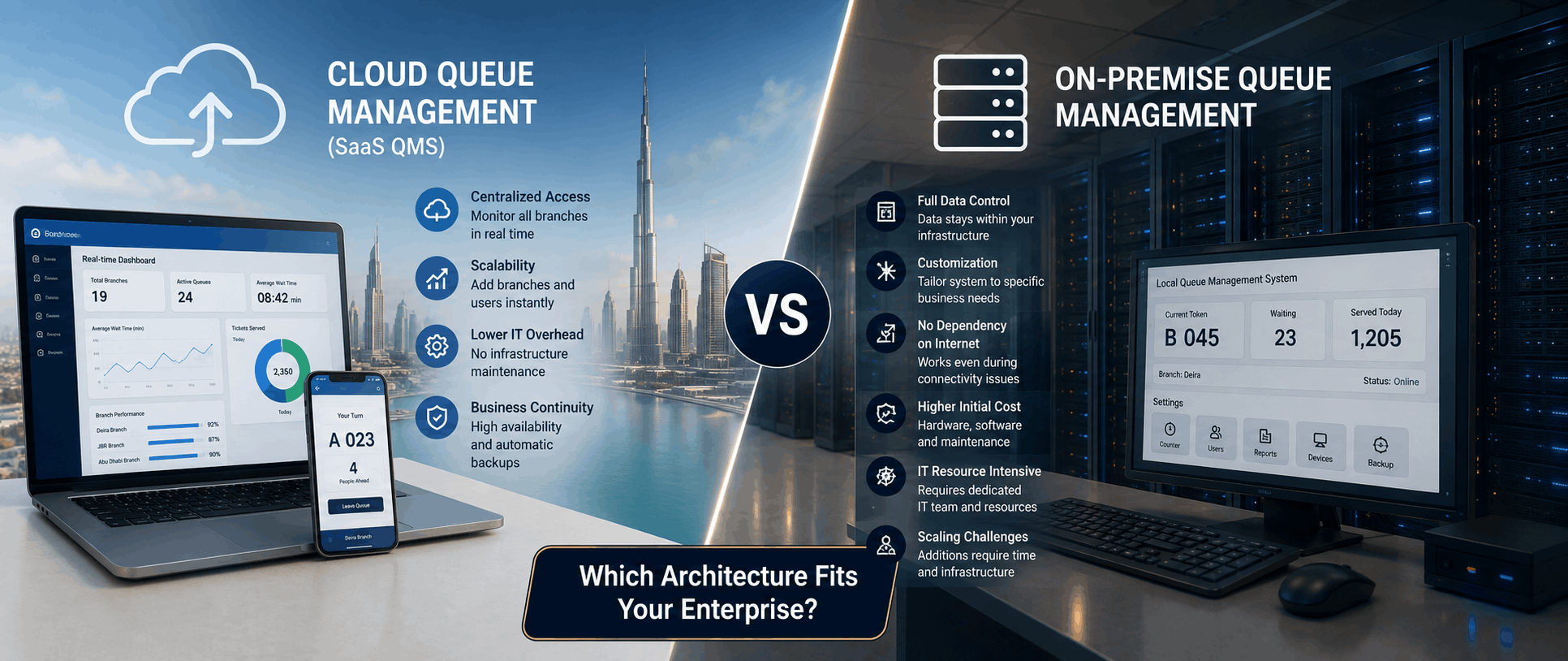
What a Cloud Queue Management System Actually Means for Your Enterprise
A SaaS QMS or a cloud-based queue management system both are not fundamentally different from a traditional on-premises QMS. A cloud-based queuing system also offers a smart software, similar functionalities, ticked issuing, waiting line management, customer flow control, and everything else a regular on-remises queue management system can offer.
Around a decade ago, a queue management system was a floor standing or wall mount ticket dispensing kiosk, with counter displays and a digital signage. But over the time, the needs have evolved a lot, now businesses want a powerful smart AI-driven customer flow management platform. A cloud-based queue management system not only meet all those needs, but it also offers additional features, such as superior functionalities for mobile users, live tracking, remote sign-ups, rich business intelligence data dashboards and much more. Furthermore, the cloud queue management system offers speedy deployment, centralized visibility across multi-branch setups, and very low downtime or failure rate.
That doesn’t mean the on-premises queue management systems are dead – in fact the present day on-premises queue management systems also offer fairly advanced features and still hold up to their worth.
See Also: The Concept of Queue Management and Crowd Control
Where On-Premise Queuing Software Still Earns Its Keep
In simple words, the on-premises queue management systems are not a relic of past, as most SaaS companies implies.
For several enterprises with a data center already in place, or for a genuine regulatory requirement to keep the queue management system fully offline at owned servers or on-premises data centers, still make a strong case for the on-premises queue management systems. For example, the government organizations and service centers, holding sensitive citizen data, or for a healthcare facility bound by the strict clinical-data policies, having an on-premises queue management system is not something uncommon, but it is a widely practiced trend. This is what lead to drastic evolution in on-premises queue management systems.
The trouble is, plenty of enterprises are stuck on on-premise not because it’s still the right fit, but because switching felt like more hassle than it was worth. That’s where the cracks tend to show.
See Also: What is Queue Management? Beginner’s Guide to Queuing Systems

Why Traditional, On-Premise Queue Systems Are Starting to Buckle
A lot of on-premises queue management systems still running in Dubai, Abu Dhabi, Sharjah and broader UAE are actually designed for single branch. If you want to add a new branch, it will not just be plugging-in a new ticket dispensing kiosk or digital signage, but a fresh license, new servers, and over a week-long on-site work. We are regularly encountering issues with off-line queue management systems, such as difficulties in synchronization, system outage due to small mistakes, such as a cable being pulled out of a PC or an engineer accidently restarted the server or media player – and so on. All these problems can be eliminated by simply deploying a cloud queue management system.
The outage not only cost additional in additional maintenance efforts, but also ruin customer experience and harm a business’s repute, which could have far more dangerous impact than a few angry customers at the service center. These are some of the critical problems businesses regularly face with a traditional on-premises queue management system architecture.
Here is how a cloud alternative actually rectify all those problems and help maximizing the efficiency, performance and integrity of the queue management system.
See Also: The Importance of Actionable Data in Queue Management System

How Cloud Queue Management System Actually Works?
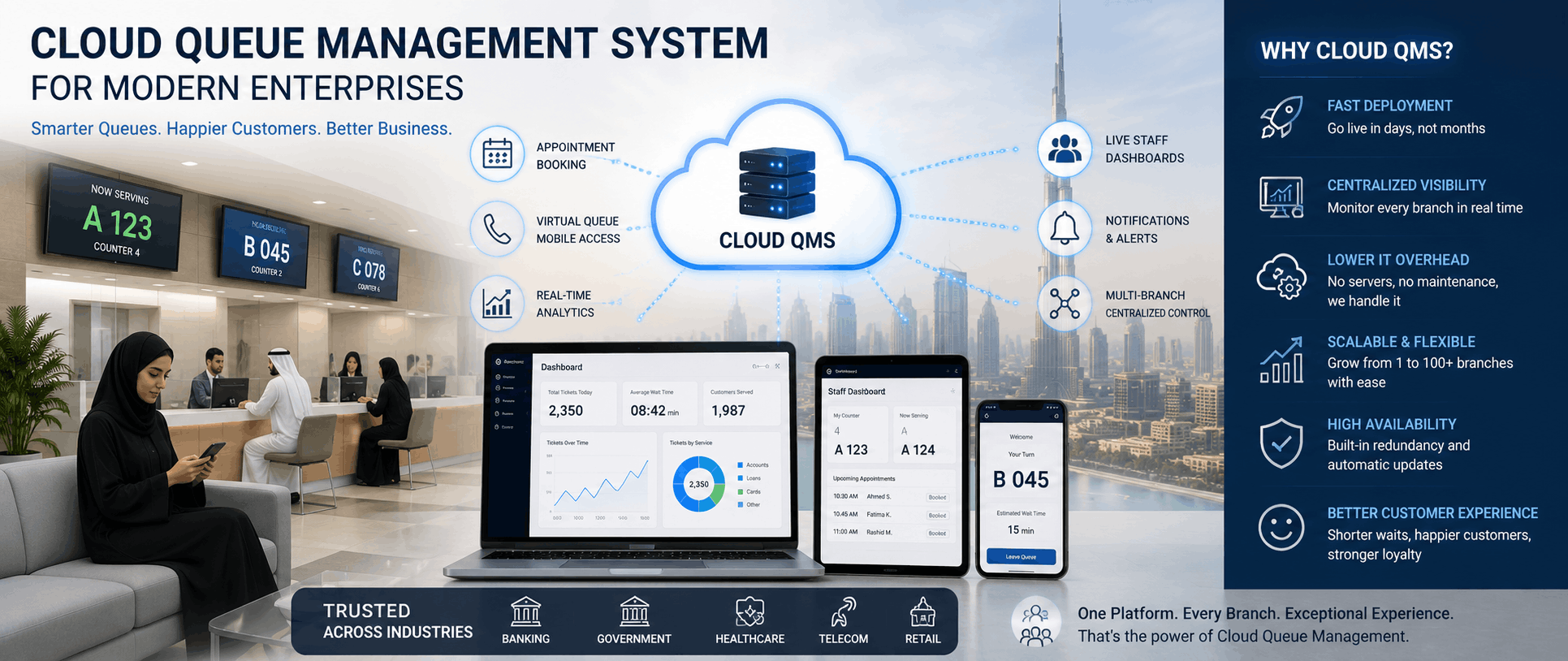
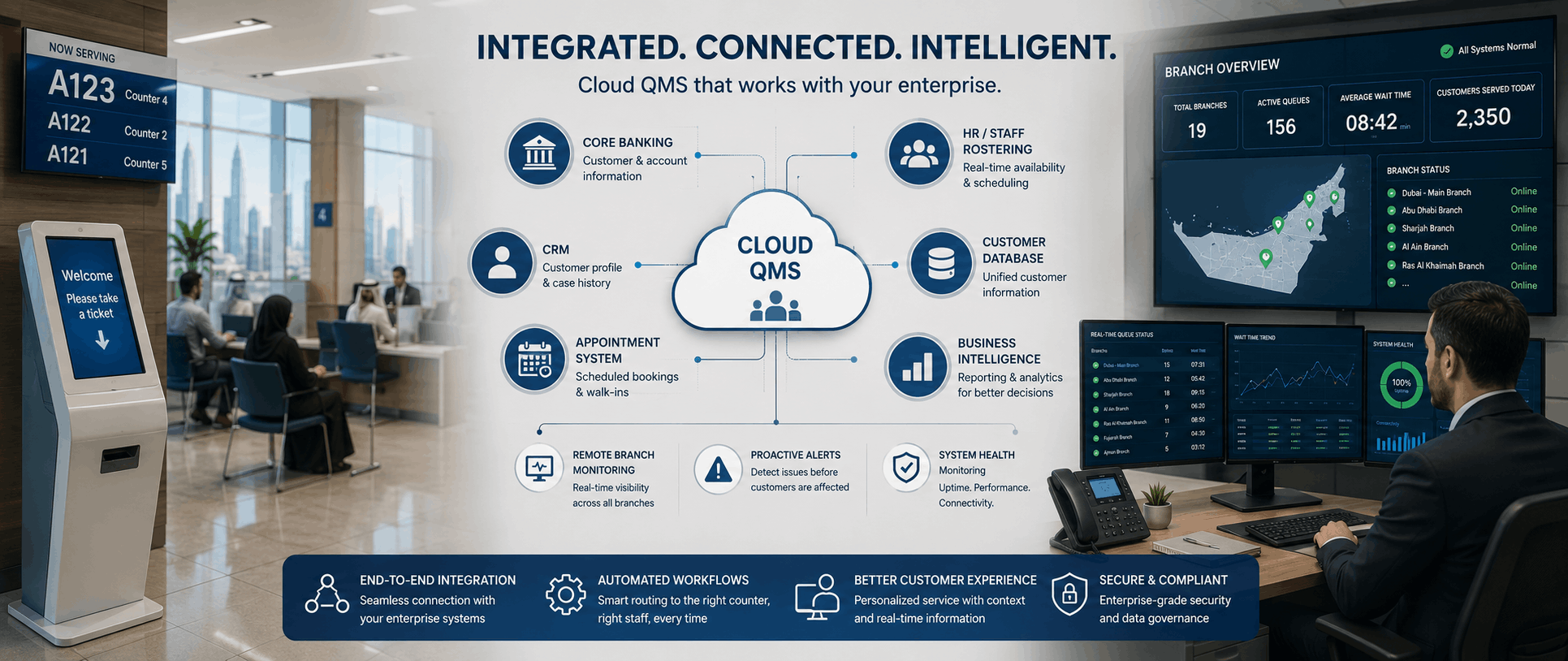
One of the biggest advantages of a cloud queue management system is that it keeps every branch and connected tools talking to a single brain in real-time.
It works in similar way, a customer arrives at a branch, signup through the ticket dispensing kiosk or scanning a QR Code at the entrance, or signup remotely using mobile app or WhatsApp. That signup is registered at a centralized server, which is either hosted by the vendor (SaaS QMS) or at a cloud environment. The request is processed, acknowledged, and then the outcome is transmitted back to all connected devices such as wait time updates, staff alerts, and queuing position, etc. All this happens instantly, and the live feedbacks and data endpoints are being read constantly by the server. This enables real-time customer flow control and queuing to ensure less possible wait time for each customer.
That central point of coordination is exactly what makes multi-branch operations manageable, efficiency and effective. Here is how a it impacts a multi-branch enterprise.
See Also: Innovations in Queue Management: The Future of Customer Service

Multi-Branch Queue Management: The Case for a Centralized QMS Dashboard
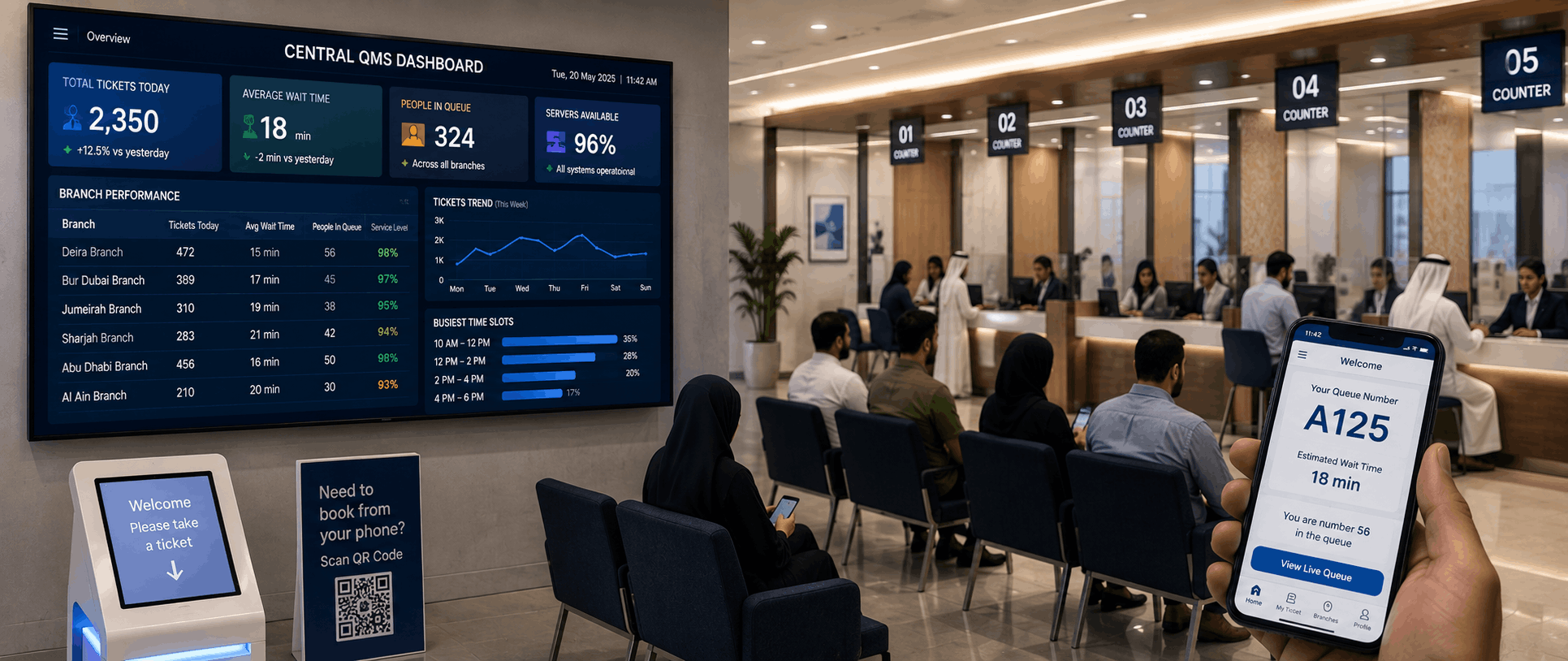
As we have discussed that in case of a single branch, the on-premises vs cloud queue management systems don’t differ a lot, however, the maintenance needs of a cloud solution are still far less than an on-premises or offline queuing system. But when it comes to multi-branch queuing, the cloud queue management system actually makes a huge difference.
One of the biggest advantages of cloud queue management system is its ability to provide a full-scale overview to the operation director or senior leadership. In a multi-branch setup, the cloud queue management system offers a rich business intelligence data dashboard effectively providing insight into real-time wait time metrices, staff utilizations at different branches, footfall and various other analytical data and stats. This enable operation director and decision makers to instantly get actionable data across entire organization, from Ras Al Khaimah to Fujairah, and from Sharjah to Abu Dhabi, while sitting at a head office in Dubai.
See Also: Queue Management Solutions for Healthcare: Improving Patient Flow
The Business Case: ROI, Efficiency, and What You’re Really Paying For
Both the on-premises and cloud queue management systems are fundamentally different from each other. The cloud QMS is often offered as a subscription plan and standard licensing for the branches, kiosks, modules, users, etc. Whereas, the on-premises queue management system is largely deployed on on-premises server or data centers, which means that the entire source ode is provided to the client. However, there are still licensing fees and certain quota limitation in place.
The cloud queue management system can be easily deployed, usually within a day or two or at the same day as well. The on-premises queuing requires servers, sometimes additional cabling, networks and other work, which takes time and require large upfront. Unlike on-premises the cloud queue management system doesn’t require large upfront, instead offer flexible monthly or annual subscription plans. Since past few years, a new trend has been witnessed across all industry verticals, which is adoption of the cloud-based software and solutions, instead of boxed software that resides in your own server or on-prem data center. Considering those key differences, it is evident that a cloud queue management system offers far much higher ROI rates. Businesses don’t want to stuck into 5-year hardware upgrade or replacement cycle which is essential on local or on-premises queue management systems.
See Also: How to Reduce Customer Churn Rate with an Efficient Queue Management System

Cloud vs. On-Premise Queuing Software: A Straight Comparison
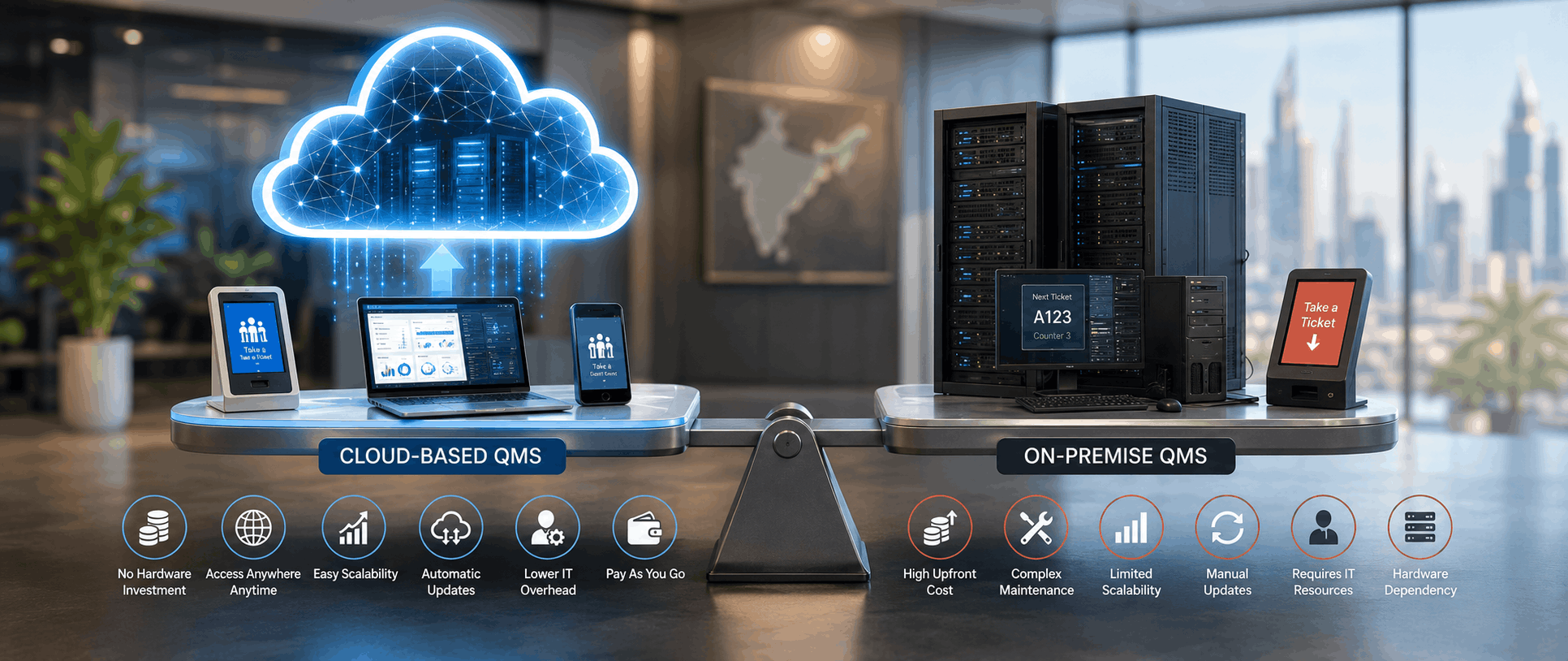
If it is only the upfront cost, the cloud queue management systems win with a great margin, there is no server room to be built, no complex networking and cabling is required, and no trap of five-year hardware refresh cycle. When it comes to scalability, adding a new branch is just acquiring a new license, not a full-scale hardware infrastructure building as required in offline or on-premises queue management systems.
Furthermore, the cloud queue management systems inherent fast-track development, upgrades and offer latest features which are usually not common in on-premises QMS. If we compare the features, the cloud queue management system offers much wider range of features than an offline or on-premises QMS. Similarly, if we compare the IT overhead, the cloud QMS clearly wins, as the infrastructure management, security updates, patches, uptime and maintenance reside with the vendor or service provider rather than your own IT team.
See Also: Why Queue Management Systems Are Essential For Modern Businesses?
Data Sovereignty, Security, Compliance and Governance: Need to Get Right
For any business the data sovereignty, security, compliance and governance are crucial business discissions. The brand reputation can be ruined if any data breach or leak happens. These factors determine the infrastructure needs of your cloud queue management system.
Certain sectors, mostly regulated sectors not just need a cloud, but if they are opting for a cloud, the cloud must be physically hosted inside the UAE and governed under the UAE Laws. There are several cloud options which are physically hosted within UAE and are specifically designed to support local businesses and enterprises. Even if you are not among the regulated sectors, while choosing a cloud queue management system make sure your cloud physically resides in UAE because that will provide you much higher protection than anywhere else in the world.
Residency is one layer of this conversation, not the whole thing. Because knowing in which country your data resides, doesn’t precisely tell you who can access it and that is something most business leaders and decision makers overlook. Some of the must have features are the encryption, whether your data is in transit or at rest, it should be protected by strong encryptions. A clear tole-based access and control mechanisms should be implemented in cloud queue management system to restrict access from higher ups to branch-staff levels. The system should have audit loggings to minimize the risks and later mitigations.
Mostly in cloud setup the cloud service provider and the vendor of queue management system have shared-responsibility arrangement which also shares the liability. However, in case of offline or local on-premises QMS, your IT team is fully responsible and liable if anything goes wrong.
See Also: Leveraging AI and Machine Learning in Queue Management Systems

Implementing and Integrating a Cloud Queue Management System with Your Existing IT Infrastructure
Whenever a business or enterprise acquire a new digital solution, they face these challenges. If a queue management system can’t talk to your existing business tools and IT infrastructure it is nothing but just an expensive ticket dispenser.
Whether it is a cloud queue management system, offline or on-premises solution, it must have ability to provide PAIs which can be connected with other enterprise solutions and business intelligence tools such as ERP, CRM, banking platforms, HR tools, and various database repositories. Furthermore, a centralized data dashboard and backend control center is also a must to have feature, even if you are single branch business, the online dashboard will help business leaders and owners to stay up-to-date all the time whether at office or not. In case of multi-branch businesses, this is not just a nice to have but an essential feature.
Furthermore, whether cloud or on-premises queue management system it is important to establish a clear understanding on lifecycle of the solution. The vendor-lock-ins are very common with such solutions. So, it is better to have a customized queue management system and have everything handover to your IT team as well, so you don’t have to rely on a single vendor for maintenance. Mostly the hardware involved have long lifecycle and businesses can keep using same ticket dispenser kiosk for many years without requiring to completely replace it. But that is something worth discussing with the vendor for each solution before you decide.
One more important thing to consider is the training and familiarity of your IT team, branch managers, and other relevant staff. So, they can start using the system without any problem. If you IT and staff is not properly trained, you will never be going to get the full benefits of the solution. A centralized dashboard and control center enable your IT to monitor all connected branches, devices, active queues, and other vital system health stats and let them take action before a problem arise or get worsened. The APIs will let you pull this data to another primary monitoring tool your IT might be using, so that is a good feature to have.
See Also: Redefining Queue Management: How to Enhance the Customer Experience
Frequently Asked Questions About Cloud Queue Management Systems
- What is a cloud queue management system, and how is it different from on-premise queuing software?
A cloud queue management system runs on a vendor’s remote servers and is accessed through a browser or app, with no on-site hardware to maintain. On-premise queuing software runs on servers you own and manage yourself, typically installed within your own data center or branch network. - Is a cloud QMS compliant with UAE data protection and sovereignty regulations?
It can be, but it depends entirely on the vendor’s hosting setup. Look for providers offering UAE-based data residency — through regional cloud regions such as AWS Middle East (UAE) or sovereign platforms like Core42 — rather than assuming compliance by default. - How much does a cloud queue management system cost for a mid-size enterprise in the UAE?
Pricing usually runs on a per-branch or per-user subscription model rather than a large upfront fee, so total cost scales with your branch count and feature set. Expect quotes to vary significantly based on integration needs, so request a detailed breakdown rather than a headline number. - Can we run a hybrid setup, keeping some data on-premise and some in the cloud?
Yes, and many regulated enterprises do exactly this — keeping sensitive customer records on-premise while running queue orchestration and analytics in the cloud. It adds architectural complexity but can satisfy both compliance and scalability needs at once. - How long does it take to roll out a cloud queue management system across multiple branches?
A single branch can often go live within weeks. A genuine multi-branch rollout, including staff training and integration with existing systems, more realistically takes two to four months depending on how many branches and how legacy your current infrastructure is. - What happens to queue operations if the internet connection at a branch goes down?
Most reputable cloud QMS platforms include offline fallback modes that keep local ticketing running and sync data once connectivity returns, but the sophistication of that fallback varies significantly by vendor — it’s worth testing explicitly before signing, not assuming it works. - Is on-premise queuing software becoming obsolete?
Not obsolete, but increasingly a niche fit rather than a default choice. It still makes sense for single-site operations with strict regulatory or offline requirements, but multi-branch enterprises are moving toward cloud and hybrid models at a steady pace.