BLOG OF RSI CONCEPTS

world map

How Self-Payment Kiosks Are Transforming Customer Experience and Business Efficiency

Businesses today operate in a highly competitive environment where customer expectations continue to rise. Customers expect convenience, speed, flexibility, and accessibility whenever they interact with a business. Whether it is paying utility bills, processing service fees, purchasing tickets, or making retail transactions, customers prefer solutions that allow them to complete their tasks quickly and without unnecessary delays.

Traditional payment counters and manual payment processing methods often create bottlenecks. Long waiting lines, increased workload on employees, and operational inefficiencies can negatively impact the overall customer experience. In many cases, businesses struggle to balance customer satisfaction with operational costs.

This is where self-payment kiosks are changing the landscape.

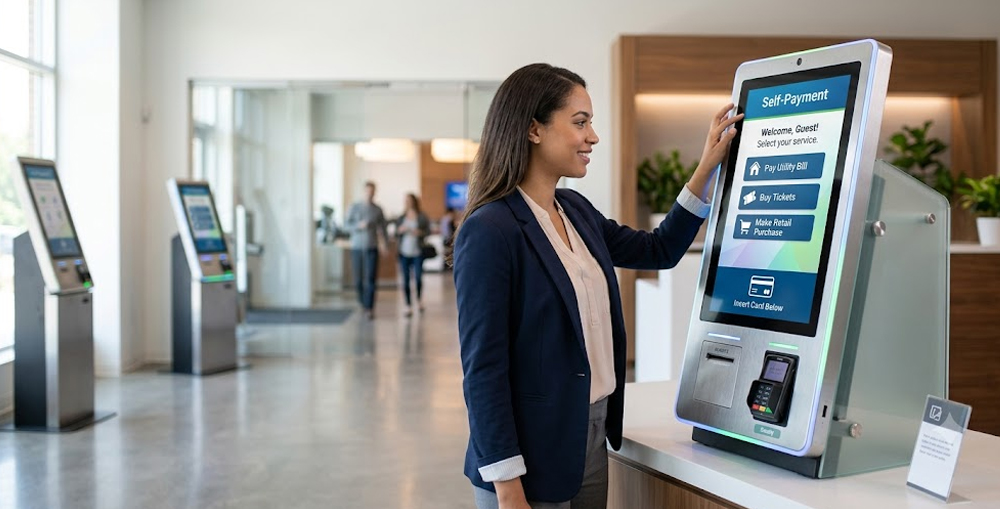
Modern self-payment kiosks provide businesses with a powerful self-service solution that allows customers to complete transactions independently. Equipped with advanced hardware, multiple payment methods, secure transaction processing, and intuitive user interfaces, these kiosks are helping organizations improve customer service while enhancing operational efficiency.
How Self-Payment Kiosks Are Transforming Customer Experience and Business Efficiency

Understanding Self-Payment Kiosks

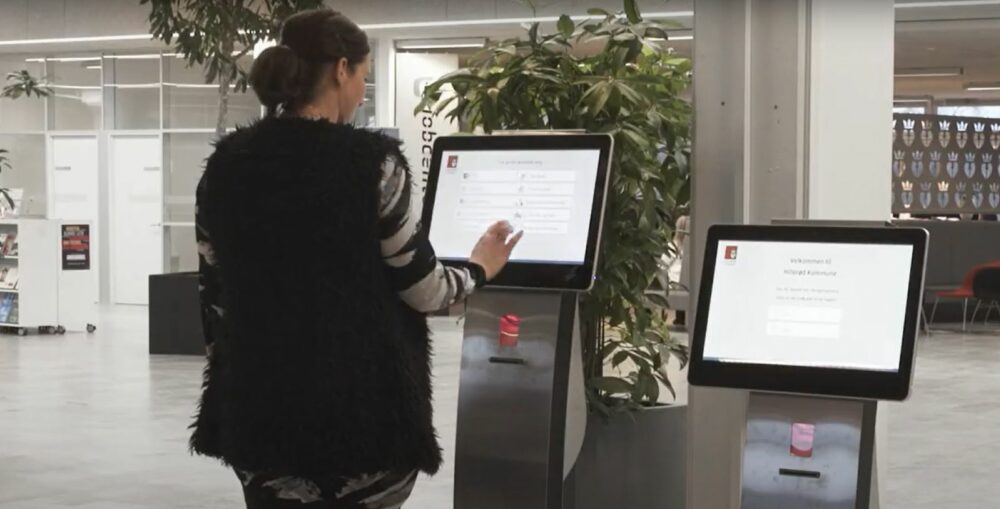
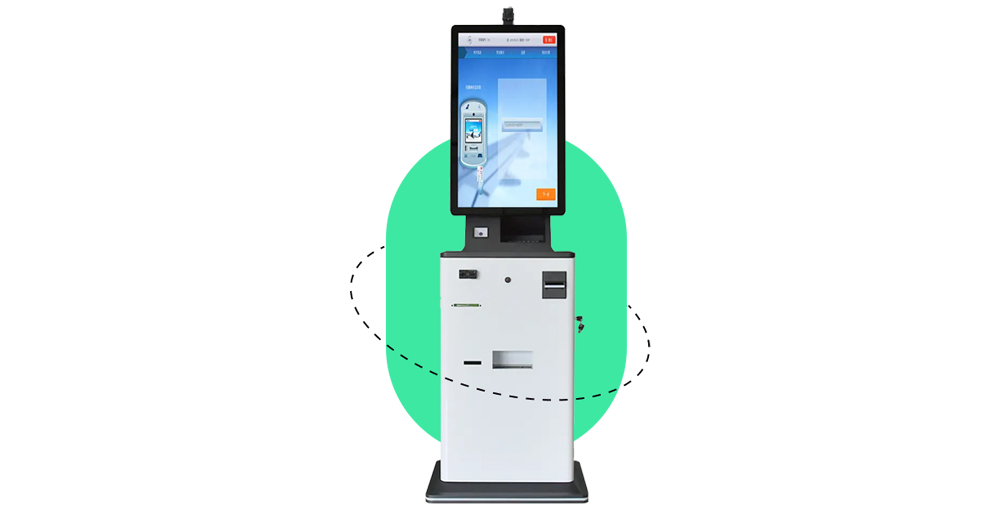
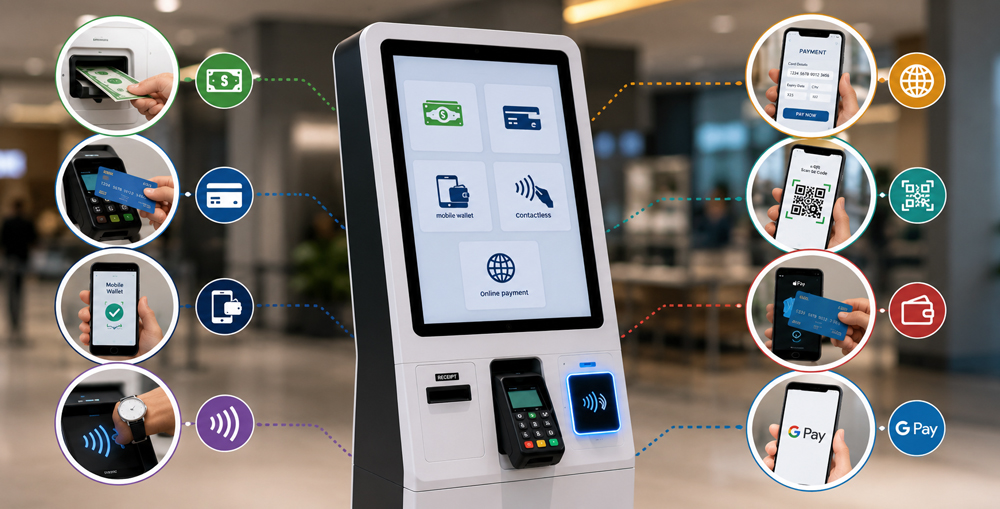
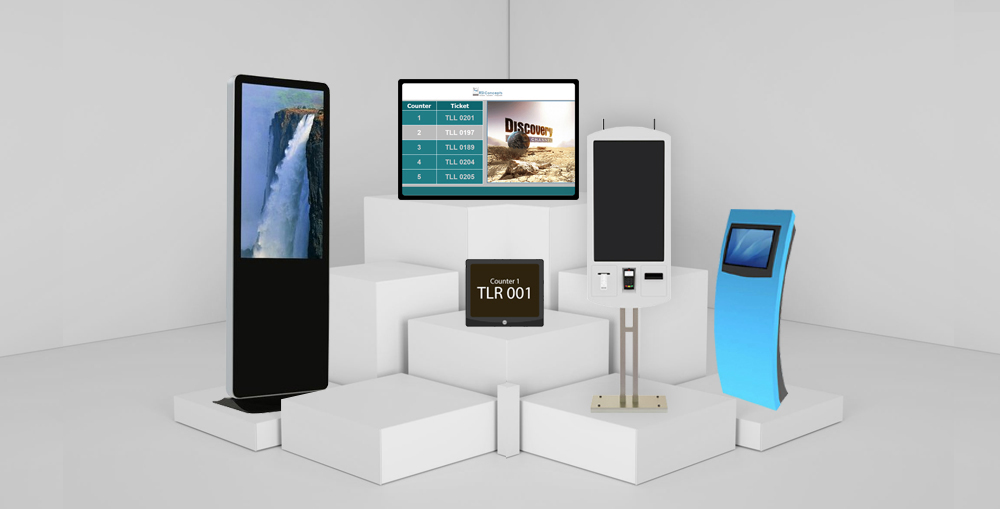
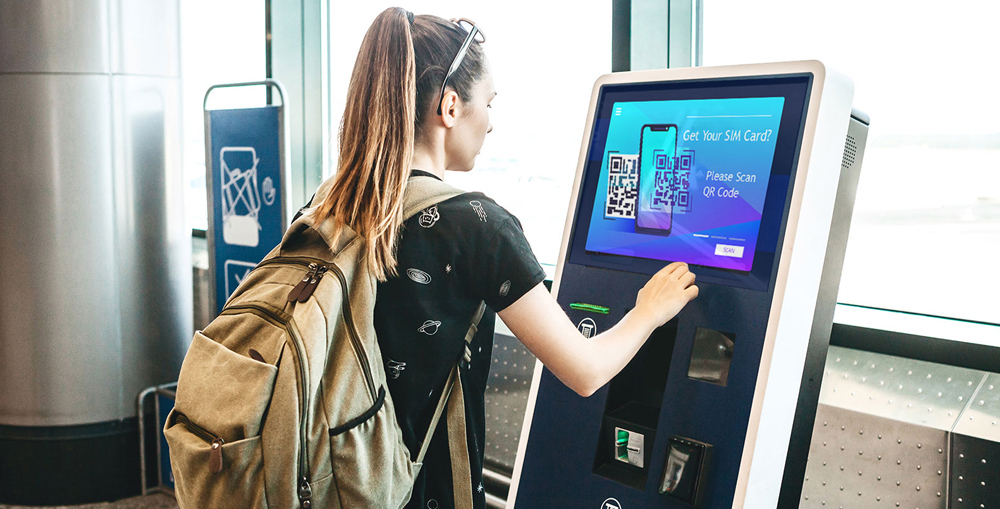
A self-payment kiosk is an interactive self-service terminal that allows customers to make payments without requiring direct assistance from service staff. Modern kiosks support a wide range of payment options including cash, debit cards, credit cards, contactless payments, digital wallets, and online payment integrations.

Unlike traditional payment counters, self-payment kiosks enable customers to control the transaction process themselves. The system guides users through each step using a simple touchscreen interface, ensuring a fast and convenient experience.

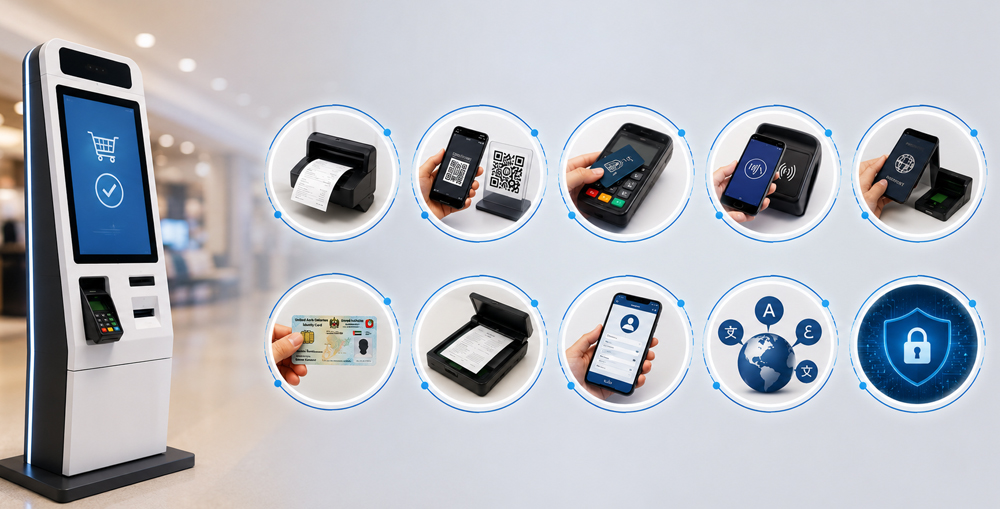
Modern self-payment kiosks can also incorporate additional features such as:

  • Receipt printing
  • QR code scanning
  • Emirates ID verification
  • Passport scanning
  • RFID integration
  • Document scanning
  • Customer registration
  • Multi-language support
  • Secure authentication mechanisms

These capabilities allow businesses to offer a comprehensive self-service experience while maintaining security and operational control.

See Also: The Impact of Self-Service Kiosks on Business Efficiency
Understanding Self-Payment Kiosks

Why Customer Expectations Are Driving Self-Service Adoption

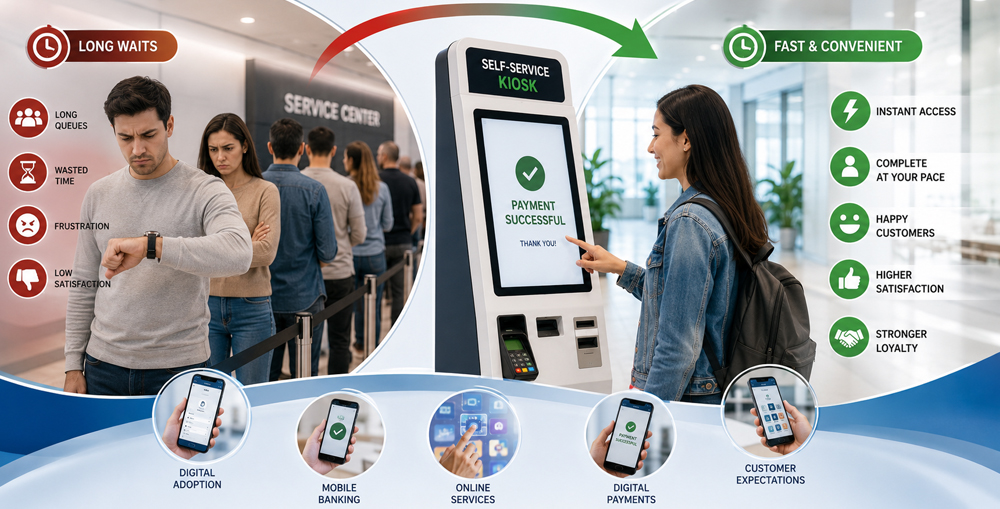
Customer behavior has changed significantly over the past decade. The widespread use of smartphones, online banking, mobile applications, and digital services has increased customer familiarity with technology.

Today’s customers value convenience more than ever before. They want immediate access to services and expect businesses to provide flexible service channels that fit their needs.

Long waiting times remain one of the most common causes of customer dissatisfaction. Customers often perceive waiting as wasted time, especially when performing simple transactions such as bill payments or account top-ups.

Self-payment kiosks help eliminate these frustrations by providing an alternative service channel. Customers can complete transactions at their own pace while reducing dependency on service representatives.

The result is a smoother customer journey, improved satisfaction levels, and stronger customer loyalty.

See Also: The Role of Self-Service Kiosks in Enhancing Customer Experience
Why Customer Expectations Are Driving Self-Service Adoption

Improving Operational Efficiency

While customer convenience is important, businesses are equally focused on improving operational efficiency.

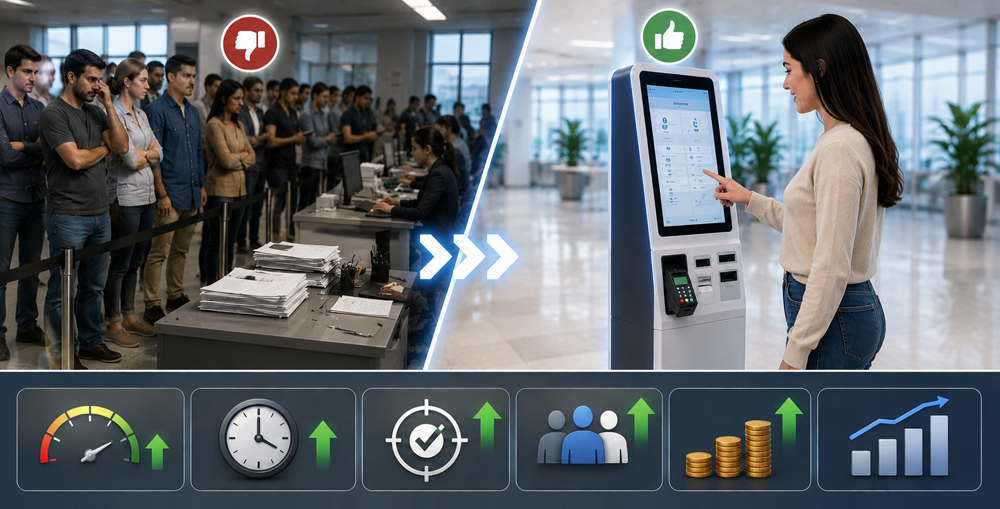
Manual payment processing often requires dedicated staff, physical counters, administrative resources, and continuous supervision. As customer volumes increase, organizations frequently need to hire additional employees to maintain service standards.

Self-payment kiosks help address these challenges by automating repetitive payment-related tasks.

Instead of assigning employees to routine transactions, businesses can redirect human resources toward higher-value activities such as customer support, problem resolution, and relationship management.

This creates several operational advantages:

Reduced Workload

Employees spend less time processing routine payments and more time assisting customers with complex requirements.

Faster Service Delivery

Transactions can be completed more quickly, reducing customer waiting times and increasing overall service capacity.

Improved Accuracy

Automation reduces human errors associated with manual payment processing and data entry.

Better Resource Utilization

Businesses can optimize staffing requirements without compromising service quality.

See Also: Integrating AI Agents into Core Business Applications for Operational Excellence
Improving Operational Efficiency

Multiple Payment Methods Enhance Convenience

One of the key strengths of modern self-payment kiosks is their ability to support multiple payment methods.

Different customers have different preferences. Some prefer cash payments, while others rely on debit cards, credit cards, mobile wallets, or contactless payment solutions.

Providing multiple payment options increases accessibility and ensures that customers can complete transactions using their preferred method.

This flexibility significantly improves customer satisfaction and helps businesses serve a broader customer base.

See Also: What is a Bill Payment Kiosk: Everything You Need to Know
Multiple Payment Methods Enhance Convenience

Advanced Security Features

Security remains one of the most important considerations for any payment solution.

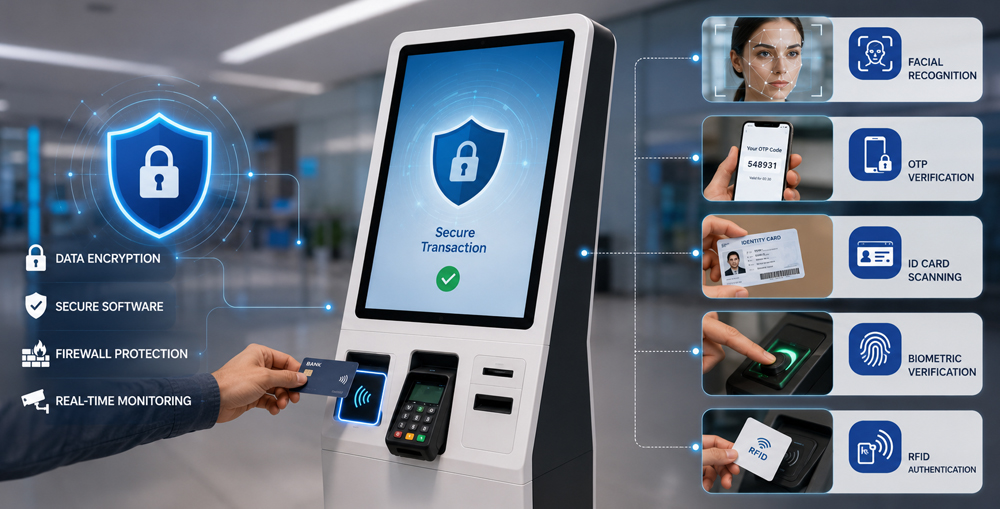
Modern self-payment kiosks are designed with both physical and digital security measures. Advanced encryption technologies help protect transaction data, while secure software environments reduce vulnerability to cyber threats.

Many kiosks also incorporate authentication technologies such as:

  • Biometric verification
  • Facial recognition
  • OTP verification
  • ID card scanning
  • RFID authentication

These security measures help organizations maintain compliance while protecting customer information.

See Also: Security Challenges and Solutions in Payment Kiosk Systems
Advanced Security Features

Delivering Higher Return on Investment

Businesses often evaluate technology investments based on long-term value and return on investment.

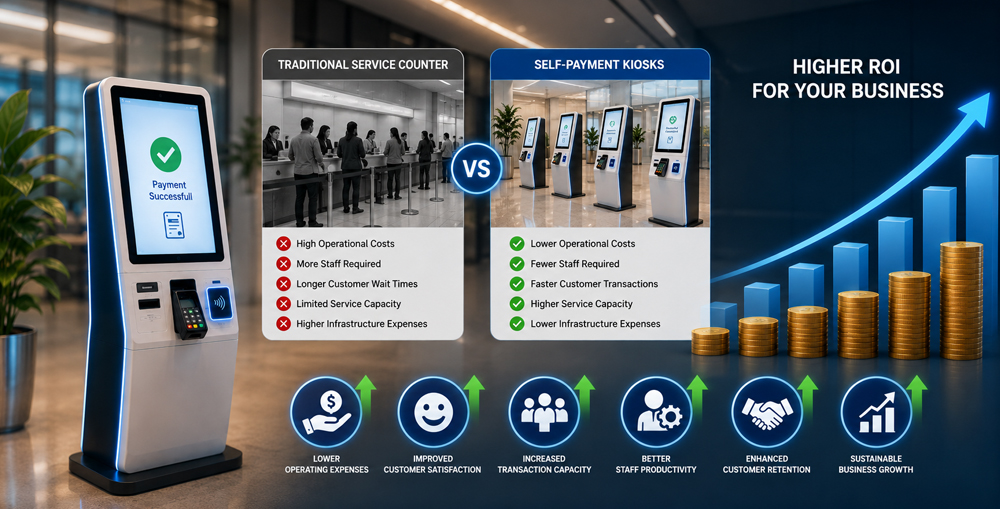
Self-payment kiosks offer significant ROI by reducing operational costs while improving service efficiency.

Compared to opening new service counters or expanding physical branches, deploying self-payment kiosks requires a substantially lower investment. Once implemented, the kiosks can operate continuously while handling large transaction volumes.

This combination of reduced operational costs and increased service capacity creates measurable business value over time.

Organizations can achieve:

  • Lower operating expenses
  • Improved customer satisfaction
  • Increased transaction capacity
  • Better staff productivity
  • Enhanced customer retention
  • Sustainable business growth

See Also: How to Achieve the High ROI using Queue Management System
Delivering Higher Return on Investment

The Future of Customer Service

The shift toward self-service technologies is no longer a temporary trend. Across industries, businesses are adopting digital solutions that empower customers while improving operational performance.

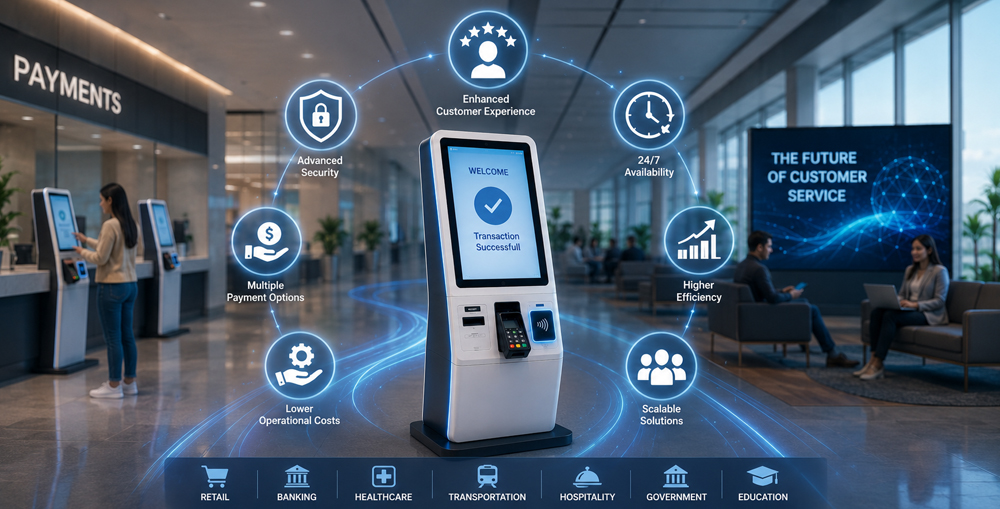
Self-payment kiosks represent a key component of this transformation. They combine convenience, efficiency, security, and scalability into a single solution that benefits both customers and organizations.

As customer expectations continue to evolve, businesses that embrace self-service technologies will be better positioned to deliver exceptional experiences while maintaining operational excellence.

See Also: Beyond First-Come, First-Serve: Innovative Strategies for Queue Management
The Future of Customer Service

Conclusion

Self-payment kiosks are redefining how businesses interact with their customers. By reducing waiting times, supporting multiple payment methods, enhancing security, and improving operational efficiency, these solutions create value for both organizations and their customers.

As digital transformation continues to shape the future of customer service, self-payment kiosks are becoming an essential tool for businesses seeking to improve customer satisfaction, reduce costs, and achieve sustainable growth.

Organizations that invest in self-service technologies today are building the foundation for a more efficient, customer-centric future.
See Also: Why You Need a Customer Flow Management Software?


Leveraging Payment Kiosks for Effective Queue Management

In today’s modern world, everyone is busy, waiting in long and slow-moving queues could be very frustrating for your customers. In such circumstances the customer flow management could also become very challenging. Businesses always seek ways to improve their internal business processes as well as customer experience. The customer experience is the most crucial factor in a business’s success. Now a days an average customer is very tech savvy comparing to around a decade back, this led to rapid adoption of digital experience and the rise of self-service solutions. The self-service interactive kiosks are a great tool to effectively manage the higher influx while delivering a great digital experience.

The payment kiosks are also a type of self-service kiosk which are majorly used to enhance customer’s transactional experience. The interactive self-service payment kiosk is a computer terminal with specialized components and features which facilitate and improve transactional interactions. These kiosks run on a software application and are proven to be very effective in queue management system. These cutting edge kiosk machines are revolutionizing the way businesses are used to of conducting transactions and managing customer flow. In this blog we will discuss how a business can leverage payment kiosks for effective queue management and optimum operational efficiency.

Leveraging Payment Kiosks for Effective Queue Management

Payment Kiosk and Queue Management

An interactive self-service payment kiosk is essentially a computer terminal with special components added to facilitate the payment process. Usually a regular payment kiosk has cash deposit feature and it also accept credit/debit cards, however, coin acceptance, change return, digital payment, contactless payments, and payment via online gateway are also widely used in UAE. The payment kiosk offers a personalized and completely independent user experience. The self-service experience not only offer convenience to customers but also expedite the internal processes resulting in quicker service delivery time which enhances customer experience.

See Also: What is a Bill Payment Kiosk: Everything You Need to Know

The queue management is a very sensitive subject for customer facing environments. Having customer wait for longer period of time could seriously harm their experience. There are two ways to integrate a self-service payment kiosk with a queue management system. Either you offer your customer a full service through the payment kiosk or you can offer them to sign-up for the queue and make a payment before arriving to service counter. In both cases the service time and quality is improved. Furthermore the payment kiosks are also a great tool to transform the customer service center. Due to flexibility and ability to customize the payment kiosk are equally effective in a wider spectrum of the industries.

Payment Kiosk and Queue Management

Payment Kiosk Help Reducing the Customer Wait Time

Different industries have different needs, the interactive self-service payment kiosks can cater to a wider range of needs with their cutting-edge technological frameworks and customized features. Whether you deploy a payment kiosk in existing service centers or at remote locations, the payment kiosks tend to reduce the customer wait time. The customers are free to perform the tasks independently, the staff assistance is not required. Furthermore the customers can choose the language of their choice which where add value to customer experience also help expediting the service delivery. Businesses can redistribute the staff further improving the overall operational efficiency and minimizing the wait time.

See Also: Introduction to Digital Signage Kiosk and Smart Kiosk

The payment kiosk can also offer integrated queue management features such as allowing customers to sign-up for the virtual queues through the kiosk while taking payment to minimize the service delivery tasks. The digitalization and software integration also help improving internal business processes effectively reducing the customer wait time. The service agent dashboard are also integrated with the payment kiosk and queue management system which help service agents swiftly retrieve the customer data and information resulting in quicker service delivery and a happy customer experience.

Payment Kiosk Help Reducing the Customer Wait Time

Payment Kiosk Elevate Customer Experience

The payment is a crucial part of the service for that businesses either have separate counters or they collect payment separately via banks, this could be very time taking and could have various complications, however, with the payment kiosks the customers can make payment seamlessly, furthermore some businesses can also transform their services into self-service which can also be done through the same payment kiosk making the process quicker and less complicated. The intuitive multi-lingual UI (user interface) with on-screen instructions and guidance can greatly enhance customer experience.

See Also: What is Queue Management? Beginner’s Guide to Queuing Systems

The customers can not only make payments through payment kiosk but they can also perform several tasks such as updating their information, profile, or managing their subscriptions. Customers can conveniently pay bills, print slips and tickets or even they can scan and upload documents if needed. Furthermore the payment kiosk offer full freedom and control, empowering the customers. The customer service centers, offices and help centers operate within working hours, however, the payment kiosk can operate 24/7 giving more freedom to the customers.

Payment Kiosk Elevate Customer Experience

Payment Kiosk Collect Valuable Business Intelligence Data

For any modern day business the business intelligence data is crucial. It help businesses understand customer behavior and gives them a deeper understanding of the customer mind. The data is crucial for strategic decisions and also help businesses improve their long-term policies and goals. The payment kiosk comes with a management software application. This application is hosted on a server and it is often called payment kiosk machine server or payment kiosk machine management software. This software comes with advanced algorithms and smart technology which is capable of collecting statistical and analytical data from each and every touch point giving an unparalleled insight to customer interaction.

See Also: The Concept of Queue Management and Crowd Control

Businesses can utilize the in-built analytical tools and customized reporting to further refine the data and make it usable for decision making. The business intelligence data help businesses understand customer’s demands, expectations, pain points, market trends and it also help them gauge the efficiency of various processes. This insight coupled with direct customer feedback data could be a game changer for businesses. Businesses can greatly elevate customer experience and make their processes more efficient by making informed decisions.

Payment Kiosk Collect Valuable Business Intelligence Data

Payment Kiosk Offers Advanced Security

The payment kiosks are designed to adhere the highest standards of the safety and security, both digital and physical. If a self-service payment kiosk is deployed in an existing service center or any other indoor environment then the physical security is optimum, however, if these kiosks are deployed in remote locations or outdoors then the maximum physical security is required. As per the local regulations and industry standards a payment kiosk whether deployed indoor or outdoor must have certain security features such as anti-theft, anti-vandalism and protective frame/body. As for as the digital security is concerned these kiosks comes with advanced data encryption technology to prevent any data breach.

See Also: What is CXM (Customer Experience Management)?

The self-service payment kiosks are built on advanced technologies, equipping it with data encryption, secure connection, and various protective measures against malicious actor or internet exploitation. The customer data is always authenticated and verified before letting them access the system. Furthermore Emirates ID scanner, Facial Recognition and CCTV Security systems are added to ensure highest levels of security and protection. This not only make the system secure but also help gaining customer trust. Any breach in security could lead to catastrophic impact on brand’s reputation that is why advanced security and protective measures are absolutely essential.

Payment Kiosk Offers Advanced Security

Payment Kiosk Offer Higher ROI

The self-service payment kiosks are easy to deploy and can easily integrate with the existing IT infrastructure. The initial cost could be high, but an ordinary payment kiosk can last for many years without requiring major maintenance or replacement of the parts, which make them very cost-effective. These kiosk machines are very reliable, they can work 24/7 without requiring much maintenance, only regular service and preventive maintenance is enough to ensure long term operation. Furthermore the self-service payment kiosks comes with highly advanced software, which can be upgraded and updated easily with very little cost, making them workable for another few years.

See Also: Improve Customer Journey with Queue Management System Business Intelligence

The less operational cost and ability to last long for many years make them highly cost-effective. A payment kiosk can help businesses reduce the amount of workforce required to operate their service center hence enabling them to redistribute the employees for better human resource management which also saves a lot of cost. Opening up new branches or regional offices is a very expensive process however, installing a self-service payment kiosk instead would cost you a fraction of that. All these traits makes them very cost-effective and enable payment kiosks to offer higher ROI in long-term.

Payment Kiosk Offer Higher ROI

Payment Kiosks are Easy to Integrate and Scale

Whenever a business is aiming to deploy a new IT solution the first thing that they should consider is its ability to integrate it with existing IT infrastructure and third-party system. Furthermore the scalability and upgradable structure ensures longevity and effectiveness of the system. The payment kiosks are built on commonly available technologies and software frameworks. This makes them ideal for integration and scalability. A payment kiosk usually have to be able to integrate with customer database, internal payment or accounts system, and central information center of the organization. This integration is usually done through secure APIs, which is the ideal way to let two software solutions interact with each other. Thi ability also help businesses incorporate innovative and creative features to enhance user experience.

As businesses grow their needs grow, as the market trend changes businesses require more features and this gives businesses a competitive advantage too. An interactive self-service payment kiosk offers easy upgrade even if you want to add more hardware features that can also be done. The UI of the kiosk can be customized easily, more features can be added with software customization and integration with other business tools and third-party software enable businesses to create more features within the system. This enable the payment kiosk to evolve alongside with emerging business needs and this ability keeps them relevant for many years adding value to their operational life which is a key to higher ROIs.

Payment Kiosks are Easy to Integrate and Scale

Conclusion

In today’s modern world where the customer satisfaction is a key to success and the importance of customer experience is paramount. Businesses find themselves often in very challenging situation managing their customer service centers. One of the biggest challenge is to streamline the customer flow while keeping the wait time at minimum. Because the customer wait time is one of the most crucial factor that can completely ruin customer experience. The queue management systems are often used to streamline customer flow, however, where businesses also require payment collection they traditional queue management system lags behind, the service delivery time is usually higher at the cash counters. Furthermore there are several unexpected scenarios which could hinder the customer flow and require immediate response from the management.

An interactive self-service payment kiosk is the ideal solution to deal with such situations, as it offers fully integrated queue management system which not only streamline customer flow but also offer them a self-service channel to improve their transactional experience. By offering independent self-service experience the payment kiosks not only empower customer but also help reducing the customer wait time. When the payment kiosks are deployed the workload of the staff is reduced too, enabling businesses to reallocate staff for better human resource management. The advanced data collection tools help businesses collecting valuable insights and business intelligence data which is vital for informed decisions.

The payment kiosks are also very flexible and can evolve alongside the emerging business needs which keeps them relevant for many years. Longer operational life, low maintenance requirements, and flexible scalability results in higher ROI. In this blog we have discussed how businesses can leverage the interactive self-service payment kiosk to elevate their queue management system. If you want to learn more or if you want us to develop a bespoke payment kiosk solution for your organization, please feel free to contact us through our Contact Us page or leave a comment in the comment box below and we will get in touch with you soon.