BLOG OF RSI CONCEPTS

world map

Leveraging AI and Machine Learning in Queue Management Systems

The long waiting lines are always a significant bottleneck in operational performance and it greatly frustrate your customers too. Businesses in Dubai, Abu Dhabi, Sharjah and all around the UAE are eager to acquire an intelligent queue management system to streamline their customer flow and to boost their operational efficiency. Unlike any other marketplace, UAE is among the most competitive market landscape in the world. Hence the demand is continuously growing which lead businesses to think of combining the revolutionary AI (artificial intelligence) and Machine Learning technologies with traditional software-based queue management systems. This lead to the rise of AI-powered queue management solutions with in-built AI features and machine learning algorithms.

With the rapidly evolving market landscape both the customer demands and the business needs are rising, rendering ordinary queue management systems inefficient and outdated. Businesses these days heavily rely on data-driven decisions. This means businesses need to build more data collection tools and should be able to utilize this data to achieve their higher goals and objectives. An AI-powered queue management system just does that, it has far superior capabilities to collect analytical data and actionable insights and it can help businesses in taking more informed decisions. In this blog we will discuss how infusing the AI and Machine Learning in queue management system can offer superior performance, automation, control and overall higher ROIs.

See Also: Innovations in Queue Management: The Future of Customer Service
Leveraging AI and Machine Learning in Queue Management Systems

What is a Queue Management System?

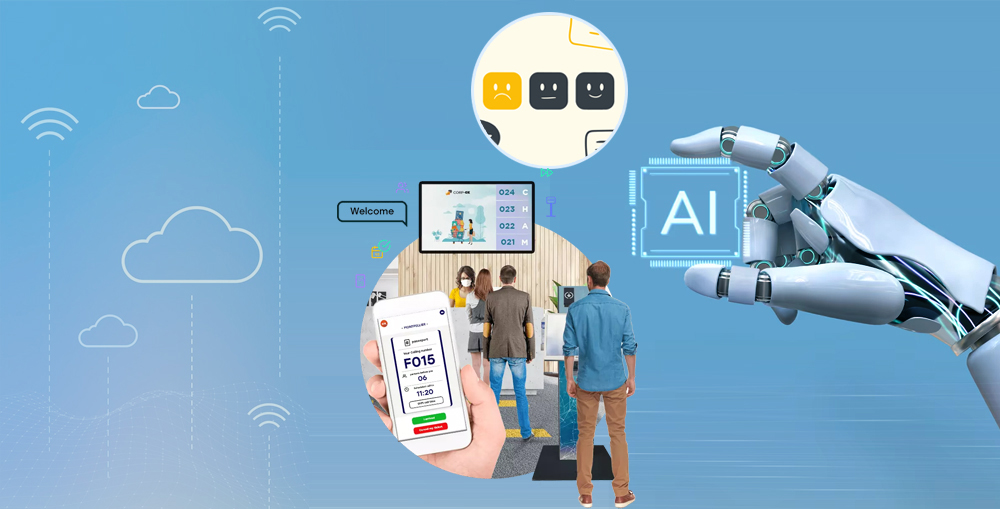
Technically a queue management system is a set of tools (both software and hardware) which help businesses manage waiting lines or queues of customers/visitors, tasks, call requests or even data requests. But in our context we will take queue management system as a solution which help businesses managing the waiting lines of their customers and visitors at their premises. The primary goal of implementing a queue management system is to make waiting efficient, enhance customer experience, make queuing fairer and improve operational efficiency. Traditionally a queue management system issues tickets, display estimated wait time and other queuing information and call customers to the counters. Additional the queuing process become automated and it also offer real-time monitoring.

Traditionally the queue management systems streamline customer flow by following first-come-first-served bases and they might follow a few other fixed logics to implement priority queuing. This might not sound much advance, but this simple automation can convert a chaos into an orderly streamlined customer flow. Since the customer flow is automated, it eliminates several manual queuing problems such as line-jumping, favoritism, and communication gaps. However a traditional queue management system has many limitations. These queuing solution struggle with unexpected surge in footfall, uneven staff, multi-step services, or unexpected bottlenecks. These solution rely on historical data and lack adoptability. This is where the AI and Machine Learning steps in.

See Also: The Concept of Queue Management and Crowd Control

What is a Queue Management System?

What is AI and Machine Learning?

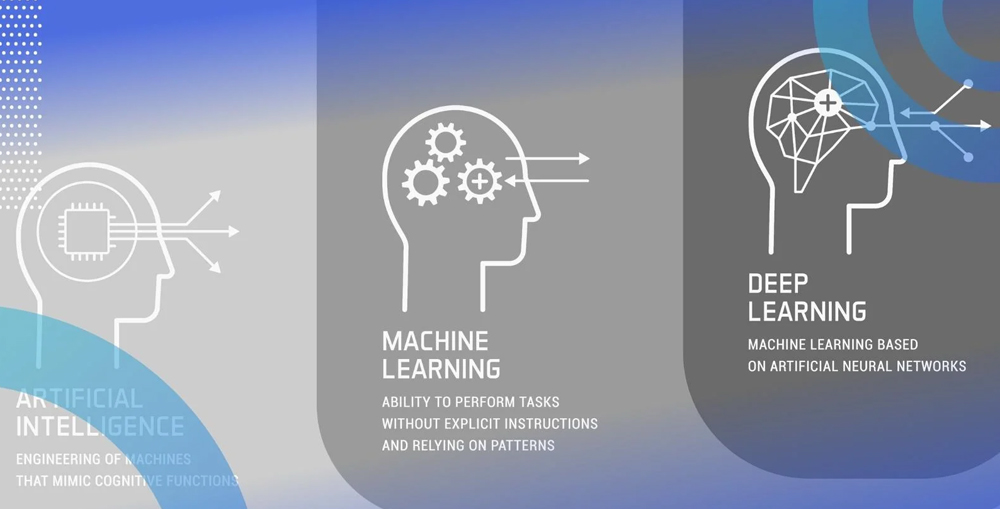
The AI or Artificial Intelligence and Machine Learning have gained huge popularity in last few years. Before we dive into our subject, it is important to learn and understand what we mean by AI and Machine Learning. The AI in simple world is a software program that can performance tasks that normally require human intelligence. Processes that involve reasoning, planning, learning, contextual understanding and perception, understanding language, identifying patterns and interactions with other software, solutions or systems. Without AI all these processes can only be managed by the human staff, but the AI has superior intelligence, far beyond fix logics and ruled-based operations. This is what makes AI special and enable AI-powered software and solutions to outperform the conventional counterparts.

The Machine Learning itself is in fact a subset or advanced component of AI. As name suggest, the software solutions or AI equipped with Machine Learning algorithms can learn from the data, interactions and experience, rather relying on fixed logics and rules-based process execution for fixed scenarios. The AI solutions equipped with Machine Learning algorithms can learn from the data, adopt to changes or new data, identify patterns in large data sets to make predictions or take decisions from what these systems have learned without reprograming them or requiring any human supervision. This means the AI is a broader concept that involves building intelligent software or computer machines, and Machine Learning is simply a way to build this intelligence by learning from the available data.

See Also: The Role of AI in Enhancing Queue Management Systems
What is AI and Machine Learning?

Why Do We Need AI and Machine Learning in Queue Management Systems?

Why should business leaders and decision-makers care about infusing these two technologies? The simple answer is to harness the remarkable advances of modern artificial intelligence technology and to elevate queue-management systems beyond the limitations of traditional software. This help driving greater operational efficiency and superior customer experience in service industry. Here are some key aspects of a queue management system which can be enhanced by integrating AI and Machine Learning:

  • Superior Customer Experience: The AI and Machine Learning help gathering in-depth insights and it can take autonomous decisions to proactively streamline the customer flow and minimize the effects of peak hours which lead to better customer experience and raise customer satisfaction.
  • Enhanced Operational Efficiency: The AI-powered queue management system can dynamically allocate staff and counters based on its predictive analysis, real-time data and current demands. This raise staff productivity and boost operational efficiency.
  • Improve Customer Loyalty: When the customers are treated right at a business they tend to come back. A queue management system simply does that, it eliminates the traditional inefficiencies from the system, empower customers, drive transparency, and increase customer loyalty.
  • Reduce Operational Cost: The AI and Machine Learning in queue management system help businesses increase the efficiency and productivity of the customer service centers. This prevent over-staffing, and enable serving more customers which significantly reduce operational cost.
  • Empower Data-Driven Decisions: The AI and Machine learning open up new avenues of data points in the queue management system. Which help gathering deeper insights and actionable reports. The data help managers and decision makers to take accurate and effective decisions.
  • Scalability and Automation: The AI and Machine Learning convert a simple ruled-based solution into a highly dynamic intelligent queuing solution. The AI can scale up easily to support growth and enable the system to handle complex tasks in a fully autonomous way.

Overall the queue-management system oversees critical stages of the customer journey and integrating modern technologies can enhance various components of the system and help improve customer experience.

See Also: How Customized AI Agents Can Streamline Business Operations

From a technical standpoint, AI and Machine Learning have driven significant advances in core software and greatly improve multiple functionalities, such as:

  • Data Collection Capabilities: The AI and Machine Learning enhance conventional data collection tools and offer additional features such as computer vision, sensory data, camera feeds, and so on. These tools help understanding the pattern in footfall and customer arrival, average service time, and even businesses can analyze the staff performance through in-built employee KPIs.
  • Forecasting and Predictive Analysis: The AI is very helpful in improving the forecasting and predictive analysis. The queue management system accurately predict how many customers will arrive today, what would be the most busy hours, considering the available staff, and service request types, how much would be average wait time, etc. to improve decision making.
  • Data-Driven Decision Making: The in-built predictive analysis algorithms machine learning help AI-powered queue management system to take autonomous decision without requiring any human assistance. This help queue management system to automatically route customers, organize queues, allocate staff and manage counters for maximum efficiency and productivity.
  • Control and Administration: The AI and Machine Learning in queue management systems drive automation but still the human intervention is critical. The queue management systems can automatically alert managers and staff to intervene whenever required. Moreover the managers can converse with data, and prepare customized reports for strategic decision making.
  • Feedback Loop and Learning: The AI is as good as the data fed to it. That is why these systems comes with in-built feedback loops, which continuously gather information and evaluate the decisions taken by the AI. The Machine Learning in queue management system strengthen the AI components to continuously improve their decisions, which keep optimizing the performance.

All these components help businesses increase transparency and efficiency of the system. Businesses can also have more control on these different modules to keep improving the system. Furthermore businesses can easily retrain the AI and align it with their emerging needs.

See Also: Why Virtual Queuing is the Next Big Thing in Queue Management
Why Do We Need AI and Machine Learning in Queue Management Systems?

Implementation Best Practices and Roadmap

The AI and Machine learning is a completely new technology, hence businesses are mostly not as that familiar with it. When it comes to implement AI there are several important things to consider. For example, there are two way to adopt to AI and Machine learning, one is to implement the AI as an additional layer with the existing queue management system software, that requires integration and in some cases it might require customization for the existing queuing solution. The other way is to acquire a queue management system which is built with integrated AI and Machine Learning algorithms. The software applications that are built considering the AI components and application in mind, have better performance and fewer problem in the implementation.

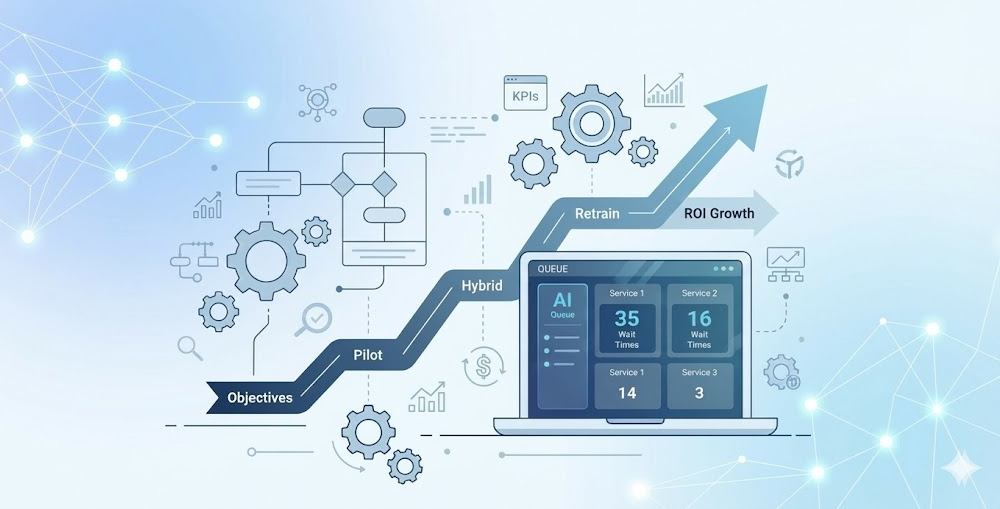
No matter what approach you take the AI can offer incredible functionality and automation. Following are a few key points that business should consider to ensure maximum outcome and ROI of an AI-powered queue management system:

  • Define Clear Objectives: For any AI application, the most important point is to have full clarity of your objectives and goals. Your objectives will dictate the roadmap to the development of your AI system.
  • Consider Existing Infrastructure & Data: Whatever features you want to incorporate in your AI-powered queue management system, you should consider all available infrastructure and available data sources.
  • Start with Pilot Implementation: It is always good to start with the pilot implementation, for example, you can start implementing in one branch, or even a few counters, and then keep tuning up the system till it reach your standards.
  • Begin with Hybrid System: By hybrid system we mean instead of giving AI full autonomy, it is better to have some rules and leave some for the AI decisions. This will help refining and training the AI algorithms.
  • Monitoring and Retraining: During the pilot project duration or even after the full-scale implementation, it is crucial to keep monitoring the AI and its outcomes and then fine tune it or retrain it with new data for better performance.
  • Measure ROI and KPIs: For any new solution or business tool it is crucial to measure its impact. Hence business leader should keep monitoring the KPIs to ensure course correction and better ROI in long term.

The AI based solutions are very dynamic, the AI itself is a very fluent and adoptive technology. An AI-powered queue management system offers much more flexibility and very high adoptability. The Machine Learning enables the system to keep improving its decisions to achieve the performance KPIs. This is what distinguishes AI-powered systems from traditional queue management systems. Moreover advanced features like Computer Vision or advanced IoT integration further increase the potency and impact of the system and results in higher customer satisfaction and lower operational cost.

See Also: A Complete Guide to a Multi-Branch Queue Management System
Implementation Best Practices and Roadmap

Conclusion

The integration of AI and Machine Learning in a queue management system is completely transforming the way businesses were managing the customer flow at their premises. The conventional queue management systems based on a powerful software application and various hardware tools which seems quite okay just a few years ago. But given the circumstances of today’s market landscape, these features are not enough. The major cause is that the conventional queue management systems is the lack of intelligence, flexibility, advanced analytical data and adoptability. This results in businesses continuously struggling and investing in queue management system every time they face a new challenge.

Because the conventional queue management systems lack the level of adoptability required for modern day’s challenges, businesses were compelled to think out of the box. The AI or Artificial Intelligence offers solution to almost all those problems. A queue management system equipped with AI and Machine Learning offer more flexibility, adoptability and incredible data collection, forecasting and analysis tools which position them as an ideal solution for modern customer service centers’ needs. In Dubai, Sharjah, Abu Dhabi and broader UAE businesses are rapidly embracing AI in almost all business functions.

The queue management systems are no exception, leveraging AI and Machine Learning offers great many benefits, businesses can improve predictive time analysis, they can manage their staff beforehand if they got a prediction of increased footfall and so on. The AI not only offers a few additional features, but it elevate the entire system with accurate insights and automation. In this blog we have discussed briefly about the role of AI and Machine Learning in queue management systems, if you want to learn more or if you want our help to design and implement a bespoke AI solution for your queuing needs, please feel free to get in touch with us through Contact Us page or write a comment in the comment below and some from our team will contact you soon.

See Also: The Role of Customized AI Agents in Modern Customer Service Strategies

See Also: Future Trends in Performance Management Systems: What to Expect in 2026


Future Trends in Performance Management Systems: What to Expect in 2026

The world has evolved a lot in past two decades, especially with the invention of modern technologies and widespread adaptation of digital solutions, our lifestyle have completely transformed. So does the work-places. The work-places have evolved a lot over past two decades, the technological advancements and automation is rapidly infusing in each and every aspect of the business operations. The performance management system is no exception. Businesses always use some kind of performance management system to optimize the efficiency of their workforce and to align them with their high-level organizational goals and objectives. The traditional evaluation methods dominated by manual reviews and feedbacks from the managers are replaced by the more in-depth appraisal methods and technology driven data processing techniques.

A modern performance management system doesn’t only rely on performance sheets and managers’ reviews. But it is a very comprehensive digital solution which is rooted deeply in the entire organization. The modern performance management system encourage continuous performance management along with more comprehensive data collection and contextual evaluations which were not possible with outdated manual performance management systems. The modern performance management systems are based on a software application and data dashboards which offer advanced data collection tools, in-depth analysis, and AI (artificial intelligence) integration. The AI have completely transformed the performance management and it is now redefining the ways organizations manage their diverse workforce and how employee perform, grow and contribute.

Why it is crucial to looking ahead in 2026? Because the workplaces are evolving, hybrid work models, flexible work hours, remote workforce, global teams, Gen-Z and integration of AI (artificial intelligence) in various business functions are the most crucial factors, redefining and reshaping the expectations of both the employees and the employers. The traditional performance management such as fixed goals, annual or biannual reviews, performance sheets and feedback forms are no longer effective or even useful. In this blog we will briefly discuss the future trends of modern performance management in 2026 and beyond through the lens of digital transformation, data-driven decision making, smart automation and integration of AI (artificial intelligence). Let us explore what to expect in 2026, how organization should prepare and how the employees should get themselves ready to embrace the future.

See Also: How Performance Management Impact on Organization’s Culture?

Future Trends in Performance Management Systems: What to Expect in 2026

Transition from Annual Reviews to Continuous Feedback Loops

The traditional performance management was consisting on annual reviews and appraisals. This means that the goals are set once a year, or in some cases twice a year. The feedback management was also slow and often times the feedback comes too late to optimize the performance or to effectively course correct. People often forget what happened a few months ago, in 12 months or in 6 months things could get changed, and the employees also demand regular guidance and appreciation of their hard work. This is not possible with any traditional annual evaluation based system. Businesses have also realized this fact and some of the enterprises have adopted to modern performance management system where the employee and manager’s interaction is more often and the feedback is also more frequent. However, most of the businesses are still relying on outdated performance management systems.

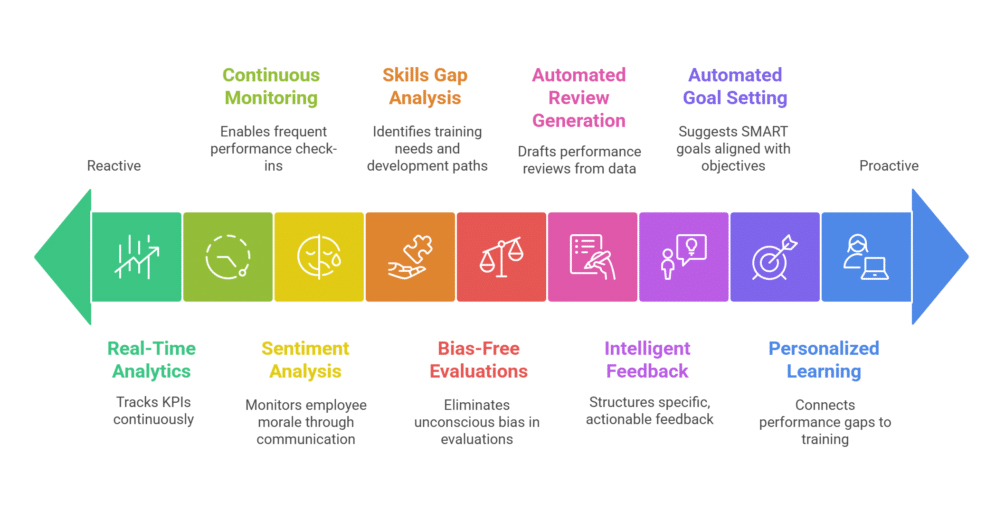
In 2026 the AI (artificial intelligence) and the automation will dominate the digital business solutions. Same is applicable for performance management systems as well and in coming years we will see the continuous performance management will become a norm. The performance management system will no longer only focused on evaluating the employees, but it will equally emphasize on employee growth and development. The enterprises and organizations are seeking ways to adopt to continuous feedback loops, more data-driven decision making tools and proactive performance management approach. For example, if an employee completed a project, the digital performance management system will highlight their progress or success toward their goal, it will highlight the areas of improvement and it will suggest training resource to boost the employee performance in future.

See Also: The Future of Performance Appraisals: 6 Innovations and Changes [Quick Guide]

The usage of modern software development techniques, integration of AI and centralized data management will help businesses build and adopt modern performance management system who will not measure the performance but continuously monitor and improve it as well to ensure maximum alignment of the outcome with the assigned goals and objectives. The AI (artificial intelligence) is a very incredible technology, which has much higher potential to collect large scale data and analyze it superior accuracy and efficiency. Even the smallest changes in trends can be detected accurately by the AI, and rather relying on a rules-based algorithms the AI relies on smart intuitive technologies. The AI even allow users to talk to the data and system, where the user commands are taken in plain language and the actions are taken to execute the complex processes.

Transition from Annual Reviews to Continuous Feedback Loops

Skills Based Performance Evaluation for Modern Needs and AI Analysis

Considering the current trends in the modern digital era, one of the biggest shift that we will going to witness in 2026 is the job roles becoming more flexible and fluent. Instead of a fixed job role or job description, the organizations and businesses have started focusing more on the skills, agility and ability to adopt to changes. This is very crucial to ensure the performance management doesn’t only limits to evaluating and rating the outcome but also incorporates the skill growth, personal development, and capabilities. The skilled-focused organization are outperforming others. Moreover the markets are moving at a rapid pace, the customers’ demands, market conditions and expectations are evolving rapidly. Which compelled organizations to focus on improving the skills and potential of their workforce rather than just relying on offering bonuses and promotions and expecting employee will perform well.

See Also: 5 Challenges in implementing Performance Management System

These shift in performance management trends are also affecting resource planning. Unlike focusing on if a person is doing a particular job, the managers are more focused on if a person has a particular skill suitable for the upcoming job or not. This is where the AI (artificial intelligence) comes into play, it help businesses map skills to role, and not only by the rules but a tangible performance data gathered from past. The AI also help on recommending the learning path with utmost accuracy, so it just doesn’t only track the performance based on the outcome and alignment with business goals but the AI also measures the skills and capability progression. Where the AI help managers it also help individual employees as well, for example, the AI can tell employees that you have improved your data analysis skill by 25% in Q2, you should focus on cross-functional team communication skills in Q3, and so on.

By integrating the AI in the performance management software, businesses can tremendously enhance and expand its capabilities. Thus in 2026 the modern performance management system can effectively include:

  • Integration of Advanced Skill Libraries and Taxonomies into Core Performance Management System
  • Real-time Tracking and Analysis of Skill Proficiency and ability to effectively apply that skill, through analytical data collection, assignments, task completion, and even peer feedbacks
  • Superior capabilities to identify areas of improvement and AI-powered skill gap-analysis along with informed data-driven suggestions for next skills or training resources
  • Meaningful training programs that directly translate into measurable performance improvements for both the individual employees and project teams

These tools and features will enhance the performance management system from just focusing on the current outcome to how the workforce can be lifted up and how individual employees can be groomed and improved to adopt to future needs and expectations.

See Also: Employee KPIs and Performance Management

See Also: Performance Management through OKR System

Skills Based Performance Evaluation for Modern Needs and AI Analysis

AI as a Digital Coach: Real-Time Data Collection, In-depth Analysis, and Predictive Insights

As we lean more into AI and the performance management systems, the role of data collection and analytical tools has become central. The AI is all about the data, it has much superior capabilities to collect, analyze and process the data than any traditional software solutions. Hence when the AI is integrated into a performance management system, it can offer a multitude of innovative features and digital tools which can play a pivotal role in adopting and implementing modern performance management methodologies. The biggest advantage of AI integration is that the performance management system doesn’t only collect numbers, but it become capable of performing complex analysis, producing customized insights and actionable reports and help managers in decision making process. The AI not only enhance the data collection capabilities of traditional performance management solution but it also open up many new avenues and possibilities, for example:

  • Goal completion metrics, check-in frequencies, peer recommendation metrics, feedback counts, rating scales, suggestion or recommendation by the clients or external partners, etc.
  • In-depth sentiment analysis of the comments, feedbacks, suggestions and reviews by multiple sources, such as managers, team leads, supervisor, client, suppliers, external partners, etc.
  • The AI can perform highly accurate predictive analysis, such as it can consider employee performance score, engagement score, learning and changes in scores to predict if the performance in next quarter will improve or drop
  • The AI also help improving the managers’ effectiveness by evaluating and relating how often the feedback is provided, and what impact does it had on the previous efficiency and progress

The one important aspect of AI integration is that the AI trains on data, hence organizations should have the clean and accurate data. Moreover, clear metrics and their definitions are essential for AI to interpret the raw data into actionable insights. The business leaders should also be trained to effectively utilize the AI-powered tools and data dashboards.

See Also: The Risk of Poor Performance Management and How to identify it?

The AI not only produce analytical and graphical reports, but it is very much capable of providing conclusive reports in plain language. For example, the Employee at a certain branch with fewer check-ins than 3 are more likely to miss their target. Or the employee at a branch with more than 5 peer-to-peer recognitions is most likely to exceed their goal by 12% and so on. AI has much higher capability to process data yet it doesn’t only mean that it is a calculator or analytical engine. In fact the AI is a kind of digital coach who monitor employees, observe patterns, highlight the areas of improvement, guide the development process, recommend career path, and tailor feedback for each individual employee. Here are a few examples of how it works:

  • The AI powered performance management system recognize a sudden rise in missing deadlines for an employee. It then identify the changes or reason that could trigger this, let say, the employee switched to the remote work. So the AI alert both employee and manager and offer recommendations to fix this such as time-management training course, or recommend a mentor or suggest other possible steps to prevent any drop in performance.
  • The managers, decision makers and business leaders see customized data dashboards, thanks to AI’s inherent analytical engine which enables it to collect and analyze both structured and non-structured data along with ability to process real-time data and account for historical data and offer predictive analysis. These dashboards highlight strengths, weaknesses, areas of improvements, goal alignment, project progress, etc. all at once place.
  • The AI doesn’t just process and analyze the data, in fact it empowers managers and decision makers. For example, if a high-performing employee is showing the signs of slowing down or burnout, the AI immediately alert the manager and recommend one-on-one meeting, set schedules, and even record the meeting transcripts. The AI also help identifying the decisions that negatively impacted the performance and remind managers to avoid repeating those.

The AI is a digital tools that empowers the users, the AI-powered digital coach cannot replace human, but it helps them and reduce their efforts which lead to higher accuracy and productivity. The AI never forgets, in fact it can remember everything and recall everything, it never repeats same mistakes, and it always remain available, which transform the traditional performance management system into a highly proactive and responsive tool.

See Also: 5 Performance Management Problems and How to Solve Them

AI as a Digital Coach: Real-Time Data Collection, In-depth Analysis, and Predictive Insights

AI Elevates Employee Well-Being, Psychological Aspects, and Transparency

The performance management is not only about achieving the goal and objective but it strongly emphasizes on employee well-being, engagements, satisfaction, transparency, and human or psychological aspects or human side of the performance management as well. Because measuring the task completion rate is not enough, if an organization or an enterprise wants a long term performance management strategy then the employee well-being, their engagement, satisfaction development, and growth and the psychological factors also matter a lot and have huge impact on the employee performance. Usually the employee well-being and satisfaction is considered as a HR concern, however, the forward looking organizations consider it as the core performance management function. This could be a bit challenging with the traditional methodologies, but the AI has the solution to that:

  • The AI offers LLM (large language model), NLP (natural language processing), NLU (natural language understanding) and highly accurate sentiment analysis capabilities. AI can effectively analyze the check-in comments, meeting transcripts, and feedbacks to identify signs of stress, burnout or disengagement and it can identify the emotional tone of the employees to provide a much deeper psychological understanding to improve the employee well-being index
  • The modern performance management system powered by the AI can also identify the changes in employee behavior and identify patterns to trigger employee’s wellness check-ins or alerts for the managers. For example, if an employee is spending more time, or working long hours, or showing signs of distancing from peers, reduce their interaction, or delay progress reports, etc.
  • The AI can set up customized feedback loops as per individual needs for both their well-being and performance, to ensure every employee gets adequate support that they might be needing from their managers and mentors. Furthermore an integrated AI in performance management system help manager increase employee engagement and provide them in-depth insights and correlation to the behavioral and professional competencies

See Also: How to Customize Performance Management System

In 2026 and beyond the performance management systems of the future will be deeply integrated with the human side of the employees, majorly focusing on employee well-being, work-life balance, and psychological factors that can hinder the performance. When it comes to employee satisfaction, the transparency is one of the most underrated aspect. This is due to the inherent gaps and loopholes of the traditional performance management systems. The bias, lack of fairness and transparency are hurting employees’ performance. When employees feel betrayed by the managers, they think their hard work will never be recognized, hence they tend to lose the passion and enthusiasm. The AI has solution to this long-standing problem. The AI eliminate the personal bias from the performance management system, it drive fairness and transparency as it majorly focused on data rather than feelings.

Where the AI emphasize on data-driven decisions, it also has some limitation. Remember, an AI is only as good as the data fed to it. If the data provided to AI is not up-to-the-mark, the AI will surely underperform and in worst cases, it could take incorrect assessments and decisions. Integrating AI with the performance management system is easier, training it and creating or defining the data points for the AI is a difficult job to do. For example, if the AI is programmed to flag the employees who are getting less peer feedbacks or ratings, then it might also flag employees from those teams, who historically happen to have less peer feedbacks than the rest. This issue can be solved by simply telling the reference points or threshold for each employee groups. Similarly various other such problems can be eliminated from the system. Thus keeping humans in loop is also crucial to boost transparency and fairness in the system.

See Also: Measuring the ROI of Performance Management Systems

AI Elevates Employee Well-Being, Psychological Aspects, and Transparency

AI Integration with Learning, Development, Talent Mobility and Manager Enablement

Businesses and organizations all around the world are started acknowledging that the performance management system is not a standalone function, but it is deeply connected to employee learning and development programs, talent mobility and career path coaching. When the AI is integrated with a performance management system it doesn’t only share the workload of the managers but it also enable them to focus more on employees, check-ins, development programs and other productive things. This also indicates a massive trend shift, rather focusing solely on the outcomes, businesses started focusing on adopting ways and methodologies to ensure future growth by strengthening the workforce. Businesses are emphasizing more on individual development, expanding the skillset of their workforce and enhancing their productivity, rather than evaluating employees on the bases of their tasks alone.

That is why it has become crucial to ensure integration of the AI and performance management system with learning platforms, skill development programs, succession plans, career pathways, and talent mobility tracking programs. Moreover the performance management system should also be integrated or fully infused with HRMS (Human Resource Management System) or HRIS (Human Resource Information System) for better data synchronization and additional data points for the AI.

See Also: Choosing a Performance Management System A Buyer’s Guide

Hence the AI can help managers and employees in many areas, such as:

  • In case of micro-learning, after a check-in the AI recognize that the employee’s role is evolving and leaning more towards remote interaction or virtual collaboration, hence the performance management system can recommend an appropriate 15 minute learning module on “leading virtual/remote meetings”. Similarly the AI can recommend learning content that will be helpful for the employees in their future role.
  • When an employee completed a project successfully, the AI algorithms analyze their progress and performance closely and then highlight them for the next project or task. Furthermore the AI automatically linked them to the talent-pool data dashboards and highlight their relevancy and compatibility for any new need which helps managers in decision making.
  • Over the passage of time the AI enabled performance management system collect comprehensive data and track skill growth for each individual employees along with their readiness for the new challenges. This help enabling internal talent mobility, rather than relying solely on the external talent hunt or recruitment drives. Sourcing talent internally is a very cost-effective strategy.
  • The AI enabled performance management systems doesn’t only recommend right training programs and learning content, but also analyze and relate the effects of the training on the individual performance. For example, after receiving advance data analytical training an employee shows a 20% increase in successful task completion rate, etc.

The integration of AI in performance management system help driving automation and make the entire system more data-driven, however, the role of the manager still remains critical. The only difference is that the managers will now be equipped with the advanced analytical tools and more insights to strengthen their decision making. This enable managers to focus more on coaching, relationship-building and employee development rather than just rating, evaluating and administration. This is crucial as the manager enablement is a bridge that fill the gaps between the strategic goals and individual employee performance. This also lifts up employee manager interactions and make one-to-one more productive by offering customized data dashboards and performance metrics optimized for the meeting agenda. The forward looking organizations train their managers too rather than just upgrading the technology.

See Also: How the HR should select a Performance Management System?

AI Integration with Learning, Development, Talent Mobility and Manager Enablement

Conclusion

As we move forward in the modern wave of technological revolution and smart technologies, the work places are also evolving at a very rapid pace. The modern performance management system has become unrecognizable form the traditional annual review, occasional feedbacks, static appraisal practices and limited scope. In 2026 and coming years the performance management systems will be deeply integrated and infused in the organizational workflows, HR operations, and AI (artificial intelligence). The innovation and advancements of AI technology paved ways for the advance analytical tools, large-scale data gathering, real-time performance updates, intuitive data dashboards, feedback loops and continuous performance management.

This staggering shift in performance management reflects and continuously growing complexity of the modern organizational performance management needs. The rise of remote workforces, global teams, hybrid work models, skill-centric performance management, more focus on employee well-being and rising need of transparency and data-driven decision making are adding to the complexity of the performance management systems. The modern performance management systems are becoming more responsive, focused on proactive methodologies, agility, and higher adoptability. The performance management evolved from a once-a-year ritual to a continuous work in forward looking organizations and enterprises.

See Also: How Customized AI Agents Can Streamline Business Operations

The decision-making processes have completely shifted from assumptions to purely data-driven. This is where the AI comes to play, the AI has much superior capabilities in collecting, processing and analyzing data in real-time. Thus integrating AI in a modern performance management solution can greatly improve the impact and outcome. Looking ahead in 2026 and beyond the true potential of performance management have shifted form just relying on the outcomes or task completion to much more comprehensive approach of focusing on the individual development, nurturing skills & competencies, enhancing employee satisfaction and engagements, and alignment with the high-level organizational goals and objectives.

The AI is emerging as a digital coach, analyzing and understanding employee performance from 360 degree. The AI process large-scale data streams, identify areas of improvements, training needs, and empower managers with actionable insights and intuitive tools. The modern performance management systems elevate transparency, emphasize on employee’s well-being, psychological safety and needs. If you want to learn more or if you want us to develop a customized AI-powered performance management system for your organization, please feel free to get in touch with us through our Contact Us page or leave a comment.


Leveraging Tailored AI Agents to Elevate Customer Support Experiences

For any business the customer support is a crucial aspect of customer experience management. The customer satisfaction depends on a good support team. However, the customer support is becoming very challenging and expensive day by day. Businesses operating in Dubai, Sharjah, Abu Dhabi and broader UAE knows how quickly the market trends and customers’ demand changed, posing even a bigger challenge. Moreover in UAE on an average a customer have multiple options available, even a single bad interaction with your support team could repel them from your business.

That is why businesses often end-up spending huge chunk of their hard-earned profits on customer support and service teams. The biggest challenge of today’s customer support is the customers’ expectations. These days customer expect instant response, quick, efficient and personalized assistance. The AI (artificial intelligence) is revolutionizing business landscape. The AI Agents are a product of AI-based solution, which are excellent at mimicking human-like behavior. This kind of automation is something that has never been seen before.

The AI Agents have potential to completely transform the customer support landscape. A customized AI Agents have ability to train on your company data, which enables them to understand the services more effectively. Instead responding with pre-defined messages like traditional Chatbots, the customized AI Agents are equipped with the NLP, LLM and ML. These technologies enable the AI Agents to accurately and efficiently understand the customer needs.

Moreover the integration with existing systems, solutions, databases and core business application enable the AI Agents to take actions, pull relevant information from any source and even escalate the matter to a human agent in case no resolution is found. These features are greatly improving the response time, as the customers will instantly receive a response, there is no need to wait in queues. Whether it is through online via mobile apps or websites or it is through call customer portals, the AI Agents have capabilities to instantly respond to customer enquiry. In this blog we will discuss how businesses can leverage customized AI Agents to enhance customer support.

See Also: How Customized AI Agents are Revolutionizing Business Automation

Leveraging Tailored AI Agents to Elevate Customer Support Experiences

Understanding Customer Support Challenges

The customer support is a crucial part of customer satisfaction. The customer support teams handle hundreds upon hundreds of enquiries daily. Most of the enquiries are just routine enquiries, such as how to use a specific feature of a product or how to reset password or how to track order, etc. When the support agent spend most of their time on repetitive tasks, they tend to refrain focusing on complex enquiries, which results in longer resolution time or multiple interaction before resolution.

Consequently the customer end up waiting longer and usually become frustrated and unhappy. Moreover, increased volume of support enquiries require businesses to hire more staff. On top of that growing business usually require 24/7 support and for multiple regions and languages. Hiring, on-boarding and training support staff is not just time consuming but a very expensive ordeal. Failing to meet the customer support demand could be catastrophic for a business and it can ruin brand reputation.

This requires businesses to obtain a perfect balance between quality support and superior operational efficiency. This compelled businesses to seek for digital solutions that can handle the large volume of simple enquiries but with human-like empathy and behavior. We have witnessed the rise of Chatbots or virtual assistants in past few years. However, these solutions lack human-touch and in some cases these tools could further expand the customer wait time. This is where the customized AI Agents comes to play.

An AI Agent is not just a regular Chatbot or virtual assistant, in fact it is built on a highly advanced AI-powered platform. The AI Agent itself is equipped with LLM, NLP, and ML kind to technologies which further help mimicking the human-like behavior and interaction. The AI Chatbots also have another remarkable feature which is their ability to understand and interpret their environment or conditions. Moreover the AI Agents can handle large volume of data which enables them to personalize the customer experience. All these features help enhancing the customer support.

See Also: The Role of AI Agents in Transforming Core Business Application Functions

Understanding Customer Support Challenges

Understanding the Customized AI Agents

As I have mentioned the AI Agents are very advanced AI-powered solutions which are specifically designed to perform a certain scope of tasks. Technically a customized AI Agent is a software system which is designed to complete tasks autonomously to pursue a specific goal for the user by leveraging reasoning, thinking, planning, and decision making capabilities. Moreover the customized AI Agents are trained on domain-specific knowledge which is your company’s own data.

This enables customized AI Agents to deliver satisfactory customer support and it enables them to answer the enquiries about your specific products and services. That is not all, the customized AI Agents are also configured to adopt to your specific workflows and internal business processes which enable a seamless integration into existing IT infrastructure and operations. This is what make customized AI Agents far more superior than generic and generative models. The customized AI Agents can solve maximum routine enquiries with instant responses and with ability to escalate the case to a human agent if they can’t solve the problem.

A customized AI Agent acts independently which enables them to handle multiple customers simultaneously without getting tired or showing any change in response or behavior. The AI Agents can operate 24/7 lifting huge burden from the human support agents. Implementing a customized AI Agent not only enhance customer experience but also help reducing the labor cost. The AI Agents boost existing staff’s performance as well, by letting them focus on more complex enquiries and productive tasks.

The customized AI Agents can easily be integrated with existing databases, core business applications, CRMs, ERPs, feedback systems, and any other business solution. With inherent ability of ML (machine learning) the AI Agents can easily adopt to changing demands and improve their interaction by identifying the hidden insight in the data and advanced analytical tools. The customized AI Agents are fine-tuned for a narrowly defined tasks, objectives, workflows and processes, which not only make them very effective and accurate, but also efficient and very impactful for automation.

See Also: Revolutionizing Customer Service with AI Agents: Personalized Support Solutions

Understanding the Customized AI Agents

How Customized AI Agents Elevate Customer Support Experience?

The customized AI Agents offer great value of benefits such as improving internal workflows and business processes, enhanced customer experience and better operational efficiency. The AI Agents autonomously handle most of the routine enquiries for customer support and offer hyper-personalized customer experience for 24/7 non-stop. Moreover the AI Agents can be trained on virtually any language which enable businesses to cater to a broader customer base without investing more resources. This let human-staff to focus on more high-value enquires and complex interactions.

Here are some key benefits of Implementing Customized AI Agents in Customer Support:

  • Improved Customer Satisfaction: The AI Agents operate 24/7 and can instantly respond to customer enquiry. Furthermore the customized AI Agents are integrated with internal business solutions and systems, which enable them to instantly solve the enquiry without putting customers on hold. Instant response and quicker resolution of customer enquires results in higher better experience and higher customer satisfactions.
  • Hyper-Personalized Customer Experience: A customized AI Agent can tap into CRM, ERPs, Sales System, Customer Databases, and various solutions which help it hyper-personalized customer experience. The AI Agent can recall the past interaction, it can understand customer persona and demographics, and cater to customer needs as per customer’s preferences. Moreover multiple AI Agents can be deployed for multiple customer segments and audience groups.
  • Enhanced Efficiency and Productivity: The AI Agents can handle up to 70% of routine tasks in different customer support scenarios. This enable businesses to automate routine enquiries and free up the human staff. This also help reducing operational cost and boost overall productivity. When the human staff are freed from the routine enquiries, they can easily focus on strategically important tasks and complex enquiries.
  • Lower Operational Cost: As the AI Agents can easily handle high volume of routine and low-complexity tasks, the AI Agents can effectively reduce the customer support cost by up to 20-30 percent. Moreover the AI Agents operate 24/7 and they can cater to all customer segmentations, regardless of demographics or language needs. Thus businesses doesn’t have to hire more staff which significantly reduce the operational cost.
  • Consistency and Quality Assurance: The customized AI Agents are have remarkable ability to access memory, adhere to rules and compliance. Same like other software solutions the AI Agents also precisely follow configurations and protocols, eliminating most common errors which are very common with human staff. The AI Agents always maintained a uniform messaging and tone, which help building brand reputation and ensures consistency and quality in customer support.
  • Seamless Integration and Automation: The AI Agents are far superior in automation and integration, comparing to legacy software. The AI Agents can integrate with almost any software solution, core business application and dataset. Which enables AI Agents to quickly access the relevant information, take action and make decisions. This helps automating tons of internal workflows and business processes, resulting in exceptional efficiency.
  • Data-Driven Insights and Improvements: The AI Agents inherent advanced analytical tools which enable these tools to get in-depth insights such as key performance metrics, customer sentiment trends, service bottlenecks, common customer pain points, and predictive analysis. These insights are presented in an intuitive dashboard with ability to customize the reports and insights which are vital for support leaders and higher management to make continuous improvements.
  • Scalability and Flexibility: The AI Agents are built on modular and very flexible technology platform. This means that businesses can easily retrain them, repurpose them and even upgrade them to align with new objectives, goals, or workflows. Another great advantage of AI Agents is that in order to upgrade them or scale them businesses doesn’t require to replace or overhaul the entire AI infrastructure, instead small tweaks at minimal cost are enough.

Despite all those benefits some businesses are still reluctant to adopt to such technologies. Majorly it is due to the implementation complexity, security concerns and fear of completely losing the human touch. However, simply following a few best practices businesses can overcome these challenges. Businesses who are planning to adopt to customized AI Agents must chose reliable technology stack with encryption capabilities, and chose market-proven cloud technology or even on-premises data center to adhere to their internal security compliance. Furthermore businesses should start with pilot projects to understand the technology and its impact, and then go for full-on adoption. These simple steps can help businesses avoiding common mistakes and will build stakeholders trust.

See Also: How Customized AI Agents Can Streamline Business Operations

How Customized AI Agents Elevate Customer Support Experience?

Conclusion

For any business the customer support is a crucial element in their business strategy. Businesses tend to invest a lot of resources and efforts in customer satisfaction solutions and systems. The customer support plays a crucial rule in customer satisfaction, hence business leaders always seek means to improve this sector. Especially businesses who are operating in Dubai, Abu Dhabi, Sharjah or any other region of UAE tend to invest huge in customer support, as the market landscape is considered to be one of the most competitive markets in the world.

The AI (artificial intelligence) has completely revolutionized the technology landscape. Now businesses all around the world are exploring ways to leverage AI to improve their operations and outcomes. The AI Agents are one of the remarkable product of the AI revolution. Businesses are rapidly adopting customized AI Agents and integrating them in various business functions. The customer support is no exception, the customized AI Agents for customer support have potential to be one of the most valuable asset for any business.

See Also: AI-Powered Customer Feedback: Revolutionizing Customer Experience Management

The customized AI Agents for customer support are emerging as a very powerful customer experience management solution. The AI Agents has unprecedented ability to automate workflows, business processes and routine tasks. When implemented in customer support department, the AI Agents can take up to 70% routine enquiries fully autonomously. The AI Agents can be integrated with virtually any legacy software application, whether it is CRM, Sales Management System, Customer Database, Chatbots, Telephony System, ERPs, Core Business Applications, or any third-party system applications.

Furthermore the AI Agents can efficiently identify customer segmentation, persona, demographics and their past interaction details. This enables customized AI Support Agents to deliver hyper-personalized customer experience. In this blog we have discussed the key benefits of implementing customized AI Agents in customer support. If you want to learn more about the subject or if you want us to help building a customized AI Agent for your business or organization, please feel free to contact us through our Contact Us page or leave a comment in the comment box below and we will get in touch with you soon.

See Also: The Future of Custom Software Development: Trends to Watch in 2025


The Future of Performance Appraisals: 6 Innovations and Changes [Quick Guide]

The performance appraisal is a crucial aspect of performance management, businesses are proactively seeking ways to maximize their performance. Traditionally the performance appraisal is a once in a year exercise associated with a lot of paper work, yearly meetings, and little bit of frustration. Both the managers and employees felt the pressure during the appraisal process. However, things have changed rapidly, businesses have started adopting more modern and advanced performance appraisals systems to boost the performance and employee engagements. Since past decade we have witnessed a wide-scale adoption of modern performance appraisal methods and systems all around the world.

Businesses in UAE are also rapidly adopting to modern performance management trends. In this blog we will discuss how a modern performance management system can greatly elevate your performance management process. The modern software-based performance management systems digitalize the process, offer advanced data collection tools, and boost employee engagements and satisfaction. The modern workforce have different priorities and require a completely different performance management approach. This is why the traditional annual reviews and performance appraisal systems are failing, compelling businesses to embrace the innovation and automation.

The Future of Performance Appraisals Innovations and Changes

The Evolution of the Performance Appraisal System

The traditional performance appraisal system focuses on annual reviews majorly focused on hierarchal feedbacks, which proven to be ineffective for the modern workforce. The major reasons of its failure are the revolutionary change in the workforce behavior alongside rapid and sudden changes in the business landscape. Businesses started realizing that they need a more frequent and continuous performance assessment framework which is very responsive and it aligns with the modern workforce mindset. Now a days businesses are more focused on continuous feedback and real-time assessments which led to real-time development and improvements.

See Also: Why Organizations need Performance Appraisal System in UAE

Moreover the one-size-fits-all approach also faded away, as businesses have realized that this method is no longer fruitful. Instead of that businesses started adopting personalized and robust assessment methodologies that are flexible and harmonious with individual employee needs and goals. Instead of appraisals being an annual event the modern performance appraisal system offers a bi-weekly or monthly assessments and a continuous feedback framework which keeps employee engaged and promote a highly collaborative and highly efficiency development system. The regular check-ins are a great way to discuss ongoing progress, give constructive feedback and align employees with organizational goals and objectives.

The Evolution of the Performance Appraisal System

1. The Blend of Modern Strategies and Technology

The technology is the backbone of the modern performance appraisal system, it completely revamped the entire process making it more efficiency and effective. A technology infused performance appraisal system is built around a performance appraisal software or performance management software (PMS). From integration of AI (artificial intelligence) and smart analytical algorithms to advanced real-time data collection tools, businesses are embracing the power of technology to elevate performance appraisal process which ensures highest levels of efficiency and accuracy. The modern performance appraisal systems offer intuitive online platform where the both managers and employees can access to the relevant performance data in real-time enabling them to take actions, when and wherever needed.

See Also: Characteristics of a Good Employee Appraisal System

These tools can greatly enhance the efficiency and eliminate the tedious paperwork from the process. Businesses can not only automate several administrative tasks but they can also get real-time updated data to understand various employee performance trends and deeper insight. This insight helps them identifying the area of improvements and taking timely actions to keep everyone on track towards achieving high-level organizational goals and objectives. Furthermore the modern performance appraisal system software are super-accessible, employees and managers both can access the system from online or even via their mobile phones. The self-assessment tools, advanced skill development modules and accurate KPIs can significantly improve the accuracy, efficiency and impact of the system.

The Blend of Modern Strategies and Technology

2. Shift towards Continuous Feedback and Focus on Employee Alignment

The traditional performance appraisal system lacks two major and most crucial factors, one is frequency of the feedbacks, in fact it only has once a year feedback and assessment system and the other most important aspect is the inefficient and ineffective approach towards employee alignment with their individual goals and in long term towards the high level organizational goals and objectives. The traditional annual reviews and feedbacks are prone to develop a gap and disconnect between the employees and the managers which results in delays in feedbacks and actions. Once a year feedback couldn’t course correct and align employees with their goals, however, the course correction and addressing to performance hindering issues is required in real-time.

See Also: How to Develop Custom Performance Appraisal System in UAE?

The bloodline of performance management and main objective of appraisal process is to align individual employee’s goals with high-level organizational strategic objectives. The annual appraisal reviews and feedback lacks this connection which results in disengagement of employees from the high-level strategic goals and objectives. This requires intense communication and a strong bond between the managers and the employees. A modern performance management system promotes communication, continuous feedback and give ownership to employees boosting engagements and cultivating a culture of collaboration, communication and collective growth. The modern performance appraisal system ensures every employees clearly understand their goals, success parameters, and how their goals and work will contributes to the higher-level organizational goals and strategic objectives.

Shift towards Continuous Feedback and Focus on Employee Alignment

3. Shift from Fixing the Weakness towards Focusing on Strength and Development

The primary focus of the modern day performance appraisal system is not focusing only on the past performance but it also has to be a catalyst for the growth, development and improvements in the future. Now a day’s businesses are more focused on employee development and retention. This help businesses gradually grow their workforce and skillset to build strength which drive performance and efficiency. Another most important and impactful advantage of the resent day employee appraisal system is to give ownership to the employees and empower them to shape their development journey. This system gives employee power, resources, support and tools to build strength, identify their weaknesses and focus on learning and continuous development.

See Also: Modern Methods of Performance Appraisal

Businesses need to build and retain a skillful workforce that can improve operational efficiency and help businesses achieve their goals and drive long-term sustainable success. The managers can leverage the inbuilt advanced tools to identify the strengths and weaknesses of the individual employees with contextual performance insights. This insight is crucial in further enhancing the employee’s skills to make them more productive and fruitful for the organization. This also help businesses and HR leaders to take informed investment decisions in development programs which help businesses build a resilient workforce which ensures high-quality products/services and satisfactory customer experience.

Shift from Fixing the Weakness towards Focusing on Strength and Development

4. Flexibility and Data-Driven Insights

In today’s modern market landscape businesses have to be very vigilant and proactive towards the rapid market changes emerging needs. This demand agile performance appraisal and data collection system which is flexible enough to enable businesses to make instant adjustments. This helps businesses align with the emerging needs and help them to be more responsive towards rapidly changing market trends. This is only possible when the business leaders and managers have highly accurate performance data and critical insights which help management identify trends, correlations and patterns which help making more accurate and informed strategic decision to improve the performance.

See Also: 5 Challenges to face if Performance Appraisal is not customized as per Organization’s Policies

Furthermore the performance appraisal system is a software based solution which enable businesses to customize their performance management system to accommodate their unique business needs and to deal with unique challenges they face. The ability to customize the performance parameters, goals, KPIs, and even the entire framework help management proactively take actions to respond to the rapidly evolving trends, customer demands, and needs. This also prepare businesses to deal with unprecedented and unexpected situation while minimizing or eliminating the disruptions. Whether it is adjusting to the goals, assessment criteria, feedback and review process or integration of the new technologies, the inherent flexibility and customization of the performance appraisal system helps businesses deal with challenges with no or minimum disruption in progress.

Flexibility and Data-Driven Insights

5. Performance Beyond Numbers – Accountability with Transparency

Traditionally the performance appraisal was focused on KPIs and achievements, lacking contextual analysis and behavioral competencies. However, the modern performance appraisal system is measuring performance beyond numbers, and recognizing the importance of accountability with highest transparency. Businesses have realized that achieving goals is important but there are several other personality traits and qualities which also plays a crucial role in overall performance as well as fostering a high-performing and engaging organizational culture. Here are a few most important qualities:

  • Teamwork and Collaboration: Today’s work environment demand higher collaboration and teamwork in order to effectively achieve the strategic objectives.
  • Adoptability: Today’s market landscape is driven by technology and the technology evolves rapidly furthermore the customer demands and market trends are also subjected to change quickly, therefore it is crucial for an employee to be able to adopt to emerging changes.
  • Ethics and Responsibility: A modern day employees should have to be ethically strong and they should exhibit exceptional ability to take ownership, responsibility and initiatives. This will make them a valuable asset for the organization.
  • Creativity and Innovation: Businesses are always facing challenges either with emerging needs, or rapid advancement in the industry, therefore an employee with higher level of problem solving skills and a creative and innovative mindset to bring new ideas to the table.

See Also: How to Design a Modern Performance Management System?

The KPIs, OKRs, and the evaluation based on above qualities and other such qualities will help businesses and organizations to build a performance appraisal framework which can precisely evaluate the true potential and abilities of an employee.

The accountability and transparency is the soul of an employee performance appraisal system. This is also one of the biggest reason why business leaders and organizations are adopting to modern performance appraisal system and methodologies. The traditional performance appraisal system lacks transparency and is prone to biased evaluation furthermore the insufficient performance data also hinder the transparency and cause lack of trust on the system. The employees are more concerned about transparency, fair evaluation, clear evaluation criteria, performance expectations and clarity in goal and objectives. This is only possible with modern performance appraisal system, continuous feedback, 360 degree feedbacks, customizable performance dashboards, and various other advanced analytical and data collection tools to promote fair accountability and transparency in the system.

See Also: The Role of Performance Management in Employee Engagement

Performance Beyond Numbers – Accountability with Transparency

6. More Focus on Reward and Recognition

The employee motivation is one of the most crucial factor contributing to the entire performance of the organization. If the employees are rewarded for their performance and their achievements are adequately recognized and well-appreciated, they tend to perform better. A regular annual raise or bonuses are not enough, businesses are finding more creative ways to reward and recognize their employees such as:

  • Public Recognition: Public recognition is one of the best way adopted by modern organizations to appreciate their employees. When employees are appreciated publicly either in marketing, social media, newsletter or internal meetings, it will not only boost their morale but it will also result in inspiring and motivating others.
  • Development Opportunities: The learning and development opportunities are a great way to raise employee retention and to boost employee skills which eventually contributes to improving performance. Employees who doesn’t found enough learning and development opportunities they feel their growth is limited and are tend to leave the organization.
  • Fair Reward Process: Fairness in the reward process is crucial, the employee who is rewarded must know on what criteria he or she is rewarded and the other employees must also know what he or she did exceptionally which make them eligible for this particular reward. The fairness and transparency is crucial for keeping everyone’s morale high.

See Also: What are the Features of a Best Performance Management System?

The fair and transparent reward and recognition program can greatly benefit both employees and the business by fostering a culture of appreciation and encouragement. Furthermore the modern employee performance appraisal system provides a systematic framework for communication which helps employees understanding their goals, business’s expectations, performance criteria and it is also very helpful in strengthening the relationship between the managers and employees which itself is a great way to increase employee engagements and boost the organizational performance.

More Focus on Reward and Recognition

Conclusion

Traditionally the employee performance appraisal process comes with a lot of paperwork, efforts, and some frustration as well. Furthermore the traditional performance appraisal system also fell short of meeting the modern need of performance management and the accuracy of the process is also questionable. Therefore businesses are now adopting to modern performance management and appraisal practices alongside software aided solutions. The modern performance appraisal system comes with a comprehensive software application which not only digitalize the process but also help automating it and offer many additional benefits which enable businesses to conduct more frequent evaluations, even project-based evaluation and bi-weekly assessments are also effectively done through it.

The modern performance appraisal system offer continuous feedback loop, communication framework, goals and objective setting facility, highly accurate KPIs monitoring tools, real-time performance data collection, personalized assessment methodologies, and specialized tools to focus on reward and recognition while boosting transparency, accuracy and efficiency. Furthermore the modern performance appraisal system also focus on higher employee alignment with organizational goals and strategic objectives. This helps businesses achieve their long-term goals and sustainable success.

Furthermore the modern performance appraisal system also focus on fostering highly collaborative organizational culture which not only boost communication but also help businesses keep employees more engaged and proactive. Businesses also want to achieve higher employee retention which is only possible when the organizations are able to identify the areas of improvements, employee problems, their needs and expectations. In this blog we have discussed how the future of performance appraisal will look like in the coming years. If you want to learn more about the subject or if you want our help to design and deploy a modern and customized employee performance appraisal system exclusively designed to meet your unique business need, please feel free to contact us through our Contact Us page or leave a comment in the comment box below and we will get in touch with you soon.

See Also: How Performance Management Impact on Organization’s Culture?

See Also: Unlocking Business Potential with AI-Powered Advanced Analytics