
BLOG OF RSI CONCEPTS

world map

Queue & Waiting Time Management

Queue and waiting time management is a crucial part of the service-based industry. Businesses and organizations in Dubai and all across the UAE are eagerly seeking ways to improve their queue management and customer wait time management. Basically, the customer journey and customer experience are what will decide if a customer will do business with the brand or not. If a customer has a bad experience they will most probably avoid that brand, if they had a good experience they will prefer to deal with the same brand again and again. This is what is called customer retention.

Customer retention is based on customer loyalty, customer loyalty heavily relies on the customer journey and customer experience. The customer journey and customer experience are heavily depending upon the queue and waiting time management. It might look like a long shot but it isn’t. These all factors have cascading effects and act like dominos, one’s fall leads to the fall of the next and eventually, the entire structure falls apart. That is the reason why queue and waiting time management is so important.

Queue & Waiting Time Management - Queue Management System UAE

The cost is also an important factor, it reduces profitability. If businesses are adding up new counters and hiring more staff, it is easy to understand that this will have a cost and running expense also. If businesses are not adding more counters they will fail in reducing the wait time, as a result, the customer churn rate will increase, the customer retention will decrease and customer loyalty will decrease. On top of that, the business will lose its reputation.

See Also: Queue Management System and Predictive Waiting Time

A negative brand identity is very bad, it affects everything. It directly impacts the cost of acquiring new customers and the businesses will end up investing a lot in the marketing and brand identity building efforts. However, a simple queue management system can save it all. The queue management system not only makes the queue and waiting time management easy but also has other benefits such as improving customer journey and experience, collecting customer feedback and business intelligence data, etc.

Queue & Waiting Time Management

Here are some benefits of a queue management system and how it can help businesses and organizations in the queue and waiting time management:

Queue Management System Manages Customer Flow and Organizes Queues

The entire service-based industry in the world is investing a huge amount of hard-earned revenue and resources to improve customer experience and customer journey. From interior and lighting to wait for time and agent’s behavior everything contributes to the customer experience and customer journey. Businesses and organizations in Dubai and all around the UAE are eager to improve customer journeys and customer experiences. The wait time has a huge influence on customers’ experience.

Several studies have shown that an average wait time threshold is 10 to 13 minutes only, which in most cases is even more than the service delivery process. Any time longer than that will start impacting customers negatively. As much as the waiting time increases from the threshold limit the customer experiences a decline. That is why the reduction in the wait time is the top priority.

Obviously instant service delivery requires a huge number of active counters, which requires a large number of trained employees, and that cost is not realistic. The businesses should optimize the number of counters and the wait time to achieve a balance that can provide optimum customer waiting time and also ensures maximum profitability.

See Also: From Chaos to Control: How Queue Management Systems Can Improve Your Business

Queue Management System Manages Customer Flow and Organizes Queues

A queue management system is a very capable tool, it controls and manages the customer flow. The sign-up and customer flow are digitally controlled. There is no human factor involved. This makes the process very efficient and agile. The customers and visitors also don’t have many complaints. As the system is controlled by the computer so customers and visitors also tolerate much more.

A well organizes customer flow reduces the wait time and also help the employees to focus on their primary tasks, which is service delivery and related jobs. This expedites the service delivery processes as well and further help to reduce the wait time.

Queue Management System Reduces the Actual Wait Time and the Perceived Wait Time

Another advantage of a queue management system is that it also help improving the ‘perceived wait time’, the perceived wait time is always longer than the actual wait time. For example, when a customer is sitting in the waiting area, they might think they are waiting for too long, however the actual time spent is not that long. This is something that involves human psyche. Our brain tend to perceive time slowly if waiting in a bored environment. A queue management system includes large digital signage screens.

These screens can play multimedia content which can divert customers form waiting time. This improves customer engagements. Moreover the screens also display live queuing information and ongoing activates along with audio announcements, which also keep the user distracted, active and engaged and the perceived wait time get reduced. Thus the queue management system not only reduce the wait time but it also help improving the waiting experience.

See Also: Queue Management System Features you Need for Modern Queuing

Queue Management System Reduces the Actual Wait Time and the Perceived Wait Time

Queue Management System Automates Customer Journey and Reduces Wait Time

The queue management system are very helpful in automating the customer journey and customer routing. Most often in Dubai and all around the UAE businesses are offering multiple services through multiple counters. There are two major factors that can improve customer flow and customer route, one is the smart load management for each counter, and the second is automatic customer journey and customer routing management. Each business has different methods and businesses practices, the queue management system helps implementing company policies easily. If a business has multiple branches the head-office can implement the company policy instantly throughout the entire network.

The customer routing and load management could also be configured as per the company policies. Each employee works differently some are more capable some are less. Some perform better is busy hours some couldn’t. These all things impact the customer journey and customer wait time. In case of stepped services, where a single service delivery requires a customer to reach to several or at least more than one counter is a bit more difficult to manage manually, however with a queue management system the customer routes and journey can be managed automatically as per company’s policies. This saves a lot of time and accelerate the customer flow.

See Also: Queue Management in Banking: Enhancing Customer Experience

Queue Management System Automates Customer Journey and Reduces Wait Time

For example, a business have five counters with ten different services. The first two counters are only exclusive for the top two services and top two of the remaining services can be delivered by any counter and rest can be delivered through the three other counters. That may sounds like a very complex scenario but it isn’t. Usually businesses divide their counters and services to improve customer experience, employee efficiency and profitability. Let say the two agents out of the five are more trained and experienced so assigned to deliver complex services or for VIP or Premium customers.

The remaining staff is sufficiently trained for all other services. If the customer journey and customer journey and customer routes are managed manually, it could be a big hustle for both the customers and the employees as well. This is where a queue management system significantly improves productivity and profitability. The entire process can be automated, the customer journey can be cut short, the wait time will be reduced and the employee performance will be increased. This will result in better resource management and due to automation only a limited amount of human resource will be needed which will increase the profitability.

See Also: Importance of Queue Management System for Government and Public Offices

Queue Management System Help Managing the Queues and Reducing Wait Time by Improving Employee Efficiency

The employee efficiency plays an important role in customer wait time. If your employees are efficient and proactive they will be able to work efficiently and they will also be able to deliver good quality of work which will increase customer happiness and customer satisfaction. Without a queue management system the employees will have to manage the queues and customer flow manually. They could easily get distracted from their primary tasks. They could easily get overloaded during the busy work hours. The employees will fail to perform at their maximum efficiency. Which will further increase the customer waiting time.

There are other aspects too such as when queues are managed manually customers have too many complaints about the mismanaged queues, employees, line jumpers, etc. Customer could easily end up in wrong queues which will again create problems for both customers and the agents. Such things will keep the employees busy in managing and calming the customers and visitors, which will reduce their performance and efficiency. The employee will be exhausted during the initial few hours of their shift, which also impacts the customer experience and increase wait time.

See Also: Streamlining the Waiting Experience: How Queue Management Systems Improve Patient Flow

Queue Management System Help Managing the Queues and Reducing Wait Time by Improving Employee Efficiency

With a digital queue management system the employees don’t have to worry about such things. They can easily focus on their primary tasks. The queues, customer flow, and the entire customer journey will be managed by the queue management system which itself reduces the wait time a lot. Then the employees will also have more time to perform their pre-sale and post-sale tasks, which will reduce the service delivery time which results in less waiting time.

Moreover when the employees work under a balanced workload they don’t stressed out and they remain more focus, sharp and active at their tasks. These factors not only increase employee efficiency but they also help improving the customer journey and customer waiting time.

Queue Management Systems Collect Business Intelligence Data

The queue management systems collect business intelligence data to identify the areas of improvements and factors which are impacting the queues and customer waiting time. The businesses intelligence is a collective data coming from various feeds and sources. The data is then processed and compiled up in actionable reports. On the bases of this data the businesses can easily identify the areas of improvements and the factors which are consuming the most wait time in the customer journey.

This enables the businesses to setup and configure their queue management system and tune up their other policies and strategies to ensure the improved queue management, better customer flow, lower customer wait time and better customer experience. There are different types of business intelligence data. The three main sources of business intelligence data is the queue management system’s usage and other stats, employee KPIs and the customer feedbacks.

See Also: Why Small and Local Businesses Need a Queue Management System?

The queue management system has ability to capture data from various points and various levels. It can accurately measure each customer’s journey, service delivery time, wait time and much more. The employee KPIs are very helpful in assessing and evaluating the employee performance. The customer feedback provide deeper understanding of the customer journey, their expectations, needs and on-going market trends.

Queue Management Systems Collect Business Intelligence Data

Collectively these all various sources form the business intelligence. Which is processed by in-built software engine and tools. Later the data is extracted in the form of various reports. The queue management systems provide different types of reports meant for different audience. These reports and customer feedback help businesses to identify the areas of improvements. For example the queue management system pointed to a particular service which takes longer than usual time.

The businesses can plan to modify the service delivery mechanisms or practices in order to make it faster. Let say an employee is very good at certain services and not so efficient at others, the business can identify this by using the KPIs, and then they can either plan training for that employee or make sure that he remain appointed on the services with good efficiency. Such things are helpful for businesses to plan for future strategies, make policies and take actions for better queue management and lower waiting time.

See Also: The Role of AI in Enhancing Queue Management Systems

Conclusion

The queue and waiting time management is a most important aspect of customer journey and customer satisfaction. If the customers are not happy and satisfied with the service they have or their experience throughout the entire customer journey, they will immediately leave the business or organization. If they had a good experience they will stay and become a loyal customer. The loyal customers are a very precious asset of any business the entire business success can be based on the customer loyalty and customer retention. It is nine to twelve time more expensive to acquire a new customer comparing to selling to an existing customer.

The queue management and waiting time dominates the entire customer experience and customer journey. No matter how good your services or products are if your business practices and service delivery methods are not good and customers are leaving unhappy and unsatisfied, they will eventually switch to others. A digital queue management system have completely revolutionized the queue and waiting time management.

A queue management system automate various aspects of the customer journey, it can effectively manages the queues without getting affected by the quantity of the incoming customers and visitors. It manages the customer routes and automatically control the customer journey. It effectively distribute customers among the relevant counters and reduce the workload of the employees. Collectively these all factors results in huge reduction in the customer waiting time and excellent queue management.

Moreover the queue management system also collect crucial business intelligence data to evaluate and assess each and every customer touch point. The queue management system can also effectively manage the employee performance. This help the management to further take steps and make policies to ensure the smoothest customer journey and a satisfactory customer experience. RSI Concepts is a leading name in queue management system providers in Dubai, UAE. If you need help with your queue management or branch transformation and customer journey management, feel free to reach us out through our Contact Us page or leave a comment in the comment box below and we will get in touch with you.

See Also: Impact of a Queue Management Software on Staff Productivity

See Also: Why Queue Management Systems Are Essential In Supermarkets


Impact of a Queue Management Software on Staff Productivity

A queue management software is used to streamline customer flow and manage the customer journey. The customer journey is very critical for customer satisfaction and the customer satisfaction is the top priority for any business in Dubai or anywhere else in the UAE. The customer satisfaction and happiness is a guarantee to success. No matter how good you are at production level, or how advance technologies you are utilizing to provide services to your customers, if their visiting experience is not good, they will eventually leave you. That is why businesses are investing a lot of resources in customer journey transformation tools and systems.

The queue management software is the most effective customer journey management tool. Now when it comes to the customer happiness, the infrastructure and systems are not enough, eventually the customer will going to have an interaction with your staff, if the staff is overloaded, tired, or not adequately trained, they will fail to provide a satisfactory customer experience. So the staff productivity is also equally important in order to achieve the ultimate customer satisfaction.

Impact of a Queue Management Software on Staff Productivity

The impact of a modern queue management software on staff productivity is huge, it can significantly improve the staff productivity. As soon as the queue management software is commissioned the businesses can witness a big improvement in the staff productivity and efficiency. Even for the long term also the queue management software can help businesses and management to keep improving the staff productivity and performance. Here is how a queue management software so impactful on staff productivity and performance:

Queue Management Software Reduce Staff Work Load

Businesses and organization who are having a good amount of daily visitors and customers are well aware of the fact that the customer flow management and queue management is a difficult task. The staff will not only have to perform their primary tasks but they are also engaged in managing the queues and customers. With the manual queue management the customer experience and customer journey is also not so good. The customers always have complaints about mismanagement, line jumpers, and long waiting lines, etc. This could completely ruin the customer experience and it makes the customer journey more difficult.

When a customer reached to a counter after this entire ordeal, they are already exhausted, the staff/agents are also over-burdened and the customer interaction can easily go bad. The staff will have to struggle a lot in order to calm the customers and to make the service delivery process pleasant and comforting for them. Eventually more customers end up unhappy and unsatisfied. The staff also complaint about the unbalanced workloads to the management. They tend to make more mistakes and their overall progress and morals get lower.

See Also: What are the Different Types of Queue Management System?

Queue Management Software Reduce Staff Work Load

Streamline the Customer Flow

However with a queue management software, the entire customer flow and queue management is controlled by the system as per the predefined company policies and the staff don’t have to engage with the customers and visitors in the waiting areas or queues, which allow them to focus on their primary tasks, their performance get raised, the customers are also clam and have a pleasant waiting experience which makes them more cooperative and understanding. This makes it easier for the staff to deliver excellent quality service and make the customer happy.

As the customers are managed by an automated system, there is no human interference so customers don’t have much complaints either. The customer flow is smooth, the customer journey gets shorter and the waiting experience gets better. On top of that as the staff is highly focused on customer service so their performance gets better, they can serve more customers in a single shift than before. Which also reduce the wait time and shorten the customer journey and makes customer happy and satisfied. The queue management software can significantly reduce the staff workload and improve their productivity and overall efficiency.

See Also: The Role of AI in Enhancing Queue Management Systems

Streamline the Customer Flow

Automatically Manages the Customer Journey and Customer Routes

The queue management software is a very capable tool. It has capabilities to automatically control and manage the entire customer flow and customer routes. Usually in Dubai and all around the UAE businesses and organizations have multiple services. And in most of the cases certain counters are assigned for certain services only. Sometimes businesses and organizations also have different categories of the customers, such as VIP Customer, Premium Customers, Customers with special needs, etc. for all such categories usually a different customer rout is established. Each category is set to provide a different level of customer service.

As the queue management software also includes a customer/visitor interface which is usually provided through a self-service kiosk. So, the system can segregate different categories of the customers at the time of their sign-up. In fact some businesses and organizations also use methods to identify the customers during the sign-up which can be done either by inputting the customer name, number, email or any other unique identification number, this also enables the system to direct the customers through different customer journey routes to makes their experience satisfactory. This also balance the workload of the staff and reduce their efforts, which further enhances their productivity and overall performance.

See Also: How Queue Management System Helps Maximizing the Efficiency?

Automatically Manages the Customer Journey and Customer Routes

Queue Management Software can Improve Service Delivery Process

Here in Dubai and all around the UAE the customers are well-informed, modern, up-to-date and have huge expectation from their favorite brand. Above all the UAE is a very rapidly growing market, there are tons of local and international businesses and organizations operating in the country and more are joining in continuously. That is why the market is highly competitive, the customers have a lot of options and don’t give a second thought before switching their service provider.

The businesses and organizations will have to maintain a certain level of quality to retain their customers. There are a lot of factors that affect the customer experience and customer journey, the service delivery process is one of the most important factor. If the service delivery process is lengthy, in-efficient or difficult the customers will be unhappy, the staff will have to put extra efforts to maximize the customer experience, which results in less customers in a single shift.

See Also: What are the Basic Components of Queue Management System?

Queue Management Software can Improve Service Delivery Process

With a queue management software the most of the customer journey steps can be automated which reduce the staff workload, moreover the queue management software also improves the service delivery process. The queue management software includes an agent dashboard which is very helpful, it can provide relevant information, perform tasks, and automate various service delivery steps which not only make the process quicker but it also reduce staff efforts and increase the staff productivity.

Integration with other Systems

A queue management software can be integrated with other enterprise solutions and systems to further improve the service delivery process and it also assists the agents in service delivery process as well. The agent dashboard could act as a bridge between various databases and central information center. It can make all the relevant information instantly available for the agents. The modern queue management software also offer a certain level of customization, which allow the businesses and organizations to link their multiple systems in the agent dashboard.

This is very important and it completely eliminates the need of switching between several interfaces and pushing information from one system to the other. Everything can be programmed and automate. This can have a huge impact on the service delivery, it makes it quicker, prevent most commonly occurring errors, reduce the staff efforts and automate various service delivery steps. Which significantly improves staff productivity.

See Also: What to Consider When Choosing a Queue Management System

Integration with other Systems

Very Helpful for Stepped-Service Delivery

The integration with third party tools and enterprise solutions enables the businesses to automate various service delivery steps and improve the staff productivity but when it comes to the stepped-services, where a customer is required to visit multiple counters for a single service delivery the very basic problem that customers and businesses face is the repetition of work at each counter, no matter how little but the repetition remains. Which consumer more time, raise the customer difficulty level and affect the entire customer journey and experience.

However, with the queue management software these things can be avoided, the very moment a customer reached to the next counter, their information are already made available for the agents automatically. The agent dashboard and third part system integration plays an important role in such improvements. It shorten the customer journey, reduce the staff efforts and improve staff productivity.

See Also: Mobile Queue Management: The Rise of App-Based Solutions

Very Helpful for Stepped-Service Delivery

Queue Management Software Measures and Monitors Staff KPIs

A queue management software is capable of measuring and monitoring various progress and performance indicators, the staff KPIs (key performance indicators) are one of those. The KPIs are very crucial for assessment and evaluation of the staff, the management can also utilize them and the HR can also utilize them. The staff KPIs are very precise and accurate and can provide deeper insight into staff performance, their strengths and weaknesses and the business can utilize this data to optimize the performance of the staff as well. Here are some most common staff KPIs measured by the queue management software:

1. Number of Daily Customers Served by an Staff

This KPI is very important it keep record of the daily performance of the staff. Businesses can quickly highlight if an staff performance is increasing or decreasing.

2. Average Staff Active Time

The average staff active time KPI measures the total time an employee spend working in a single shift. This KPI is completely configurable to make sure the data collected is accurate and precise.

3. Average Service Delivery Time

The average service delivery time is the time an agent takes to deliver a service, this KPI measures the time for all service deliveries and also keep record for separate services.

4. Average Pre and Post Service Work Time

The pre-service and post-service work is also essential, the agent must have to be prepared for the next customer and they must have to do some stuff after the service delivery is done. Usually these tasks are defined, so only a certain amount of time is required, if an agent is taking more than that that means their performance is not so good.

See Also: How a Queue Management System Can Transform Your Business Operations

Queue Management Software Measures and Monitors Staff KPIs

These are only a few KPIs there are so many other KPIs too, which can be configured in a queue management software. These KPIs provide the businesses with a deeper understanding of the staff performance and progress. For example let say an agent is serving 30 customers if he is appointed on counter 8 which is offering service A, B and C, when the same agent is appointed to counter number 6 which is offering service B, D and G the agent only serves 20 customers. Now sometimes the services are different and some services delivery take more time than the others.

Such all information are already available with the business, if these variables are taken into account the business can precisely measure the performance and progress of the staff and arrange training sessions for them or reassign them to a different task or appoint them to the services only which they are good at and so on. The staff performance and progress is also important for the HR department, they can also utilize the queue management software KPIs for their HR purposes. If the performance and progress is accurately measured and the staff is informed and advised on how to improve their performance their overall productivity get raised day by day.

See Also: Why Small and Local Businesses Need a Queue Management System?

Queue Management Software can Collect Customer Feedback

Queue management software are a very effective tool to collect customer feedbacks. The customer feedback is very vital for a business. A few years ago businesses in Dubai and all around the UAE often overlooked the customer feedback and businesses and organization who were collecting customer feedback they were also not paying much attention to it.

However, things have changed, now a days the customer feedback is critically important as the entire business progress depends on the customer satisfaction and happiness. The customer feedback that can be collected is usually of the following types:

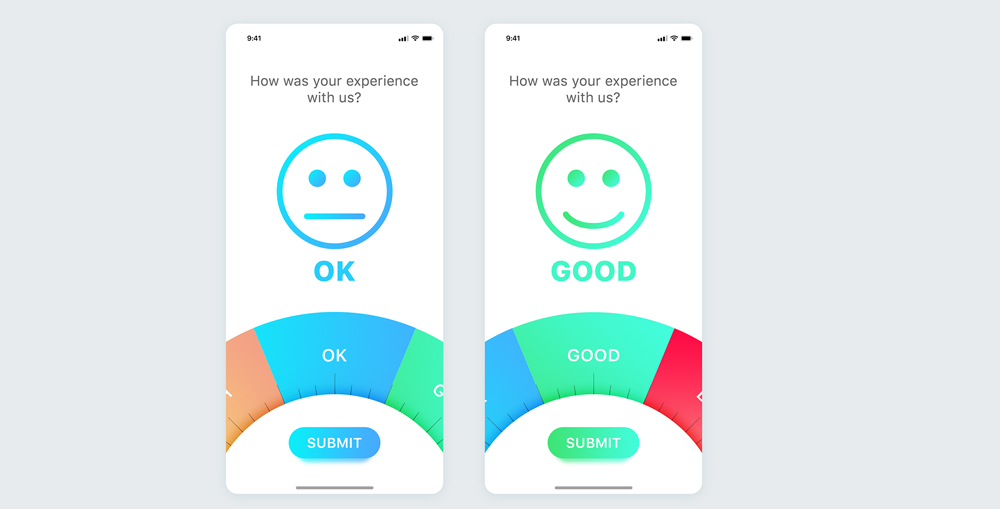
  • Customer Happiness Meter/Scale
  • CSAT Survey (Customer Satisfaction Score)
  • CES Survey (Customer Effort Score)
  • NPS Survey (Net Promoter Score)
  • Generic Customer Feedback Survey
  • Customer Experience &Staff Behavioral Feedback

Queue Management Software can Collect Customer Feedback

The business can collect valuable business intelligence data from these feedback. The customer feedback data can provide a deeper understanding of the staff/agent’s behavior and the overall customer journey. Businesses can even evaluate the quality of their products and services too via customer feedback.

See Also: The Future of Queue Management Systems: Trends to Watch in 2025

Another advantage of the customer feedback is that when a business ask its customers about their opinion and suggestion they feel more connected with the brand and think that the business cares about them. It improve customer’s relationship with businesses. The businesses can prepare various questions and ask the customer about the behavior of the staff/agents, later that same feedback data can be used to improve the staff performance and productivity.

Conclusion

The queue management software is a great tool to streamline the customer flow and manage the customer journey. The queue system is also very helpful in improving staff productivity. As the queue system can easily automate various customer journey steps and it is also capable of improving the service delivery process, the staff performance raised automatically. Usually the staff is busy in managing the customers and visitors in the and handling their queues manually, which not only put extra burden on the staff but it also ruin the customer experience and customer journey, the customer also got so many complaints and unexpected delays due to manual management.

However, with a queue management software the entire customer journey can be managed automatically as per the pre-configured settings and company policy. It also automates the customer routing and improve customer flow. Which reduce a huge chunk of extra workload from the staff. The staff/agents can easily focus more on their primary tasks, the entire customer flow is controlled and well-managed through the queue management software. This significantly improve the staff productivity.

Moreover in long term the businesses and organizations can also get valuable business intelligence, including staff performance and KPIs, customer feedback and statistical and analytical data from each and every touch-point of the customer journey. Which help the businesses in making new policies, improving their strategies and taking steps to further improve staff performance and productivity.

RSI Concepts is a leading queue management software provider in Dubai, UAE. If you want to improve the staff productivity and customer journey by implementing a state-of-the-art queue management software or a customized solution, feel free to contact us through our Contact Us page or leave a comment in the comment box below and we will get in touch with you soon.

See Also: The Ultimate Guide to Queue Management


The Ultimate Guide to Queue Management

In any service based industry in Dubai or anywhere in UAE the biggest problem every business and customer face is the long wait time and hard to manage queues. No one likes to wait. Whether you are a bank, a government office, a healthcare facility, an educational institute, a service provider or anything else, you will always find it difficult to manage the queues and your customers will always complaint about the long wait time. This not only ruin the customer journey and customer experience but it also destroys the brand reputation and the customer relationship.

Which could have very bad consequences in long term and could jeopardize the future of the business or organization. It is difficult to completely eliminate the waiting, but it can be reduced, organized and managed to make the customer waiting experience more pleasant and their journey more satisfactory. For that a queue management system is used.

The Ultimate Guide to Queue Management

What is a Queue Management System?

A queue management system is used to manage the customer flow effectively, organize the queues, and reduce the customer wait time. This is the very basic definition of a queue management system. However, these days the business and organization in Dubai and all around the UAE are using the queue management system to transform the customer journey and customer experience. The main goal for any business of organization is to have satisfied customers. That is what a queue management system is used for.

But it also provide other benefits, such as it increase employees’ work efficiency, it help improving profitability, reduces expenses and help improving customer relationship with the brand. The queue management systems are also a great source of valuable business intelligence which is vital for decision making and planning for the future. From the technical point of view a queue management system is a tool that help building and managing queuing processes, waiting line disciplines, customer routing, services channels, KPIs, feedbacks, statistical data and much more.

What is a Queue Management System?

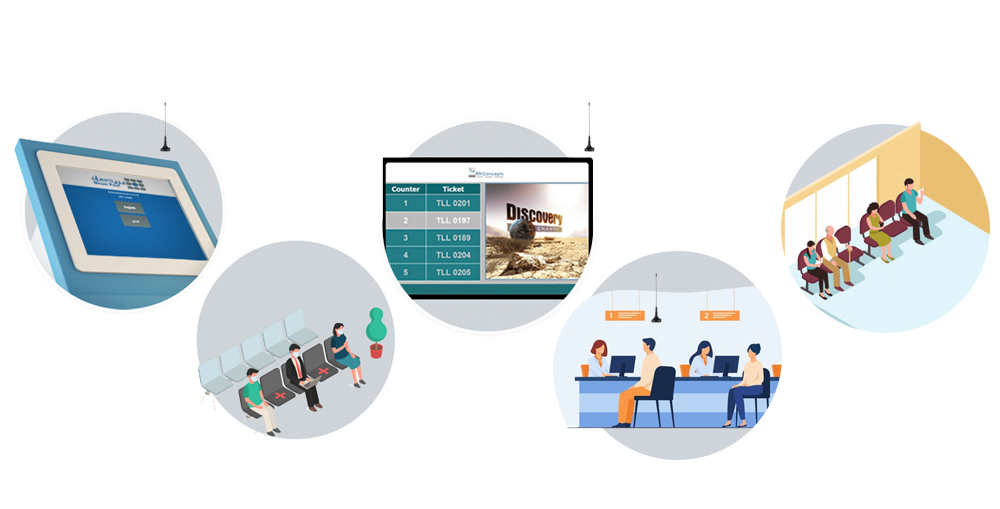
The digital queue management system consists of several different parts but all these parts can be classified in two main categories, the software and the hardware.

See Also: World’s First WhatsApp Queue Management Solution

Queue Management System Hardware Components

A variety of hardware accessories and components can be added and integrated in a queue management system to achieve certain functionalities, however there are some essential queue management system hardware components:

  • Self-Service Interactive Sing-up Kiosk/Ticket Dispensing Kiosk
  • Digital Signage Screens
  • Counter Plates
  • Announcement System/Audio System

Some non-essential but popular components are:

  • Emirates ID Card Reader
  • RFID Reader
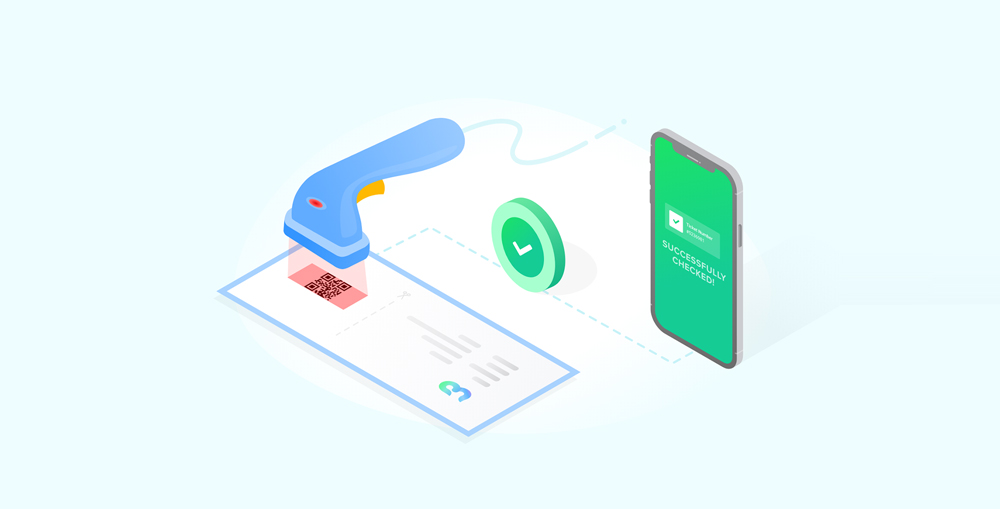
  • QR Code Reader
  • Payment POS and/or Cash Acceptance

There are a lot many other components that can be added to meet certain needs and unconventional requirements. Here are the details of all essential hardware components:

Self-Service Interactive Sing-up Kiosk/Ticket Dispensing Kiosk

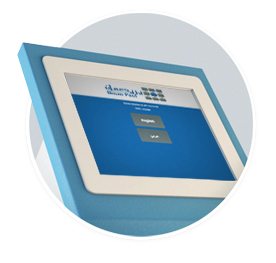
Self-Service Interactive Sing-up Kiosk/Ticket Dispensing KioskThe self-service interactive sign-up kiosk or ticket dispensing kiosk is used to allow the customers and visitors to sign-up for the queues. Usually a business is offering multiple services, and mostly certain counters are dedicated for certain services. Whatever the case is, a customer or visitor can select the desired service from the available services list and sign-up for that queue. Even if there is only one counter the self-service interactive kiosk is helpful for sign-up process, it saves time and automate the sign-up process. It also dispense a ticket bearing the customer number in the queue with estimated time to their turn or any other additional information or marketing content.

Digital Signage Screens

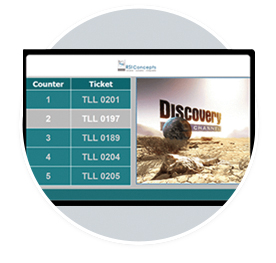
Digital Signage ScreensThe digital signage screens are a very important hardware component of any queue management system. The screens are used to display the real-time queuing updates and other relevant information. It can also provide the list of the active counters along with the current ticket number serving on the counter. Businesses can also display the estimated time for the next few customers in line. Such information are very helpful in improving customer’s waiting experience. Moreover, the digital signage screens can also play multimedia content on it which keep the users engaged and also make their waiting experience pleasant.

Counter Plates

Counter PlatesThe counter plates are small digital displays that are placed on each counter. Usually these are small elongated LCD screens or LED displays, which display the counter number and also the active ticket number. Such information is very helpful for customer in finding their service counter.

Announcement System/Audio System

Announcement System/Audio SystemAs the name suggest, it is a sound system used for customer calling and it can make announcements for the ticket number along with the counter number and any other required details. The audio announcement system consists of multiple speakers which are placed in different location to make the announcements audible for everyone in the waiting area. The announcements can be bilingual i,e English and Arabic or also in any other language.

Queue Management System Software Components

A queue management system software is an intelligent application and a well-crafted control console for the management. The software is used to implement policies, monitoring, and aiding queuing processes as well as it can also help improving various service delivery processes. The usually queue management system have a standard software application which is hosted on a server, it can be hosted in online hosting, cloud, or local/in-premises data center as well.

The interactive kiosks, announcement system, digital signage and the agent computers are linked with the queue management system server application. The application also provide the administrative panel and control console. Here are some essential queue management system software components:

  • Administrative Control Panel
  • Agent Dashboard
  • Self-Service Interactive Kiosk User Interface
  • Digital Signage Controls
  • Reporting and KPIs Monitoring Module
  • Statistical Data Analytical Engine
  • Customer Feedbacks

Here are some popular queue management system software components:

  • Virtual Queuing Module
  • Appointment Booking System
  • Mobile Apps
  • QR Code Module

Here are the details of essential queue management software components:

Administrative Control Panel

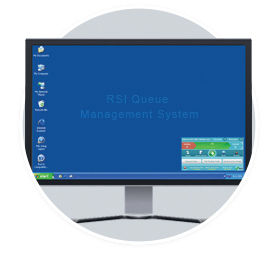
Administrative Control PanelThe administrative control panel is basically a control console for the entire queue management system. The businesses can add and manage multiple branches. Multiple system users can be added as per the administrative hierarchy. The businesses can add head office users, higher level managers, branch managers, employees with various access levels, agents and other system users. The administrative control panel makes it easy to integrate the queue management system in the business and organization management and work flow.

The Agent Dashboard

The Agent DashboardThe agent dashboard is the agent control panel. The agent can manage and control queues. They can utilize the customer calling functionality to call customers and make announcements. The service delivery related features can also be integrated in the agent dashboard to improve the service delivery process and quality. The system integration with other systems such as customer data base, sales system, CRM, etc. can be achieved via APIs which is a very secure and most efficient way for such data integration and synchronization.

Self-Service Interactive Kiosk User Interface

Self-Service Interactive Kiosk User InterfaceThe self-service interactive kiosk user interface is the very first touch point of the customer. The customer generates their ticket number from the kiosks and sign-up for their queue. The interface can provide functionality to select from a list of available services as well as it can provide relevant information and any other functionality required for the sign-up such as scanning of the Emirates ID card or making payment for the service, etc.

Digital Signage Controls

Digital Signage ControlsThe digital signage controls is a part of the administrative control console, it allows the management to run multimedia content on the digital signage screens along with the queuing information and other updates. The signage controls allow the management to perform basic digital signage functionalities to improve the user engagements and interactions during the wait time.

Reporting and KPIs Monitoring Module

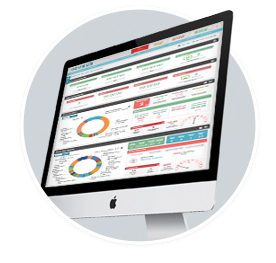
Reporting and KPIs Monitoring ModuleThe queue management system software has capabilities to monitor and capture data from each and every touch point of the customer journey. It also record valuable statistical data and measures various KPIs and other indicators. Which is very helpful for the management and make them able to make informed decisions on the bases of highly accurate data feeds from various sources.

Statistical Data Analytical Engine

Statistical Data Analytical EngineThe statistical and data analytical engine is also a part of the reporting module but it is a very useful component. It analyze the data and allow the management to extract the data in multiple format. It also help the management in creating reports with visual and graphical analysis and data presentations.

Customer Feedbacks

Customer FeedbacksThe customer feedback is a very important and essential part of business intelligence. It provides a direct window into the customer’s minds. The business can utilize the feedback to evaluate each and every aspect of the customer journey, the quality of the service and products, the employee performance and much more. The customer feedback along with other business intelligence highlights the areas of improvements and enables the management to take actions and make strategies for future improvement to maximize the customer satisfaction and quality of the service and products.

How to Choose a Best Queue Management System?

When it comes to the queue management system there are so many different vendors and systems available in the market. Businesses often get confused when they are selecting a queue management system. There are also some popular brands which advertise their systems with different brand names. However, there are certain things that a business should consider while selecting a queue management system to make sure it will be helpful in solving their problems.

How to Choose a Best Queue Management System?

Here are some key points to consider while selecting a queue management system or configuring/customizing a queue management system:

What are the Different Queuing Process Types?

The queuing process is basically managing the queues, streamlining the customer flow and improving customer journey. However there are certain service delivery mechanisms which are different for each business and that is how a business should chose a queuing process for their queue management system:

Single Phase Single Channel Queuing

When a business has single counter which serves each customer and a full service is delivered through a single counter it is called single phase single channel queuing.

Multi-Phase Single Channel Queuing

When a customer will have to go to multiple counters to get a full service delivery and each counter serves a single step of the service it is called multi-phase single channel queuing.

Single Phase Multi-Channel Queuing

When a single service can be delivered at a single counter and there are multiple counters who can serve the same service it is called single phase multi-channel queuing.

Multi-Phase Multi-Channel Queuing

When a single service delivery requires a customer to visit multiple counters and for each step more than one counters are available it is called multi-phase multi-channel queuing.

How the Branch, Office or Facility Operates?

The capacity of the branch, office or customer service center is also important and it will help you selecting an appropriate queue management system which will meet your needs. Here are some important things that you should understand about the facility:

The Population of the Customers

The population of the customers or daily footfall is classified in two categories, one is limited and the second is unlimited. Facilities like boarding counters and clinic have limited number of expected customer or daily footfall. Facilities like customer service centers and banks doesn’t have a limited or pre-defined number of expected customers or daily footfall.

The Method of Arrival

The method of arrival is also important. Usually business operate on single arrival mode, it means that each customer will come individually. However some businesses are serving customers in group arrival mode. It means the customer will arrive there in form of a large group such as Immigration Services, HR Departments, etc.

The Infrastructure of the Facility

The infrastructure of the facility is also important. A business should consider the number of counters, space for the queues, capacity of the waiting areas, and size and shape of the facility. These things will help business in determining the type of the queue management system as well as the size and quantity of the components require for a cost-efficient queue management system solution.

See Also: Why Business Need Mobile Apps along with Classic Queue Management System?

What are the Benefits of a Queue Management System?

A queue management system can significantly improve the customer journey and provide several benefits which help businesses in improving profitability and ensuring steady growth. Here are some of the major benefits of a digital queue management system:

  1. Reduce Customer Wait Time
  2. Improve Customer Waiting Experience
  3. Improve Customer Journey
  4. Improve Customer Happiness and Customer Satisfaction
  5. Improve Customer Loyalty and Reduce Customer Churn Rate
  6. Organize Queues and Customer Flow Effectively
  7. Automate the Customer Journey
  8. Improve Employee Performance and Reduce their Workload
  9. Improve Resource Management and Reduce Operational Cost
  10. Improve Service Delivery Quality
  11. Collect Customer Feedback
  12. Gather Valuable Business Intelligence
  13. Measure KPIs, Prepare Reports and Improve Future Strategies
  14. Improve Revenue and Profitability
  15. Bring Innovation and Get Competitive Edge

What are the Benefits of a Queue Management System?

These are only a few benefits of a queue management system. When a business implement a queuing solution they can literally transform the entire customer journey and customer experience which will help them improving service quality and customer retention. The customer happiness improves customer loyalty and customer loyalty help business building good relationship with then and a positive brand image in the market. In a long term a queue management system can provide excellent ROIs.

See Also: Top 10 Virtual Queue Management Benefits

Conclusion

A queue management system is considered to be an essential part of the service based industry. Especially in Dubai and all around the UAE where the competition is tough and the customers have too many choices, it is extremely important to stay ahead of your competition and ensure ultimate customer experience and customer journey. The happy and satisfied customers are more loyal to the brands and loyal customers can be a great asset for a business. The customer loyalty plays an important role in business growth.

In this blog we have discussed the queue management and the queue management system. If you follow the above mentioned guide to understand the queuing process and to assess your queuing needs, you will be able to get a very efficient and cost-effective queue management system. RSI Concepts is a leading name in Queue Management System providers in Dubai, UAE. If you need any more help, feel free to reach us out through our Contact Us page or leave a comment in the comment box below and we will get in touch with you soon.

See Also: Why should you adopt queue management systems?


Why should you adopt queue management systems?

Why should you adopt queue management systems?

An efficient queue management system organize customer flow, improve service delivery processes and quality, help building good reputation and relationship with customers and improve overall profitability or the entire business. For every business the customer happiness and customer satisfaction is the top priority. The customer satisfaction is an umbrella term which covers the entire performance of the business including its each and every moving part. Business in Dubai and all over the UAE are adopting digital queue management systems for better performance and customer happiness.

The UAE economy is rapidly expanding, the Expo 2020 is on the verge, which will attract more investors and we will see more businesses and startups. The competition here is already touch, customers have too many choices, and this phenomenon resulted in high standards and high expectations of the customers. Which compelled the businesses to take drastic measures in order to stay ahead of the competition. The customer satisfaction is the driving force, and it could impact everything. If you are having happy customers you will grow if not, you will eventually end up in big troubles such as slow growth, poor performance, declining brand reputation and lost revenue.

A queue management system is a key to success, it can completely transform the customer experience and customer journey and it can ensure highest customer satisfaction, which will lead to continuous growth, good brand reputation and higher productivity.

See Also: What are the Different Types of Queue Management System?

Here are some key reasons why you should adopt a queue management system now, if you want to secure your business’s long term future:

Reason No. 1: Queue Management System Reduce Wait Time

The queue management system have amazing capabilities to reduce the wait time and improve customer journey. Usually without a queue management system there are long queues, people have to stand in lines, and sometimes people try to be ahead in the line by line jumping or crossing someone, which end up in disputes and cause delays in the customer flow. In such scenarios the business have to manage the queues manually, which requires more staff as well as requires more work from the server/agent. This means that the servers/agents could also get distracted from their primary task and had to manage other unnecessary problems.

This results in unwanted delays and interruptions in the customer flow and results in prolonged wait times. Another huge factor is psychological, it is human nature that we have the fear of unknown, similarly when we have to wait in a scenario where we don’t know or estimate the end time, the wait gets more stressful and this amplifies the negative feelings in your customers too. If they don’t know when their wait time will end, they will feel more stressed while waiting, and when their turn will come they will be unhappy already, it will be very difficult for the agent/server to improve their experience at that time and make them happy.

See Also: From Chaos to Control: How Queue Management Systems Can Improve Your Business

Reason No. 1: Queue Management System Reduce Wait Time

While the agents/servers are also dealing with unwanted circumstances their efficiency and service quality also reduced. So the long wait time not only bother your customers and visitors but it also have negative impact on the employees and agents/servers. The long wait time could have double impact on overall customer journey and customer satisfaction. This is why businesses are very eager to reduce the wait time and service delivery time.

Poor waiting conditions, long wait time, less than optimum employee efficiency will result in higher per service costs. Which also impact on the profitability and revenue. On top of that the bad customer experience will repel customers and promote negative brand identity, which makes it even harder for businesses to acquire new customers.

Reason No. 2: Queue Management System Offers Better Customer Journey Management

The queue management system offers a better customer journey by automating various steps and processes which reduce customer wait time, improve customer flow and also increase employee efficiency. Each and every business have its own distinctive culture and approach to address problems. Every business have different services and also different sets of targeted audience for each service. Some services are delivered in a single go from one counter, some requires a customer to reach to multiple counters to get a full service and so on.

These factors contributes to make customer journey management more tricky and sophisticated. Along with all that business often have express counters or premium services for VIP customers and separate counters for aged, disabled people, etc. These all factors should be considered while preparing the roadmap of the customer journey. In Dubai, UAE and in fact all around the world businesses are also including employee’s factors too to further improve and optimize the customer journey.

See Also: Must have features of a Queue Management System

Reason No. 2: Queue Management System Offers Better Customer Journey Management

A good queue management system should be able to process all these variables and then it should also be able to automate the customer journey to attain the highest efficiency levels. During the sign-up the queue management system can ask to choose the service, it can also ask to enter any other details which will identify the customer as ordinary, VIP or any other category. Then the queue management system should be able to route each customer to their counters. In case of multi-step service delivery, the queuing system should be able to direct the customers to the next counter and so on.

The employee performance should be monitored and the task should be suggested as per their performance. For example an employee is very efficient at delivering service A, D and E however when they are assigned to the counters for service B and C they don’t perform well. Such data provide the management an insight on the employee performance and give them a chances to either improve employee performance or assign them tasks as per their expertise. Collectively all these things will significantly improve customer journey and customer experience which will result in maximum customer satisfaction.

See Also: What are advance components of Queue Management System?

Reason No. 3: Queue Management System Aid Customer Retention and Increase Customer Loyalty

The queue management system improve customer journey, customer happiness and boost employee performance which improve service quality, and these all will directly impact the customer retention and customer loyalty. Often customer retention and customer loyalty is interchanged but that is not true both are different, though most of the times both exhibit same response with certain changes. Anyway, the customer retention is to keep a customer who will do repeated business, however the customer loyalty is to make a customer your fan and not only have more repeated business but also get help from them in brand promotion.

A customer might do repeated business but they are not necessarily happy or satisfied, there could be no other good alternate, or any other factor which is making them to do repeated business. However a loyal customer is the result of an ultimate level of customer satisfaction. The loyal customers are good brand advocate and tend to promote the business and its products and services. They will often defend the brand on social media, online or public places. That kind of clientele is the most valuable asset of any business.

See Also: The Role of AI in Enhancing Queue Management Systems

Reason No. 3: Queue Management System Aid Customer Retention and Increase Customer Loyalty

The studies and market researches have shown that acquiring a new customer is nine to twelve time costly than selling to an existing customer. This could have a huge impact on your marketing budget and overall profitability. Acquiring new customers is not only expensive but it is difficult too, the communication and marketing not only require investment but a lot of efforts too. It is always good to have a strong foundation of the loyal customers.

The loyal customers help promoting a positive image of the brand and improve brand reputation. A good brand identity and good brand reputation attract more customers. If a brand have a good reputation and positive popularity the marketing turnover is also good. Which means that the customer retention and customer loyalty have far greater impact on the ROIs of the business and also aid achieving marketing and growth goals.

Reason No. 4: Queue Management System Improves Employee Performance and Monitor KPIs

The queue management system is very helpful in improving employee performance by reducing their work load and automating various steps and processes of the customer journey and service delivery. Moreover the KPIs or Key Performance Indicators are also a great tool to assess and improve the employee performance. When the employee performance got improved it automatically improves the service delivery process, service quality and customer happiness/satisfaction.

The queue management system can capture various APIs and statistical data. The employee KPIs are very important for optimizing the employee performance. The queue management system can monitor the employee, their on-desk time and off-desk time, average service delivery time, behavior and much more. The KPIs can also provide insight on the overall behavior and patterns of the employees, such as at which part of the day the employee perform better and when they slow down, how do they react in under more work load and how much customers they can serve in a single day.

See Also: Streamlining Customer Service: The Power of a Modern Queue Management System

Reason No. 4: Improve Employee Performance and Monitor KPIs

These all are very useful information and help the management is identifying the areas of improvements and taking actions to improve everything. Moreover the employee KPIs are also used to analyze the employee performance and expertise on a particular service, for example an employee can serve 20 customers a day when they are appointed for service A while they can serve 45 customers in a single day when they are appointed for service D, etc.

This type of data helps businesses to improve employee performance by smartly managing their tasks, workloads and arranging training session for them. The employee KPIs can also be integrated with other enterprise solutions and business tools such as Enterprise Performance Management System [Our Product Page LINK], HRMS, etc.

Reason No. 5: Queue Management System Collects Customer Feedback and Business Intelligence

Mostly the modern queue management systems comes with an in-built customer feedback collection tool. The customer feedback is very important it provides direct and unfiltered opinion of the customer and it also help building trust and good relationship with the customers. When customers know a business is eager to listen to them they get a very positive impression of that brand. They think the brand values them a lot and listen to their opinion to make changes to please them. This increase customer loyalty as well.

Moreover the customer feedback is a single most reliable and accurate source of the business intelligence. Sometimes all the logics and numbers tells a different story but the customers behave completely opposite to what a business had anticipated. So, it is extremely important to understand your customers and audience, the customer feedback is the best tool to do that. It will provide you accurate information about the market trends, customer’s liking disliking, their expectations and it will also help you in evaluating all what you are doing to please your customers.

See Also: How Queue Management System Helps Maximizing the Efficiency?

Reason No. 5: Queue Management System Collects Customer Feedback and Business Intelligence

Here in Dubai and all around the UAE business often collect customer feedback but overlooked other business intelligence metrics. However in order to be able to make informed decisions and successful future strategies a business must closely monitor and analyze all the touch points, statistical and usage data. For example, which products or services are most popular, which features of a particular product or service are appreciated the most by the customers and vice versa. This will provide a foundation for the innovation and modernization.

Business can plan new products and services, they can improve existing products and services and similarly business can improve various aspects of the customer journey only by analyzing the customer feedback, statistical and analytical data collected by the queue management system. The data collection is one thing but in order to be able to extract actionable reports is a completely different thing. A good queue management system always provide additional data analytical and processing tools along with in-built smart data analytical engine which help business to evaluate the entire operation and quality of services/products simultaneously.

Read More: Top 10 Virtual Queue Management Benefits

Reason No. 6: Queue Management System Enables Easy System Integration and Remote Management

A queue management system enables easy system integration with secure web services or APIs to get it connected with the centralized information center and it provides features to remotely manage all of the connected branches from the head office. The system integration enables the queue management system to fetch and push data to other systems and tools. For example if a customer is required to sign-up by entering their customer ID the customer ID has to be verified too. In order to verify the customer ID the queue management system must have access to the customer data.

Which might be stored in another system or database. So this verification can be done using system integration or APIs. Similarly if a business wants to include more hardware accessories such as Emirates ID reader, RFID, QR Code Reader, or any other accessory that can be added and linked to the central information center or to the relevant system by the system integration method.

Reason No. 6: Queue Management System Enables Easy System Integration and Remote Management

The queue management system also allow simple and easy integration with self-service interactive systems, kiosks, web portals, mobile apps, appointment booking system, SMS, Emails, and much more using the system integration methods and techniques. This also enables the queue management system to provide a centralized and remote management. The head office can monitor and control all of the connected branches in real time.

This makes it easier for the management to implement company policies throughout the network and monitor all branches and offices through a unified administrative dashboard. Furthermore the administrative dashboard also allows to add branch managers, servers/agents and other job roles to make the management easy and in-line with the internal structure of the business.

See Also: Why Business Need Mobile Apps along with Classic Queue Management System?

Conclusion

Here in Dubai and all around the UAE business are spending a huge chunk of their hard-earned revenue on customer journey transformation tools and systems. The customer satisfaction and happiness is extremely crucial for sustainability and long term growth. The customer happiness and satisfaction also help a business to build a positive reputation and good brand identity. A queue management system can easily reduce the customer wait time and manages the customer flow automatically. It can also automate various business processes and service delivery steps which further improve customer experience.

The customer flow management and customer routing can also be automated with the help of a queue management system. The automation and digitalization improve the customer journey and reduce the work load of the employees which further improve the employee performance and their service delivery quality also get improved. Which results in happy and satisfied customers. The customer satisfaction improve customer retention and customer loyalty which results in significant cost reduction in new lead generation and marketing expenses. Along with that the positive band identity and good reputation also help attracting more customers and increase the revenue.

The customer feedback and business intelligence gathering plays an extremely important role in identifying the areas of improvements and making new plans and strategies to improve everything. The system integration open ups new avenues to innovation and modernization and help future expansion as well. It also enables remote management and provide the head office with real-time updates and data. All these improvements and their impact can potentially increase your sales and growth by multiple times.

A queue management system is an essential for long term success and steady growth. RSI Concepts is a leading name in queue management system providers in Dubai, UAE, if you need any help with designing and implementing a queue management solution or want to improve or upgrade an old queuing system, feel free to let us know. You can contact us through our Contact Us page or leave a comment in the comment box below and we will get in touch with you soon.

See Also: World’s First WhatsApp Queue Management Solution

See Also: The Future of Queue Management Systems: Trends to Watch in 2025


World’s First WhatsApp Queue Management Solution

The queue management systems and solutions are considered to be a mandatory tool for any service based industry. Whenever a business will have to manage daily customers and guests, they need an effective and efficient customer flow management. Which is only possible with a digital queue management system. These days as the customers are more inclined towards a bit more digitalized and contactless user experience, the virtual queuing gain popularity. Businesses are getting amazing results after implementing virtual queue management system.

When it comes to virtual queue management system, it offers many benefits and the biggest advantage is that is enables the guests and customers to sign-up remotely for the queues. However there are certain ways that a customer can sign-up. The most popular method is the smartphone applications, which have a lot many other advantages and benefits too. However, the most convenient method to enable remote sign-up is the WhatsApp. These days in Dubai and all around the UAE almost everyone have WhatsApp, in fact it is one of the most popular messenger app in the entire world.

World’s First WhatsApp Queue Management Solution

How WhatsApp Queue Management System Works?

A queue management system is all about improving and managing the customer experience and the WhatsApp is the simplest method a business can offer to their customers. The WhatsApp Queue Management Solution is a queue management system integrated with the WhatsApp instant messaging application. The customers can sign-up using their WhatsApp, no need to print tickets, or call at the branch to reserve a spot, or access to the customer portals for appointment or anything else.

See Also: How to Set Up SMS based Queue Management System?

Usually businesses encourages their customers to install their mobile apps on their smartphones, however, not everyone appreciates it. But with the WhatsApp queue management solution the customer can instantly sign-up for the queue, get live coverage and announcements on the WhatsApp without getting hustle of any app installation, or accessing a website or anything else. This makes the customer journey over simplified and yet very impactful. The customers get a great user experience and end up happy and satisfied with the brand.

How WhatsApp Queue Management System Works?

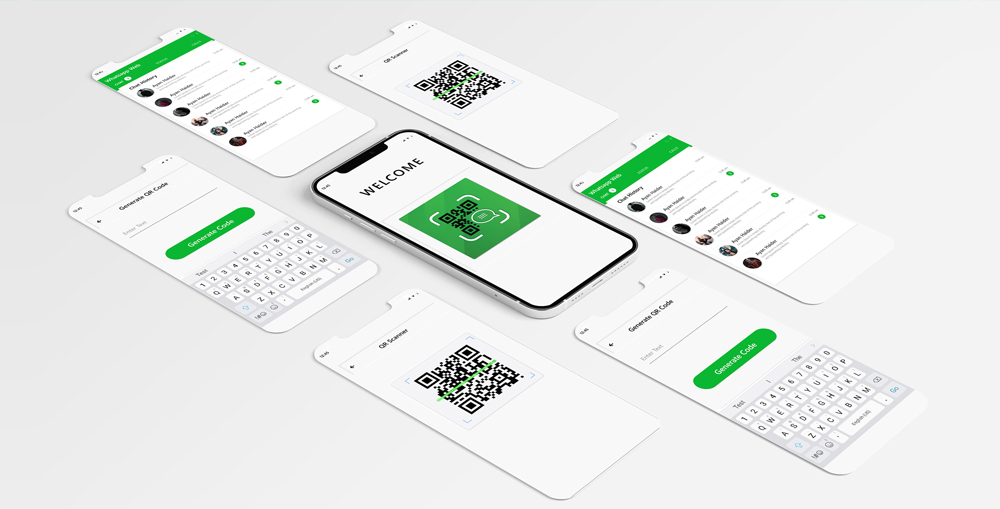
The WhatsApp queue management is very simple and easy for the customers. All they need is to scan a QR Code, and the mobile phone will automatically open up a new WhatsApp window, which usually have a list of the categories, and then the customer can choose the appropriate category to sign-up for and instantly receive an e-token or digital token for the queue. The customers can get real-time updates of the ongoing queue and will be notified when their turn will be near and also when their turn will come. After the customers got served the businesses can easily collect customer feedback from the WhatsApp.

What are the benefits of WhatsApp Queue Management?

What are the benefits of WhatsApp Queue Management?

The biggest advantage of a WhatsApp queue management system is that it significantly improve customer experience and customer satisfaction. There is also no need to download and install any new application which occupies storage space on the phone. The customers’ overall journey is reduced and their efforts are also reduced.

See Also: Why Business Need Mobile Apps along with Classic Queue Management System?

Here are some of the best advantages and features of a WhatsApp queue management:

  • Remote Sign-up Facility
  • Real-time branch data and updates
  • Easy Sign-up using a QR Code
  • Reduced wait time and automatic customer journey management
  • The WhatsApp interface makes it easier for the customers and help reducing customer effort score
  • Completely contactless sign-up process
  • Customized notifications, reminders and alerts throughout the entire customer journey
  • Direct communication with the customers
  • Simple Information broadcasting such as branch timing, current queuing status, pre-signup requirements, etc.
  • Ability to check status of multiple branches, and on-demand status updates
  • In-built customer feedback system or integrated customer feedback system
  • Reduce customer wait time, improve customer flow and reduce workload of the employees result is improved employee efficiency
  • Easy branch management, crowd prevention and social distancing compliance features
  • Improved customer experience and smooth customer journey results in higher customer satisfaction
  • Simple and easy administration, automation capabilities and monitoring tools enable the business to have a close eye on the entire process
  • Customer feedback collection, KPIs monitoring and business intelligence gathering
  • Very Cost-effective queuing solution

These are the general features of a WhatsApp queue management solution. Moreover when a system is customized for a particular business or enterprise it could offer a lot more benefits and could be a great competitive advantage. The system integration also allows to integrate the WhatsApp queuing system with other business tools and enterprise solutions to enable a robust and swift control and command center at head-office or at the branch. The remote management makes it easier for the head office to monitor and improve the performance of the connected branches and make informed decisions on the bases of customer feedback and business intelligence.

See Also: The Future of Queue Management Systems: Trends to Watch in 2025

Conclusion

WhatsApp is one of the most popular app in the world. In Dubai and UAE almost everyone have WhatsApp on their phones. The WhatsApp sign-up process is very simple and convenient. The customer will have to scan a QR Code and they will be directed to the WhatsApp chat where they can chose the required service and sign-up for the queue. The customers are not even required to be physically present in the queue, they can wait anywhere. The WhatsApp queue management system also provide live queuing information and on-demand info requests are also available. This queuing method significantly reduce the wait time, improve customer flow, prevent crowd formation at the branch and reduce work load of the employees as well.

The employee’s performance also got improved and consequently the service quality also improves. The WhatsApp queue management solution are a very cost-effective queuing solution and it can significantly improve customer happiness and overall business’s productivity and profitability. RSI Concepts is a leading queue management system provider in Dubai, UAE, if you want to upgrade your customer flow management to meet the needs and expectations of your customers, feel free to get in touch with us through our Contact Us page or leave a comment in the comment box below.

See Also: Top 10 Virtual Queue Management Benefits


Top 10 Virtual Queue Management Benefits

Top 10 Virtual Queue Management Benefits

One of the biggest challenge for business in Dubai, UAE and all around the world is to provide a great customer experience and customer journey. However, the reality is no one likes to wait in long lines, people often think that waiting in long queues is a waste of time. People thinks that the businesses and brands who failed to reduce the wait time or long queues don’t care much about their customers. Business too could have a very negative perception about the wait time, often businesses think that the wait time can’t be reduced or can’t be reduced more than a certain level.

However, that is not the case. The customer wait time can be reduced significantly by proven methods and technologies. The virtual queuing is one of them. It is the most effective queue management system type which help in reducing the wait time. The virtual queue management systems are very effective in managing the customer flow and they also help improving customer experience.

Top 10 Virtual Queue Management Benefits

The effective customer flow management also improves employee efficiency which also help improving customer experience. The primary goal of having any queue management system is to make your customers happy and satisfied. Only the satisfied customers are loyal to the brand. The unhappy customers will immediately switch to others as soon as they got another option. Here in Dubai and all around the UAE the competition is too high, customers have a lot of option. The customer expectations are also very high and the customer retention is very difficult.

A virtual queue management system is a very helpful tool in improving customer satisfaction hence it improves customer retention too. The loyal customers act as a strong foundation for the business. The business can build their future on that base. If a business keep on losing existing customers then they will have to invest more in acquiring new customers and studies have shown that acquiring new customers could be 8 to 12 times expensive then selling to the existing customers. That is why the queue management system is extremely important for any business.

See Also: Must have features of a Queue Management System

Here are top 10 benefits of the virtual queue management system:

Virtual Queue Management System Benefit No. 1: Reduce Wait Time

Virtual Queue Management System Benefit No. 1: Reduce Wait Time

The virtual queue management systems can significantly reduce the wait time. In fact the virtual queuing is the only queuing method that can promise to completely eliminate the wait time. Thanks to the remote sign-up, smartphone apps, the other features of the virtual queue management, the customers can be booked a spot in the waiting line (virtual queues) and the estimated time of their turn is given to them, which allow them the freedom to spend their time in other activities or arrive at the branch at the very exact time of their turn.

The customers can also schedule a visit or book an appointment at the time of their convenience which also add value to customer journey and customer experience. If customers and visitors will have to wait in the long queues inside the branch then the staff could also get overloaded, as they will have to manage the crowd too along with their primary tasks, which further prolonged the wait time and harm the customer satisfaction.

See Also: 5 Challenges and Solutions of Queue Management System in Banks

Virtual Queue Management System Benefit No. 2:Remote Sign-Up

Virtual Queue Management System Benefit No. 2:Remote Sign-Up

The remote sign-up improve customer experience and provide them freedom to sign-up remotely for the physical queue. That is not all, with the virtual queue management system the customers and visitors can also wait elsewhere, they are not required to wait physically in the queues, instead they are placed in a virtual queue and their number called as they were physically present in the physical queue.

The virtual sign-ups can be done through various mediums and methods for example, Queue Management System Smartphone Apps, Online Appointment Booking System, Website, Customer Portals, Email, SMS, Call, etc. When a customer or visitor is remotely signed-up using any medium they have been issued an e-ticket or mobile ticket which is their position in the queue. Along with that mobile ticket they are also given the estimated time of their turn along with the counter number. This helps them to plan their arrival accordingly and save a lot of wait time.

See Also: Queue Management System Features you Need for Modern Queuing

Virtual Queue Management System Benefit No. 3:Prevents Crowd

Virtual Queue Management System Benefit No. 3:Prevents Crowd

The crowd and congestion in the branch can have big impact on customer journey and customer churn rate. Customers often leave when they see crowd or too long queues, in addition to that it also put more burden on the staff and management and it is harder to manage crowd. Customers and visitors usually avoid reaching out to staff or spending much time in conversation with the staff when they see a lot of people waiting in the queue or when there is a crowd. This can prevent new sales as well as it will leave your customers unsatisfied.

Some customers and visitors often left without getting serve or purchase due to crowd and too much congestion. A virtual queue management system provides the facility to arrive just in time and immediately get served, which means there will be no congestion or crowd formation, the customers and visitors will be comfortable and the staff can also focus on primary tasks rather managing crowd. The staff performance get improved and they deliver better quality service.

See Also: What are the Different Types of Queue Management System?

Virtual Queue Management System Benefit No. 4: Implement Social Distancing Easily

Virtual Queue Management System Benefit No. 4: Implement Social Distancing Easily

Implementing social distancing is mandatory for all public places and offices. If you appoint staff to prevent people from entering into the store/branch then the crowd could form outside the store/branch. People also don’t like such practices. But with the help of a virtual queue management system the customer journey can be made contactless, the management can easily control the number of active queues and can easily prevent congestion. The management can also limit the number of active queues in a way to ensure the social distancing which will protect the customers and visitors as well as the staff.

Businesses and stores in Dubai and all around the UAE are only permitted to have a certain percentage of the full capacity of hosting the number of customers and visitors at a time. Which makes it very hard when managed manually, but with a virtual queue management system the system can be configured to ensure the number of customers and visitors will not exceed that limit. Moreover the virtual queue management system also provide direct communication channels to the customers which makes it easier to send instructions and notifications to the customers and visitors. This helps maintaining the social distancing and implementing other company policies with ease and accuracy.

See Also: The Role of AI in Enhancing Queue Management Systems

Virtual Queue Management System Benefit No. 5: Improve Employee Efficiency

Virtual Queue Management System Benefit No. 5: Improve Employee Efficiency

The major factors that reduce the staff efficiency are the crowd formation and unbalanced work load. If there is congestion then the employees will have to stay on the counter all the time and they couldn’t spare time for off-the-counter tasks. Which is a big reason of employee work deficiency. Moreover when the customers are coming through a bad customer journey the employee may focus more on a single customer to make them happy and satisfied and for that a single employee will have to spend more time on a single customer. This reduces their daily capacity of handling customers and visitors.

But when the number of customers are controlled and the customer flow is managed by a virtual queue management system there could be no crowd formation, the work load of the employee also get reduced, they can have small breaks too, which significantly improve their productivity and capacity to work. Another great advantage of the virtual queuing is that it can provide basic information and data of the customer beforehand through the agent portal/dashboard which really expedite the service delivery process and increase the capacity of the employees to serve more customers in a single shift.

See Also: How Queue Management System Helps Maximizing the Efficiency?

Virtual Queue Management System Benefit No. 6:Integration with Smartphone Apps

Virtual Queue Management System Benefit No. 6:Integration with Smartphone Apps

Virtual queue management system also integrates smartphone apps to improve customer journey and customer experience. The customers can get the e-ticket or mobile-ticket from the smartphone applications. The easy sign-up process and is one of the main advantage of the virtual queue management systems. The business can also easily communicate with their customers using the smartphone apps. The live queuing data and ticket information can be published on the smartphone applications.

The alerts, notifications and queuing information make sure the customer can easily reach in time to get the service delivered with very little or almost no wait time. The smartphone applications integration also provide other useful information and functionalities such as branch locator, branch details, nearest branch or least busy branches and so on. Moreover the smartphone applications can also be used for various other purposes such as making online payments, submitting customer feedback and much more.

See Also: Streamlining Customer Service: The Power of a Modern Queue Management System

Virtual Queue Management System Benefit No. 7:Collect Customer Feedback Easily

Virtual Queue Management System Benefit No. 7:Collect Customer Feedback Easily

The customer Feedback is a very important piece of information for any business. As businesses often spend thousands upon thousands on solutions and system aiming to improve customer journey and customer satisfaction, it is crucial to understand how your all efforts are going. The best way is to let your customers talk to you, let them identify the areas of improvements and let them tell you what do they expect from you. The customer feedback system comes as an additional module to virtual queue management system.

The businesses can utilize this module to collect various types of customer feedback such as NPS (Net Promoter Score), Customer Effort Score, Customer Satisfaction store and much more. The feedback can be collected via smartphone apps, SMS, emails, online links, etc. The feedback data is very helpful in identifying the areas of improvement. It help businesses to understand their strengths and weaknesses. It is also very helpful in evaluating employee performance, customer journey, business practices, product/service quality and a lot more.

See Also: Mobile Queue Management: The Rise of App-Based Solutions

Virtual Queue Management System Benefit No. 8:Cost Reduction and Profitability

Virtual Queue Management System Benefit No. 8:Cost Reduction and Profitability

The virtual queue management systems can be very helpful for business in cost reduction and improving profitability. The less wait time, enhanced customer journey, quick service delivery, and employee performance can significantly increase the overall operational capabilities and work efficiency of the branch/store. This means with the same amount of resources the business can serve more customers with better work quality. Hence per service delivery cost is automatically reduced. Moreover as the entire customer flow and customer journey is managed by the virtual queue management system, businesses can automate various business processes.

The automatic customer flow management, reduced customer numbers in the branch and efficient customer journey reduce the work load of the employee and improve their efficiency, these all factors collectively results in less cost per service delivery. Either the business can use the same resources to serve more customers or can adjust the resources as per the needs to minimize the cost. In each case the per service delivery cost get reduced significantly and the profitability get increased.

See Also: The Future of Queue Management Systems: Trends to Watch in 2025

Virtual Queue Management System Benefit No. 9: System Integration and Central Management

Virtual Queue Management System Benefit No. 9: System Integration and Central Management

Another great advantage of the virtual queue management system is that it is very flexible towards integration with other tools, systems and third party software. The system is usually hosted online, which means that connecting all the branches to the head-office is very simple. The virtual queue management system can be integrated with smartphone applications, online appointment booking module, CRM (Customer Relationship Management tools), Customer Feedback and Survey Modules, CLM (Customer Loyalty Program), ERP, Sales System, Enterprise Performance Management System and much more.

The integration is usually achieved using APIs, which is a very secure and efficient technology. This high connectivity also enables the head-office to monitor and control (if needed) any connected branch. All the real-time monitoring data and queuing stats are available for the head-office, branch manager or anyone else who is authorized to access them. The central management is very important as businesses usually scale, and require to add branches and counters.

See Also: Ultimate Guide to Google Adwords in UAE

Virtual Queue Management System Benefit No. 10: Reporting, KPIs and Business Intelligence

Virtual Queue Management System Benefit No. 10: Reporting, KPIs and Business Intelligence

The virtual queue management system is capable of capturing data at all touch points in the customer journey along with various other KPIs (key performance indicators). As the system is integrated with smartphone applications and customer feedback modules, it also collect various types of statistical data from these two interfaces. The KPIs are important to assess various customer journey steps and the employee performance. The customer feedback is very important and can be used for evaluating the entire business operation. Moreover the system is also capable of collecting stats and fetching data from other connected systems and tools. Collectively these all data streams forms and sophisticated matrices of analytical and statistical data which is called business intelligence.

Such data is very important for the management to assess and evaluate their ongoing business process, methodologies and the entire infrastructure. It also includes the evaluation of the products and services. A good queue management system always have an in-built data analytical and statistical tool, which can compile this data in the form of actionable reports. The management can use these reports to improve their strategies, methods and processes. With the help of such reports the management can easily make informed decision which can help them to improve the entire business operations for future.

See Also: How to Setup IT Infrastructure of a Startup in Dubai

Conclusion

For the businesses in Dubai and all around the UAE the virtual queue management system is a great tool keep up with the latest trends while maintaining the highest level of operational efficiency. The virtual queue management systems enables a business to effectively control the customer flow and also allow the customers and visitors to sign-up remotely through the easy remote sign-up channels. The crowd prevention, automatic customer flow management and automation of various customer journey steps reduced the work load of the employees, which improve employee performance and efficiency.

Only the basic features of the virtual queue management systems can effectively reduce the per service delivery cost and on top of that the businesses can also customize the virtual queue management systems to further improve their efficiency and profitability. The system integration via APIs, smartphone apps, customer feedback system module and central management are the key features of a virtual queue management system. RSI Concepts is a leading name in Queue Management System providers in Dubai, UAE. Feel free to contact us through our Contact Us page or leave a comment in the comment box below to learn more about our queue management systems and solutions.

See Also: Why Business Need Mobile Apps along with Classic Queue Management System?


Ultimate Guide to Google Adwords in UAE

Ultimate Guide to Google Adwords in UAE

The Google Adwords is a very effective digital marketing platform. It is an estimate that the yearly Google searches are 1.2 Trillion worldwide which means that 3.5 billion searches per day and 40 Thousand searcher per second. This is staggering. The Google is the top search engine occupying 92% of the search engine market worldwide. It is the most dominate search engine worldwide. The UAE as a nation is a very modernized and advanced nation, almost 94% of the population have access to the internet. This means the digital marketing could be your ultimate game changer.

In the modern world the focus has already been shifted from the typical and traditional marketing channels to the digital and online marketing channels. The biggest advantage of the digital marketing is that it enables businesses to effectively reach to their targeted audience. It is cheaper comparing to the traditional marketing methods and it also returns good results. In the digital marketing eco-system we can confidently say that the Google is the leader having huge market share (92%) and excellent marketing tools.

What is Google Adwords?

What is Google Adwords?

The Google Adwords is a paid digital marketing platform works on pay-per-click (PPC) or pay-per-impression (PPM) advertisement models. The Google Ads are the most effective in terms of driving good quality traffic and higher conversion rates. As whenever someone searches in the Google they are most likely to have already plans for purchase. So it yields higher online conversions.

It is a common misconception that higher the budget you have more the return you will get from your Google Adwords campaigns. But that is not the case, the ROI is vastly dependent on Ad Quality, Quality Score and Relevance. Of course the budget is also very important, but it is not like the budget is the only variable in the ROI. Here are some stats that will give you an idea of how effective the Google Adwords are:

  • 8% CTR (click through rate)
  • 180M monthly impressions
  • 43% of Prospects Convert into a Sale from YouTube Ads
  • 65% of Clicks from Ready-to-buy Users

The Google Adword’s Tools also allow you to optimize your advertisement campaigns to suit your budget and you can also stop any campaign or advert at any time to keep the budget within your monthly spending limits. Another great feature is scheduling of the ads, so that you run your ads only at the times when you are expecting most of your targeted audience to be online. These all features and campaign optimization tools enable the businesses to get the higher ROIs from Google Adwords.

See Also: Read this before starting Digital Marketing Campaign in Dubai

Understanding the Technical Terminologies of Google Adwords

Understanding the Technical Terminologies of Google Adwords

Since our content is for all levels of marketers with varying technical knowledge and understanding of the Google Adwords platform so let us begin with a short introduction to the frequently used terminologies. These introduction will provide you basic technical understanding of platform and you will be able to setup and execute your Google Adwords Campaigns without any help from the professional.

However, we always recommend to acquire professional services to ensure highest possible return over your investments. Here are some basic technical terms used in the Google Adwords platform:

  1. Keyword: The keyword is a ‘word’ or ‘phrase’ a user used to search for a particular information in the search engine.
  2. SERP: The word SERP represents ‘Search Engine Result Page’ and it is the page which contains the results/links when a user put an enquiry/keyword in the search engine.
  3. Clicks: The clicks are the actual clicks and counted when a visitor clicks on the ad.
  4. Impressions: The impression is the count of how many times your ad appears on the SERP regardless of if it is clicked or not.
  5. CTR: The CTR means ‘Click through Rate’. When you divide your ad’s number of clicks by the number of impressions you will get the CTR.
  6. Budget:The budget is the overall budget of the Adwords campaign. There are monthly budgets too and campaign budgets too.
  7. Bid:Like any other auction the Adwords also allow the advertisers to bid on the placements, ads with higher bids appears on top positions.
  8. Conversion: The conversion is a genuine lead or sale but it is also taken as the required action being taken by the user, which could be a purchase or a contact form or subscription, etc.
  9. Ad Rank: The ad rank is measured by multiplying maximum bid value and quality score and it determines the rank/placement of the ad in the result page.
  10. Quality Score: That is a very complex Google rating criteria, it includes CTR, quality of the landing page, past performance in SERP, and the relevance and keywords.

These are some of the basic terminologies that are being frequently used in the Google Adwords.

See Also: A Complete Guide to High-Converting Web Development

What are the Types of Google Adwords Campaigns?

What are the Types of Google Adwords Campaigns?

There has to be a goal and objective of any marketing effort. Similarly for Google Adwords campaigns there are several types which are designed to keep in mind several different goals and objectives. It is extremely important that you choose a right campaign type else you will end up spending huge amounts with very low or no gains whatsoever. The Google ads are everywhere on the internet, it could be on search result pages, videos, websites and blogs you are reading and in mobile applications too.

It is quite possible that we have clicked on some of these ads without realizing it. This may sound difficult but Google have made it a lot easier with continuous innovation and improvements in its tools and interfaces. Here are different types of Google Adwords Campaigns:

  1. Search Campaign: It is basically the textual ads on the SERP.
  2. Display Campaign: These are images based adverts published on website which are connected to Google networks.
  3. Video Campaign: The video ads are published of video streaming websites, the main platform is the YouTube and these ads are also published on other affiliate websites.
  4. Shopping Campaign: These ads are basically product ads and are catered to the users who are ready to buy and searched for a specific product.
  5. Mobile App Campaign: These ads are used to promote mobile apps across Search, Google App Store, YouTube and display network.
  6. Local Campaign: The ads are automatically optimized to publish on multiple channels (search, display, YouTube, and Maps) along with the location details of the business.
  7. Smart Campaign: The smart campaigns are automated, you just create some ads and Google Adwords will find the target and optimize the campaign to ensure the best ROI.

These are basic campaign types of Google Adwrods. The correct selection is critical for the success of the campaign. The selection should be based on your goal and objective. What you want to achieve should be the driving factor of the selection of the campaign. For example if you want to launch a brand awareness campaign then the Video and Display campaigns are a suitable choice. In case if you want to get more leads and sales then the Search, Shopping and Local campaigns are the best choice.

See Also: Top 5 CMS Platforms for Web Development

How to Set Up a Google Adwords Campaign?

How to Set Up a Google Adwords Campaign?

Setting up Google Adwords Campaign is very easy using the Google Adword Dashboard tool. Once you have basic know how of the tool, you understand the terminologies and their meaning, and have understanding of different campaign types you can easily create a successful campaign. All you need is to setup your goals first, for example, if you want to acquire more leads and online conversions you must chose an appropriate campaign for that, if you need brand awareness campaign then another campaign has to be chosen. Here are some basic steps that will help you creating an effective Google Adwords campaign:

  1. Creating Adwords Campaign Step 1: Do keyword research using Keyword Planner (Free tool provided by Google) tool or any other tool. It is crucial that you create ads for the keywords and key-phrases which people are searching else there will be very low or no conversion.
  2. Creating Adwords Campaign Step 2:Shortlist the good keywords and key-phrases with adequate search volume and make sure you will be able to afford them too. In the Google Keyword Planner you will also find CPC which is Cost per Click. This is an estimated CPC but it is a good reference point to begin with. Consider the competition and also take account of the bid range, this will help you estimated the cost of the keyword.
  3. Create Adword Campaign Step 3: Now that the keyword list is finalized the next step is creating a search ad (we are writing about search campaign as it is the most widely used Adwords campaign) with a very strong USP. The USP is a unique selling proposition, you have to think that what statement can convince your prospects to make them purchase your product or service.
  4. Create Adwords Campaign Step 4: Make an offer which can help you get more clicks even if you are at second or third position or even at the bottom of the page. Tell the visitors about the value of your product or service but it has to be very realistic, and use a simple call to action, adding phone number can also improve conversion rates.
  5. Create Adwords Campaign Step 5: Use an excellent landing page. Do not divert the entire traffic to your homepage or contact page, instead prepare an excellent landing page which could offer a great customer journey and it will help you improve your conversion rates. Remember you are paying for each click.

These are some general steps of creating a compelling Google Adwords Campaign.

See Also: Integrating AI Agents into Core Business Applications for Operational Excellence

How to Increase Google Adwords Campaign’s ROI?

How to Increase Google Adwords Campaign’s ROI?

Once you have learned the basics of the Adwords and are able to create your first campaign you might first feel lucky and have good results too but eventually you will start thinking about improving the ROI of your Google Adwords Campaign. This will not only reduce the cost of the campaign but it will also increase its profitability. It doesn’t matter if you are an individual, a business (small or large), a professional marketer or a startup, the Google Adwords could become expensive and need to be optimized to improve the results. Here are some simple steps that will help you optimizing your Google Adwords Campaigns to increase your return over investment (ROI):

  1. Increase Adwords Campaign’s ROI Step 1:The first step is to filter out your audiences. Target appropriate demographics and location data to ensure your ad is displaying only to the people who will be more interested in purchase. This method is equally beneficial for both B2B and B2C advertisers.
  2. Increase Adwords Campaign’s ROI Step 2:The next thing that can be done is segregating your audience by the income group (this feature might not available for all countries and regions). For certain products and services certain income groups are more profitable than others.
  3. Increase Adwords Campaign’s ROI Step 3: The headlines get the most attentions, trying with dynamic keyword insertion is the best way to increase the CTR and conversion rate. This is also very helpful when you are targeting low search volume keywords.
  4. Increase Adwords Campaign’s ROI Step 4: The remarketing is a great tool to improve campaign ROI, so enable it on all campaigns. The remarketing is displaying your ads to the people who have already viewed them, such users are more likely to convert.
  5. Increase Adwords Campaign’s ROI Step 5:Use display ads, the display ads are a great source of generating leads and improving brand awareness. They are comparatively cost-efficient and provide you a chance to publish more information.
  6. Increase Adwords Campaign’s ROI Step 6: Evaluate your ad placements and try to avoid the platforms which are not returning good amount of leads. By default certain mediums are selected make sure you are putting ads only on the mediums with higher conversion rates.

These are some steps that you can take to further optimize your Google Adwords Campaigns. The campaign optimization for cost and ROI is a continuous process hence the above steps should be taken on regular intervals. Moreover you can schedule your campaigns and limit your daily and monthly budget to keep it under you monthly cap.

See Also: How to Setup IT Infrastructure of a Startup in Dubai

Conclusion

The Google Adwords is considered to be the most effective digital marketing tool. There are other platforms too with their own pros and cons but the Google with its monopoly in the search market is on the top. Especially if you want to generate good amount of leads very quickly then the Google Adwords is a great choice. This also makes it a bit expensive than other platforms. But if the campaigns are created as per the standards and certain steps are followed during the campaign creation process the best ROI is a guarantee.

The Google Adwords is equally beneficial for all types and sizes of businesses. It really doesn’t matter if your monthly budget is AED 1,000 or AED 10,000, the important thing is that you have a better understanding of the Google Adwords platform, its interface and tools and its management. The Adwords campaign management and optimization is extremely important. It is not like a one day process but from the day one till today you have to keep a closer eye on the stats and keep tweaking here and there to compare the results.

This way you can achieve the highest ROI of you Google Adwords Campaigns. RSI Concepts is a leading digital marketing agency in Dubai, UAE. If you need any help with your digital marketing feel free to reach us out through our Contact Us page or leave a comment in the comment box below and we will get in touch with you.

See Also: Why Business Need Mobile Apps along with Classic Queue Management System?


Why Business Need Mobile Apps along with Classic Queue Management System?

Why Business Need Mobile Apps along with Classic Queue Management System

A classic queue management system is a system that enables businesses to manage and control the customer journey at their stores, branches, and customer support centers. The queue management system is a great tool to manage customer flow and is very popular in Dubai and all around the UAE. If you have ever visited a bank or a telecom service provider or any government department, you would have noticed queuing systems there, they are everywhere. That is why whenever someone is visiting a business or organization, they are expecting a queue management system rather than long lines managed by the staff manually. Another most impactful event happened in 2020, yes the pandemic, and it changes everything, it also had changed the general behavior and expectation of the customers as well.

Nowadays, customers prefer a fully or partially contactless customer journey along with a bit more digitalized customer experience. On top of that, social distancing has become a new norm. Businesses have to limit the visitors and customers to a certain number, depending upon their facility’s capacity. For example, earlier if you could accommodate 100 customers at a time, now you should have only 40 or so. The social distancing, strict policies, and changed customer behavior demanded an innovative and high-tech solution to manage customer flow and customer journey. In Dubai and all around the UAE more than 90 percent of the population owns a smartphone and also have access to the internet.

The government is offering tons of services digitally via smartphone applications. And the smartphone usage is also higher in the country as compared to the other regions. People tend to spend hours on their smartphones on daily basis. This makes the smartphone a very powerful and effective platform for communication and customer services. The flexibility of smartphones and technological advancements lead to an entirely new era of digitalization. The queue management system is not different, businesses often ask about the mobile app for their queue management systems.

See Also: What are the Different Types of Queue Management System?

When a mobile app is integrated with a classic queue management system it can offer a variety of features such as:

Improved Customer Experience and Customer Journey

Improved Customer Experience and Customer Journey

The mobile apps are very convenient and easy to use. Everyone loves them these days. People tend to rely on mobile apps more than on websites for acquiring digital solutions. Several surveys and data suggest that if given a choice between a website and a smartphone app for digital services most of the customers will prefer mobile apps. The mobile apps don’t always require you to sign in, the customers can leave a process in the middle, and as soon as they will open the mobile app next time the process can be continued from there.

Smartphone apps are easier to perform tasks, people tend to spend more time on different types of mobile apps rather than surfing the websites. This is why people prefer mobile apps over traditional websites. For example, when it comes to online banking, almost 90% of the times customers prefer to use smartphone apps rather than the website. This is why mobile apps are very important and can be more efficient. The customer journey is improved with mobile apps, and people feel more comfortable with the mobile apps.

See Also: What Is Virtual Queuing? A Guide to Virtual Queues

In the case of a classic queue management system, the mobile app can provide various features which can improve customer experience and customer journey. Such as:

Enables Smart Mobile Queuing

Enables Smart Mobile Queuing

When a classic queue management system mobile app is used the businesses can offer their customers and visitors to have a facility to issue mobile tickets. These are also like the regular paper tickets but the only difference is the mobile ticket are digital and are stored inside the mobile app. This allows the customers to have freedom of waiting anywhere whether outside or inside the branch. Those kinds of features and flexibilities can significantly improve customer experience and customer journey.

This also reduces the workload of the staff and employees and improves their efficiency. When the wait time is reduced and the customer has a great experience prior to reaching the counter, it is easier to satisfy them as well. If a customer had a bad waiting experience or they will have to wait for so long at the end when they reach to the counter they are already frustrated and annoyed, it becomes far more difficult to please them at that time and more customers end up leaving unhappy.

See Also: Why a Virtual Queuing System Is Better Than Clipboard and Pen

Less Wait Time More Customer Happiness

Less Wait Time More Customer Happiness

The wait time is very crucial for customer happiness. The studies have shown that an average customer can wait for up to 13 minutes and wait time any longer than that start impacting their mood and as much as the wait time extends it keeps bothering the customers and the customers start getting annoyed, anxious, or stressed. Long wait times completely ruin the customer experience. No matter how hard an agent/server tries to please them they will not be happy.

Another important factor about the wait time is if the wait time is known or not. The fear of the unknown is in human nature, the studies have shown that if the wait time is known to the customers they feel better and the waiting is also less stressful, but it the wait time is unknown then the customers will get more anxious. The smartphone application can be used to provide live information about the queuing with the estimated time of the customer’s turn.

This also reduces the negative impact of waiting. With smart queuing and virtual queuing using mobile apps, the wait time can be reduced to virtually none. As the customers have the freedom to wait anywhere, they are only required to arrive at the very exact time of their turn which means they will get served immediately after arriving at the business. This improves the customer journey and customer happiness.

See Also: Benefits of Virtual Queue Management System

Offers Virtual Queuing with Mobile Apps

Offers Virtual Queuing with Mobile Apps

The queue management system mobile apps are a great platform to offer virtual queuing. The virtual queuing allows the customers and visitors to signup remotely, without being physically arriving at the business or branch. Usually, the remote sign-up is done through various mediums such as Smartphone applications, SMS, Email, Phone Call, Customer Portals, Websites, etc. But the mobile apps are the best way to offer virtual queuing. The mobile app can instantly issue an E-Ticket or digital token, which sign-up a customer for a virtual queue. The mobile apps can also provide real-time updates, queuing data, notifications, alerts, and much more.

This allows the customers to sign-up for the queue from their smartphones, then they can either wait outside or plan their visit accordingly that they reach closer to the estimated time of their turn. This reduces the wait time and is also very helpful for the staff and management. Virtual queuing also allows implementing social distancing and other company policies easily. The management can have more control over the customer flow and can also communicate with the customers through the mobile app if needed.

See Also: How to Set Up SMS based Queue Management System?

Mobile App Provides Branch Locator and Trip Planner

Mobile App Provides Branch Locator and Trip Planner

The branch locator and trip planner are very useful features of the queue management system mobile app. The branch locator helps the customers to search and locate the branches in their proximity. It can also provide additional data such as the route to the branch, the current queuing details in the branch, the timings, contact details, and much more. The branch locator helps customers and visitors locating a branch with the probability of getting the quickest service.

The customers and visitors can also have access to the important branch information, such as the route which can also be linked with navigation and the information of the busy hours, busy days, and the most convenient time to visit. Which could help the customers to easily plan their visit. Such features are very helpful in making the customer journey more desirable and convenient and also improve customer happiness.

See Also: Streamlining Customer Service: The Power of a Modern Queue Management System

Mobile App Provides Appointment Booking Facility

Mobile App Provides Appointment Booking Facility

The queue management system mobile app can also be linked to an appointment booking system or it can have an in-built appointment booking module that enables the customers to easily plan their visit and book an appointment at their convenience. Moreover, the mobile app also keeps a record of past appointments and it can also provide useful information about the busy hours, busy days, etc. Sometimes some services are exclusive for certain branches only, that information is very important for the customers.

If a customer arrived at a branch and then learned that the service they need is only offered at another branch they will be upset and annoyed. There is so much other information that can be provided in order to improve customer experience and customer journey. The customers and visitors can easily book appointments using mobile apps and set reminders and alerts for that appointments. The calendar app can be integrated too to highlight the appointment on the calendar. There are so many features that can be added to improve customer experience and customer journey.

See Also: Why Virtual Queuing is the Next Big Thing in Queue Management

Mobile Apps Collect Customer Feedback

Mobile Apps Collect Customer Feedback

The queue management system mobile apps are a great way to collect customer feedback. Usually, businesses use tablets, touch screens, and kiosks to collect feedback. Sometimes customers don’t use these devices as they think if they will do the survey the next customer will have to wait. Especially the customer who had a great experience and want to give a positive remark, usually avoid attempting feedback because they don’t want to put the next customer on wait. That is why mobile apps are a better alternative for customer feedback.

Moreover, when businesses are setting up feedbacks and surveys for the mobile apps or online they can have more questions. The customers usually do such things when they are free so more questions will not go to affect the conversion rate. In fact, when customer feedbacks and surveys are done through mobile apps the conversion rate is always higher. The mobile apps can have notifications, reminders, and alerts which encourages more customers to do the feedback.

Another great advantage of conducting customer surveys and feedbacks through mobile apps is that the business doesn’t have to ask the customer to input their contact and identity details, this can be extracted from the app automatically. Some businesses also have follow-up features. The customer support agent can contact the customers after the submission of their feedback.

The personalized communication also improves customers’ happiness and increases their confidence and trust in the brand. Especially in case of negative feedback the staff can easily follow up with the customers and resolve their problems or inform them about the actions taken to prevent any such inconvenience in the future.

See Also: Qualities of a Good Mobile App for Queue Management System

Mobile Apps Provide Valuable Business Intelligence

Mobile Apps Provide Valuable Business Intelligence

Business intelligence is the most important data that is required while decision-making and making future strategies. The mobile apps contribute to that too. The customer data, their purchase patterns, their favorite products and services, and all such information are very helpful to understand the market trends and to evaluate the products and services. Moreover, mobile apps can also be helpful in tracking the customer journey.

The mobile app can track the time between the ticket generation and the service delivery accurately. With this data along with the data of the services, the business can easily understand which services are taking more time and which are taking less time. The business can also utilize this information to compare with the employee KPIs to increase their assessment accuracy and measure performance.

In addition to all that the customer feedback collected from the mobile app is extremely important and it can provide a variety of information which are crucial for making informed decisions and effective policies. The customer surveys, happiness meter, NPS Score, difficulty score, customer satisfaction score, and much more are very helpful in evaluating various business processes and practices. Mobile apps are a great source of vital business intelligence data.

See Also: Why Virtual Queuing Has become an Essential Part of Modern Queue Management Systems?

Conclusion

The mobile apps are used by everyone, whether it is a social media application, a service app, banking app, eCommerce, food ordering app, everyone is using the mobile apps in one form or another. The pandemic has completely changed the marketing industry and businesses and marketers are eagerly seeking innovative solutions to provide their customers with a digitalized and contactless experience. For classic queue management systems, the virtual queuing and mobile app-based queuing feature is gaining popularity.

The mobile apps are a great tool for virtual queuing as well as for ordinary queuing. The mobile apps provide better control over customer flow management and also enhance the customer journey. Businesses can offer so many innovative features to improve customer engagements and increase customer happiness. The mobile apps can offer online appointment booking, branch locators, E-Ticket or digital tokens for the queue, remote sign-up facility, and real-time queuing tracking with alerts and notifications, and much more.

The customer feedback collection and business intelligence gathering is a great source of data that can be very helpful in analyzing, evaluating, and improving business processes and practices. RSI Concepts is a leading name in Queue Management System and Customer Satisfaction Solutions providers in Dubai, UAE. Feel free to reach out if you want to transform your customer’s journey by integrating mobile apps with your classic queue management system. You can contact us through our Contact Us page or leave a comment in the comment box below and we will get in touch with you soon.

See Also: How to Setup IT Infrastructure of a Startup in Dubai

See Also: How to Achieve the High ROI using Queue Management System


How to Setup IT Infrastructure of a Startup in Dubai

How to Setup IT Infrastructure of a Startup in Dubai

The IT infrastructure is considered to be the backbone of any business or enterprise not only in Dubai, UAE but all around the world. These days businesses can’t even function without any IT enabled support or system. The IT Infrastructure comprises of all the digital and information technology related solutions and systems including both hardware, software and online components. The startups and small businesses have limited resources, hence whatever they have in hand should perform at the optimum levels to ensure growth and stability.

The IT infrastructure enabled a startup or running business to provide IT services and solutions to its employees, customers and the management or stack holders. For example, the company emails comes under IT, the computers, network, software, ERP, CRM and the online websites also comes under IT. So IT infrastructure is a bit broader term and we will cover all important aspects in this blog.  Keep reading to learn and understand the IT infrastructure and how to start and what components should you have to kick start.

How to Setup IT Infrastructure of a Startup in Dubai

Plan and Budget Estimation of IT Infrastructure for Startup

Plan and Budget Estimation of IT Infrastructure for Startup

To begin with, you should have a plan for your IT infrastructure the most important thing is the budgeting and the needs. It could be hard to consider each and everything at this point of time, but make a list of all your requirements first. Then decide which one can be setup on cloud and which one has to be done in-premises. Here are some key points that you should think of:

  1. Make a list of all your needs
  2. Consider the possibilities of both Cloud and In-premises Solutions
  3. Consider the possibility of outsourcing (especially online components)
  4. Plan for the service and maintenance requirements
  5. Do cost Estimation for each component individually
  6. Search for solution and service providers, analyze and assess them deeply
  7. Search for purchase plans/subscriptions for individual items as well as clubbed packages
  8. Estimate the maintenance, operational and renewal costs
  9. Estimate the scaling and future Expansion costs for each component
  10. Compare different service providers, suppliers and vendors

This is the very first and most important step in setting up your IT infrastructure. Sometimes the vendors and suppliers offer very good deals if you opt for a package that includes several components. Sometimes some items are cost-effective and some looks expensive. Ask your vendors and suppliers about the scalability and future expansion cost and terms for each item individually as well as the package or plan.

It is extremely important that each software or hardware component you are acquiring should have ability to scale in future, so rather than replacing the entire solution you should be able to add or remove components as per your needs. This is how you should plan and do cost estimation for IT infrastructure. As startups and small businesses have limited resources so it is very important for them to have cost-efficient solutions which can maximize their operation capabilities and enable them to achieve high profitability and a stable growth.

See Also: Integrating AI Agents into Core Business Applications for Operational Excellence

Cloud-Based IT Infrastructure for a Startup

Cloud-Based IT Infrastructure for a Startup

Basically, the Cloud-Based IT Infrastructure is a bit modern solution for a very older problem. The cloud computing can greatly cut the cost and it also allow more flexible information flow and data access. Cloud computing can offer data storage, software and applications and information flow and all is hosted in online servers. The startup or small business owners and managers might want to get access to the data and information from their home, or while on the move via smartphone or tablet, which is very easy with the cloud computing. All you need is a device with internet access and you can be linked to the company network and you would be able to access everything.

Cloud-Based IT Infrastructure for a Startup

Here are some basic utilities of cloud computing:

  1. Storage Service: The cloud computing is very famous for its cost-efficient storage solutions, it allows data sharing and access for the daily operation with extremely easy access modes.
  2. Backup or Failsafe Solution: The backup or failsafe solution makes a regular backup of your company’s entire data and protect your data in case of server crash, cyber-attacks and unplanned deletion of the data.
  3. Cloud Hosting Service: The cloud hosting service is similar to the regular hosting but with added benefits and it is used for hosting emails, websites, web-applications and online tools.
  4. SAAS and PAAS Solutions: The SAAS is software as a service and the PAAS is product as a service, both are almost the same with a few differences. The most popular examples are Salesforce, Quick Books, Office 365, ERPs and Google Apps.

The cloud computing has gained popularity in past few years, earlier it was available but expensive. Later all types and sizes of businesses and enterprises start adopting to cloud computing based platforms and suddenly a lot of vendors jumped in to the market, this increased the competition and we have witnessed a lot of innovative products and solutions with the competitive cost. The cloud computing offers more features at less costs which also lead to rapid adoption of cloud based platforms.

See Also: The Impact of Cloud Computing on Custom Software Development [Full Guide]

Here are some key benefits of cloud based solutions and products:

  • Remote Access: Cloud computing allow remote access to software and applications. The business software and applications are usually not commonly used at home, so in typical arrangements these types of tools are installed on company computers. The cloud allow users to access such applications and software from anywhere, it can truly bring your office to your living room.
  • High Consistency between Employees: Usually more than one employees are working on a single file or project. The cloud store all the files on the internet in a central information center so whatever work is done by any employee will automatically get updated on the file and each employee get the latest version of the file whenever they access it or work on it.
  • Simple Data Access and Authentication: Usually the main reason for switching to cloud is to enable high availability and simple access to the data. Any employee or user can access the data from the compatible device with sufficient authority and access credentials.
  • Reliable Data Security and Backup: The data security and backup is always the main concern of a business. The company data is like the fuel in the engine, if lost the engine can’t run even for a second. The businesses can easily recover data from the cloud backups in case of a hardware failure, cyber-attach, naturel disaster, etc.
  • Higher Redundancy and Availability: The cloud architecture by default offers great redundancy and higher availability comparing to in-premises small networks. Usually the standard availability is 99.99% per annum and the clouds are also optimized to keep on working normally in case of failure of a component or even partial failure.
  • Cost Efficient: Setting up in-house or in-premises data center and network requires high initial cost, expertise to keep it operational and physical space to construct it. However, the cloud doesn’t require any of that. The cloud offers both unmanaged and fully managed servers businesses can chose any to optimize their initial and running cost.

These are some of the key benefits of the cloud computing. However, sometimes it is difficult to acquire small plans, the redundancy and the backups are also meant to be purchased separately. Usually businesses running with customized solutions and software require certain control of the server which could be very difficult in case of fully managed clouds. The business will also have to rely on the service provider for support, service and system updates.

See Also: Unlocking Business Potential with AI-Powered Advanced Analytics

In-house or In-premises IT Infrastructure for a Startup

In-house or In-premises IT Infrastructure for a Startup

The in-house or in-premises IT infrastructure is the more traditional approach, it means all the network devices, storage devices, servers are physically installed in the business facility. Usually the business who need more control over their networks and data management goes for in-premises IT infrastructure. The in-premises IT infrastructure is very easy to set for startups and small businesses and is not as that expensive either. An entry level server will cost you no more than an ordinary PC. Technically a single entry level server can easily support up to 25 users but ideally 10 users per server is a good setup. Moreover rather than adding more servers, the existing server can be upgraded with added memory and storage to improve the network. The routers, network switches and hubs are also not so expensive.

In-house or In-premises IT Infrastructure for a Startup

Here are some basic utilities of in-house or in-premises IT infrastructure:

  1. Flexible Storage: The business can have as much storage as they want, they can also easily extend the storage by adding new drives to the server or storage devices and these days network enabled storage solutions are also very cost-efficient.
  2. Offline Backups: The business can easily manage and maintain offline backups for their entire company data. The offline backups are more reliable and secure.
  3. Easy Hosting Solution: The businesses can easily host any type of application in their in-house or in-premises data centers. As they have no limitation or restriction so they can easily upgrade or downgrade their hosting servers to meet the needs of the customized software and applications.
  4. Private Company Network: Businesses often seek to establish private company networks to make sure no one from the outside of the company network can have any access to the data and information. When all data is stored on the in-premises servers the private network can be built easily.

The in-house or in-premises IT infrastructure are very popular among the medium and large size businesses and enterprises. Especially businesses who have very sensitive data have certain security needs the in-premises based IT infrastructure is the best option for them. The technology is evolving rapidly, the consumer level computers and devices have become very powerful. The startups or small businesses can even use consumer level devices too to build their IT infrastructure.

See Also: The Future of ERP: Leveraging AI for Smarter Enterprise Management

But we always advice to use only business level hardware and solutions as eventually when the business will start growing they will have to switch to the business level components. Here are some key benefits of the in-house of in-premises IT Infrastructure:

  • Full Control over IT Environment: The business has no restriction to align with the any operating system, or its versions or any such limitation. The business can chose and setup any environment they want as per their needs and requirements.
  • Data Security and Protection: The business have full authority and control over the data security and protection, no third party can access your critical data. The private data and sensitive data can be hosted offline to ensure better security and controlled access.
  • Easy Scalability: The expansion and scalability is a lot easier and cost-efficient with the in-premises IT infrastructure. Although there would a physical limitation of your data center but usually that is not a problem at all.
  • No Need of Internet: Unlike cloud based IT infrastructure the in-house setup doesn’t require internet as all the data is stored and applications are hosted in the local/private company network so internet is not required.
  • Quicker and Easier Maintenance: As the entire IT infrastructure is physically approachable by the business or the IT staff, the maintenance and problem fixing is quicker and easier. No need to rely on the service providers or support teams.
  • No Annual Subscriptions or Licensing: As the in-premises IT infrastructure is based on purchased components which in most cases are one time purchase so annual subscriptions or licensing is not required. In case of a startup or small business the in-premises IT infrastructure can be very cost effective. The initial and running cost is quit comparable to the cloud computing.

These are some key benefits of the in-house or in-premises IT infrastructure. However usually the initial cost is higher, the business must have sufficient technical staff to keep the network up and running. One or two servers are fine, but for an infrastructure larger than that, proper physical environment such as electrical wiring, air conditioning/ventilation and physical security are must to have. The up-time or recovery-time totally depends upon the infrastructure itself and the IT staff. Sometimes some employees or the higher management requires to access the company data from outside of the premises which requires special networking setups and could be technically difficult for the users.

See Also: Implementing AI Agents for Seamless Customer Service Automation
Hybrid IT Infrastructure for Startup

Hybrid IT Infrastructure for Startup

Hybrid IT infrastructure is the infrastructure which have components from both the cloud based and the in-house or in-premises based IT infrastructure. The main objective for such setup is usually to optimize the cost and improve the efficiency. In that kind of setup the businesses can trade-off certain features of both types of IT infrastructures to achieve more innovative and efficient functionalities. This type of setup is fairly common among all types and sizes of the businesses and organizations, whether it is a startup or a large enterprise both can equally benefits from the hybrid IT infrastructure. For example, any system or application that has to be online can be hosted on cloud and all other systems can be hosted in in-house or in-premises IT infrastructure.

The email servers are usually very hard and costly to maintain in the in-premises environment so it can be moved to cloud, similarly the websites and customer portals can also be moved to the clouds. However the ERPs, HRMS, or other such tools can be hosted to in-premises IT infrastructure to achieve the ultimate security, privacy and data protection levels. The business should have to be creative and should have sound knowledge of both IT infrastructures to form a very cost-efficient and productive hybrid IT infrastructure for their needs.

See Also: Customized AI Agents in Real Estate: Enhancing Property Management and Client Engagement
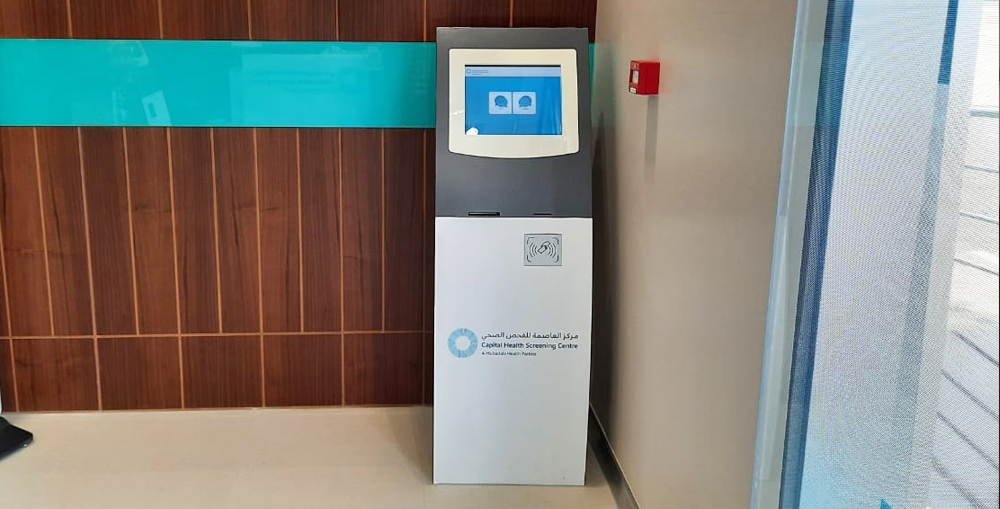
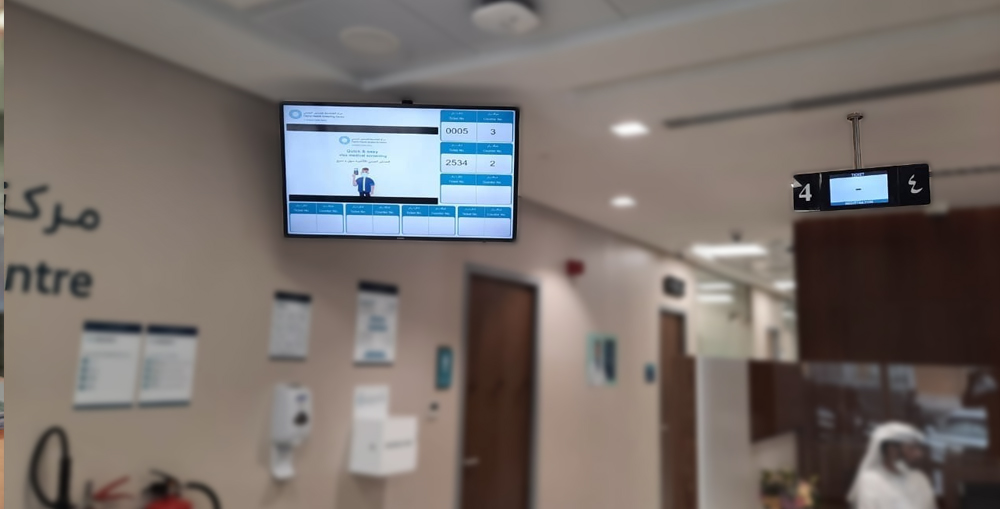
Users Devices and Peripherals for Startup

Users Devices and Peripherals for Startup

No matter either you go with cloud computing, in-premises or hybrid IT infrastructure you will going to need basic user devices and peripherals for your employees. You will have to provide computers, printers, scanners and internet connection to your employees. There is a business practice known as BYOD, or bring your own device. It means the business ask their employees to bring their own laptops, mobiles, etc. The big equipment such as printers, scanners and internet connectivity to local storage is provided by the business. However, it is always in the interest of the business to provide each and every device, even if an employee is permitted to use company mobile connection then the business should not only provide the connection but the mobile phone too. Which should be strictly used for only work related communication.

For startups and small businesses where the employees are less than 10 any consumer level network routers and WiFi will work perfectly fine. But if you have more employees or rely heavily on the internet then only business level branded network routers, switches and WiFi should be used. It is better to have a LAN connection for each PC, this will provide better speed and file sharing on local network but good quality WiFi hubs also works fine. In case of printers and scanners, it is always good to have an all-in-one network enabled printer which have printing, scanning and photo copying facilities all in one. This will save you a lot of cost.

As in a small setup all of the employees will be in closer proximity and everyone can reach to the printer, scanner and photo-copier easily. When purchasing user devices the licensing is very important, compare both Windows and Apple systems and then analyze which will be more compatible with the tools and software your employee would run and then take the decision. Local network storages are also required for quicker file sharing between employees, so use network enabled storage devices with SSD drives for better speed and longer life. Make sure all the important data and files are stored in a backed up storage.

See Also: Custom Software Development vs. Off-the-Shelf Solutions: Which is Right for You?

Outsourcing of the IT Infrastructure Components for Startup

Outsourcing of the IT Infrastructure Components for Startup

Outsourcing could be very beneficial in some cases. It can save cost, efforts and a lot of time. For example in case of the email service, if you want to have an in-premises email server it will going to require a lot of efforts, time and expensive securities to keep it operational. Even in case of cloud based solution in any case whether you acquire a managed email server or an unmanaged email server the cost will be very high. It is always better to outsource your emails. Similarly hosting websites and small web-based applications is also more cost efficient and easy-to-manage when outsourced to a reliable IT service provider such as RSI Concepts.

The important thing to understand while outsourcing any component is that the outsourcing company should have a good profile with local clientele and a great track record. The professional company will not only be more cost effective but it will ensure a hustle free service and will keep you informed of the market trends and updates. It will keep you updated and informed of the information and ideas which otherwise you wouldn’t be able to get exposed to at your own. This will help you competing with others and will also help you in doing improvements.

See Also: Why Custom Software Development is Essential for Digital Transformation

Acquiring Necessary Tools, Digital Services and Online Components for Startup

Acquiring Necessary Tools,Digital Services and Online Components for Startup

There are so many enterprise level tools and systems that could help boosting your operational capabilities as well as work efficiency. However, for a startup or a small business it is not profitable to invest in those top-notched expensive off-the-shelf solutions. When planning for other IT solutions and software such as ERPs, Sales System, Inventory Management System, Customer Loyalty Program, HR System or any such tool, only go for the very necessary tools. It is always better to acquire a customized solution provider and ask them to build you a customized Intranet which can serve you with all your needs. The solution or system has to be an all-in-one system. It should be able to fulfill you all accounts, purchase, sales and customer relationship needs.
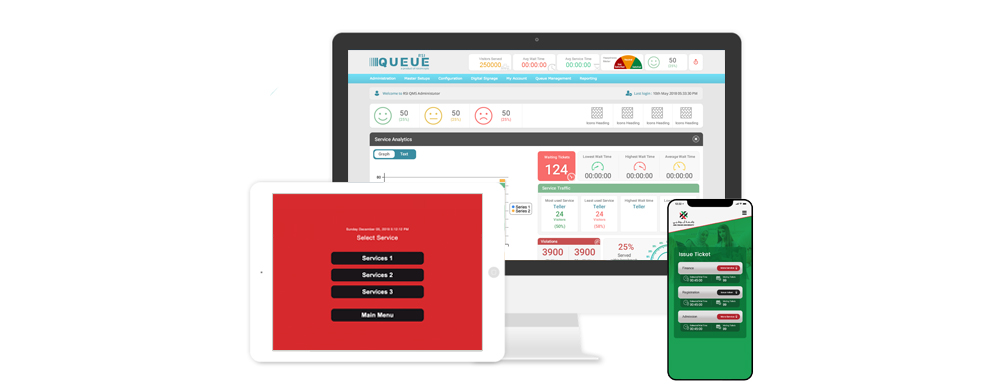
Another very essential online component of digital services is the digital marketing and online branding. The website is the basic component of all your online branding activities. When it comes to the websites, you will going to need the domain name, hosting, web designs and development service and occasionally you might be doing Search Engine Optimization (SEO), social media management and paid digital marketing services too. Make sure for all such solutions and services you chose only a single vendor, it will be a lot easier and cost-efficient to manage all these services with a single service provider rather outsourcing them to so many different vendors.

See Also: Step-by-Step Guide to Planning Your Custom Software Development Project

Conclusion

The IT Infrastructure is the backbone of any business small or large. It is literally the foundation at which the entire structure stands on. The rate of businesses going bankrupt on the same year in which they somehow loss their data is increasing day by day. That is why when it comes to the IT infrastructure the business should have to plan it very thoughtfully. In this blog we have listed the details of both in-house or in-premises IT infrastructure and the cloud computing based IT infrastructure. We have also listed another type which is the hybrid IT infrastructure which includes components from both main classes.

For a startup or a small business the hybrid IT infrastructure is the best option unless there is a specific need. It all depends upon the needs of the business. The outsourcing is also a great option for certain components. Whenever planning for the IT infrastructure the very important thing to consider is the initial cost and the running cost. In case of in-house or in-premises IT setup the business must have sufficient technical staff to keep the setup operational and running. Each type of IT infrastructure have their own benefits and limitations, think about the benefits and the limitation and then decide which component should be taken from which class and what services and components should be outsourced.

A business also requires essential software tools and user IT equipment. Plan those things with great care. Especially when you are planning to purchase computers and other devices for the employees make sure the platform or operating system you are opting for is also compatible with the rest of the IT infrastructure as well and also take the lifecycle and longevity in account. This guide is to help new startups and small businesses in building cost-effective IT infrastructure which can support them with growth and productivity.

The major reason for most failure of new startups or small businesses is that their IT infrastructure is not optimized to enable the employees to work on maximum efficiency. The initial cost and running cost is also a big burden for startups and small businesses. RSI Concepts is a leading name in IT solutions and services providers in Dubai, UAE. Feel free to reach us our through our Contact Us page or leave a comment in the comment box below and we will get in touch with you soon.

See Also: How Queue Management Systems are helping Businesses Grow in 2021


How Queue Management Systems are Helping Businesses Grow

How Queue Management Systems are helping Businesses Grow in 2021

The impact of the year 2021 was a complete shift in customer behavior, expectations, and market trends. Businesses are quickly adopting new technological solutions to deal with such changes. A queue management system is a great tool to transform customer journeys and to monitor each and every aspect of them. The businesses in Dubai and all around the UAE are strictly following the health and safety protocols, the social distancing is a new norm. The number of active queues and customers inside the premises has significantly dropped, however, the facilities remained of the same size.


Businesses wants to make the customer journey as quickly as possible to be able to serve an equal number of customers daily before the pandemic. Although this is a temporary situation and soon the businesses will resume as per their older states. However, the change in the customer behavior and market trend will be going to take a lot longer to reverse. Most probably it won’t reverse at all. In such conditions, businesses will have to have a better control over the customer journey and customer experience. Which is only possible with an efficient queue management system.

See Also: What are the Different Types of Queue Management System?

How Queue Management Systems are helping Businesses Grow in 2021

No matter what type of industry you operate in, almost all businesses want or have to keep their customers in lines and queues. It doesn’t matter how large or small your facility is, the important thing is to ensure a flawless customer journey and a satisfactory customer experience. Which is a key to success. Happy and satisfied customers tend to be the best advocate of the brand and help to promote a positive brand identity which improves the brand’s reputation and overall image in the market. This attracts more customers and it also helps to improve the conversion rates of the marketing activities.

Here are some key areas where queue management systems are helping business to ensure their steady growth in 2021:

Queue Management System Improves Customer Journey and Customer Experience

Queue Management System Improves Customer Journey and Customer Experience

A queue management system can completely transform the customer journey and enhances the customer experience. The main concern of all businesses is to improve customer journey and their experiences through their branch or offices. A queue management system can automatically manages the customer flow and route them according to the predefined company policies and protocols. Managing the lines manually required more staff and it also cause problems, most of the customers complains about line jumpers and mismanagement and got unhappy with the staff, this ruins their experience. The manual management of the queues also results in more workload on the staff and slowly moving queues.

This not only increases the wait time, but it also results in crowd formation and more pressure on the staff as well as on the customers and visitors too. The customer experience is ruined and the customer journey is prolonged. The customers left unhappy and unsatisfied. However a digital queue management system can prevent all these problems. A queue management system organizes each aspect of the customer journey and improve customer experience at each touch point. The customers and visitors can sign-up for the queue using an interactive interface which is mostly an interactive touch screen kiosks. The customer can select the service they want to avail and sign-up for the required queue.

See Also: What are the Basic Components of Queue Management System?

Once they signed-up they are directed to a waiting area. In the waiting area the businesses can further improve their waiting experience by utilizing the digital signage screens comes with any standard queue management system. Usually these digital signage are used to display live queuing information, but adverts and multimedia content can also be played to increase customer engagements. The queuing information are also very important for the customers. So these digital

Queue Management System Helps Improving Customer Retention

Queue Management System Helps Improving Customer Retention

The queue management systems are a great help to improve customer retention and customer loyalty. As the customer retention and customer loyalty both are linked with each other and both depends upon the customer journey and customer experience. A queue management system helps businesses and organizations to streamline their customer flow and to improve their waiting experience. This had a very positive impact on the customers and it also increase customer happiness rates. Customer happiness lead to improved customer loyalty, the loyal customers are the one who do repeated business with the brand and generate more revenue.

According to several studies and market researches attaining a new customers could be 9 to 12 times more expensive than retaining an existing customer. This directly impact the profitability of the business. Business always seek methods to retain their existing customers. As the customers who are happy with their brand are tend to be more loyal and only loyal customers are the one who promote a positive brand identity.

See Also: Why Small and Local Businesses Need a Queue Management System?

The positive brand identity helps the brand to attract more customers easily. A positive brand reputation also improves the outcome of the marketing efforts and campaigns. Once a customer or visitors builds a positive image of the brand it is much easier and less costly to satisfy them for the business. Only by improving the customer journey and customer experiences a brand can significantly improve their customer retention rates with the help of a queue management system.

Virtual Queuing Boosts Customer Happiness and Productivity

Virtual Queuing Boosts Customer Happiness and Productivity

Virtual Queuing is not a new type of queue management system in fact this form of queuing was there since more than 5, 6 years. However, due to the situation in 2020 the virtual queuing suddenly got attentions and businesses immediately rushed toward adopting this technology. The main concept of virtual queuing is to enable the customers and visitors to sign-up remotely and let them wait in the virtual queues without being physically present in the physical queue. This means that the customers and visitors will only have to come at the very time of their turn and they don’t have to wait inside the premises. This means there will be absolutely no wait time.

See Also: Queue Management System Features you Need for Modern Queuing

Wait time is extremely important in customer journey and customer happiness. Studies have shown that around only 13 minutes of wait time is acceptable by any customer or visitor, any time longer than that start impacting customer happiness and customer experience. Which is why the virtual queuing is a very advanced and modern form of customer flow management and it boosts customer happiness. Another reason why virtual queuing enabled queue management systems are gaining popularity is because the management can easily control the entire customer flow, they can limit the number of customers to be allowed inside the premises which ensure social distancing and health and safety of the customers and visitors as well as of the staff.

Apart from that when an option is given to the customers they prefer not to wait inside the premises, instead customers only arrive at the very exact time of their turn, which will prevent crowd formation and make it a lot easier for the staff to manage the customers and visitors inside the premises. This reduce the work load of the employees and make them more productive. As the agents and servers are relieved from extra work, their productivity automatically raised, they would be able to serve more customers in a single shift.

This enable businesses to reduce the number of employees and make rest of the employees more efficient which definitely reduce the cost and increases profitability. The balanced work load also improve the capabilities of the employees and make them able to serve customers better, which also improves customer experience and increase customer happiness.

See Also: 5 Challenges and Solutions of Queue Management System in Banks

Virtual Queuing Boosts Customer Happiness and Productivity

There are several methods and techniques used for virtual queuing, for example the customers can be allowed to sign-up from their smartphone applications, SMS, Email, Call, QR Code, etc. The queuing data and information can be provided on the customer portals, smartphone applications or temporary link which can be shared with the customers through SMS or Email or via Smartphone Apps. The customer calling and announcements can also be made through SMS, Smartphone Applications, Notifications, etc.

This further enhances the customer experience and increase their satisfaction. It leaves a very good impression on customers and customers thinks that the brand really cares about them and is very serious in facilitating them and making everything convenient for them. This help business promoting positive brand identity and it improves brand reputation.

Customer Feedback Module Aids Progress and Development Process

Customer Feedback ModuleAids Progress and Development Process

The customer feedback is a very important indicator of the business progress and development. Business here in Dubai and all around the UAE often overlooked this tool and keep pouring huge amount of resources for development and improvement in various sectors. But the question arises how would a business know if their all efforts and investments are in the right direction? The most accurate and easier method is to ask your customers if they are happy with all what you are doing to please them or not? That is why the customer feedback plays a vital role in business’s growth and progress.

See Also: Importance of Queue Management System for Government and Public Offices

Asking customers to opine on a certain aspect of the service delivery or customer experience is very simple and easy using a customer feedback module integrated with the queue management system. We have frequently witnessed small touch screens on the counters of banks, exchanges and retail stores. These are the simplest and easiest form of customer feedback. The businesses and organizations can also utilize these small touch screens or tablets to conduct small customer feedback surveys.

Linking the customer feedback system with a queue management system comes with several advantages. For example in such case the business don’t necessarily need to ask for identification information, as such information can be obtained from the queue management system itself, this enables the management to keep the customer feedback survey simple and easier which encourages more customers to share their opinion.

As one of the most annoying thing for any customer is to fill in long forms or to fill in identification data before submitting their feedbacks. The identification of the customer is not always needed but most of the time it is very helpful. A simple NPS Score (Net Promoter Score), or CSAT Survey (Customer Satisfaction Survey) could provide enough information to let the business trace the discrepancies or I would rather say the areas of improvements in the customer journey.

See Also: How to Implement a Queue Management System at an Airport?

Customer Feedback ModuleAids Progress and Development Process

Another advantage of the customer feedback module is that the management can conduct several campaigns to get a complete analysis of the entire customer journey including all touch points and business can also take reviews about their products and services. For example the business set a campaign to ask customer about the wait time only, the next campaign could be for the behavior of the server, another campaign could be to get NPS Score or to know the customers opinion about what is good or bad in a particular product or service and so on.

These all campaigns’ data can be combined to produce comprehensive reports which can be included in the policy making and decision making process. This ensures the development and progress of the business will be in right direction in future and it also provide a very accurate analysis of all the efforts that are being done till date to improve customer journey and customer happiness.

Queue Management System’s KPIs Help Improving the Performance

Queue Management System’s KPIs Help Improving the Performance

Queue Management System comes with in-built KPIs monitoring tool. The KPIs are Key Performance Indicators, mainly referred to as the performance of the employees. Apart from the KPIs the queue management system can also measure and monitor other aspects of the customer journey. The employee performance management and their KPIs are very important for the management to ensure the ultimate efficiency of the entire branch. The employee performance is measured by several indicators some are generic and some depends upon the situation and work flow of the business.

See Also: Queue Management System for Trucks and Logistic Centers

For example how much time is consumed by an employee to serve a single customer, this value is taken usually on average and it also records number of daily services. The queue management system also measure and records the work efficiency of an employee during the busiest hours and during the least busy hours and in between. Such information is very helpful in measuring and assessing the overall performance of an employee.

Queue Management System’s KPIs Help Improving the Performance

Moreover there are certain employees who perform well with certain services, means some agents are much better on certain services and when they are assigned the same they perform well comparing to other services, some employees perform well during the busiest hours and some perform better under medium work load. Such parameters are very important to manage human resource and the business can plan a setup to ensure the highest performance of all the employees all the time.

The KPIs also include the customer feedback data associated with a particular employee, which also provide more details on the subject. The business can also record the idle time and operating time during the day and can track record of such details. The KPIs monitoring is also important for optimizing the cost per service delivery. When all the employees are provided the conditions where they can perform at their best the customer journey and customer experience automatically improved. Resulting in cost optimization and more customer retention.

See Also: The Role of Queue Management Systems in Healthcare Facilities

Business Intelligence and Reports Help Making Profitable Policies

Business Intelligence and Reports Help Making Profitable Policies

Another remarkable feature of the queue management system is the in-built data analytical and statistical engine that captures extremely useful data and stats. The queue management system can capture the various parameters and aspects of the entire customer journey such as number of daily customers, busy hours, busy days, etc. It also captures average service time for each service, the customer journey duration for different categories of the customers, such as regular or ordinary customers, VIP customers, or the customers with special needs and so on. It can capture the system usage information as well.

The employee performance and KPIs are also included in the business intelligence and reporting to make the data more accurate and comprehensive. The customer feedbacks and data from other systems and business tools can also be included in these reports. Collectively the data is processed through the in-built smart algorithms and then several reports are compiled.

The major category of the reports are comprehensive or detailed reports, summary reports, trend reports and corporate or executive reports. These reports are designed for different levels of the management and are very helpful in analyzing the entire operation. On the bases of these reports and data the management can make more informed decisions and set up strategies to improve operational capabilities and efficiency, which directly impact the profitability and growth.

See Also: Why Performance Management System is a Necessity for Companies in Dubai

Conclusion

The year 2021 come with completely new challenges and business in Dubai and all around the UAE are eagerly seeking methods and tools to deal with the situation. The very top priority is to maximize the customer journey and customer experience to increase the customer retention which is considered to be the guarantee for the steady growth and profitability. Studies have shown that it is almost 9 to 12 times more expensive to get a new customer than retaining an existing customer and generating repeated business from them. This means the loyal customers can act as a strong foundation at which a business can aim for the growth and progress.

Businesses are investing a lot in customer satisfaction solution, a queue management system is a complete tool to manage and monitor the entire customer journey and all its relevant factors. A queue management system can completely transform the customer journey by automating the customer flow and improving a lot of business processes that further accelerate the customer journey and ensure least possible wait time.

The wait time is the most influential factor in customer satisfaction and customer happiness, a queue management system can significantly reduce the wait time and it is also very capable of improving the wait time experience and maintain customer engagement. It also improves employee efficiency and other aspects of the customer journey which make customer experience better. Furthermore customer feedbacks, KPIs monitoring and business intelligence gathering makes a queue management system an ultimate tool to optimize the customer journey.

The business intelligence data allow businesses to assess each and every aspect of the customer journey and then make informed decisions and strategies to improve them. The virtual queuing and smartphone applications further improve the customer experience, ensure social distancing and more control over the customer flow management and improve service delivery time and quality.

A queue management system is the most cost-efficient and effective tool to transform customer journey and improve business growth rate. RSI Concepts is a leading queue management system provider in Dubai, we are providing a complete range of customer satisfaction solutions and monitoring tools. Feel free to reach us through our Contact Us page or leave a comment in the comment box below and we will get in touch with you soon.

See Also: 2021 Digital Branch Transformation Trends

See Also: The Future of Queue Management Systems: Trends to Watch in 2025