
BLOG OF RSI CONCEPTS

world map

Digital Branch Transformation Trends

2021 Digital Branch Transformation Trends

The 2021 is the year of change and transformation in Dubai and all around the UAE, especially how the digital and online solutions got integrated within our daily lives, it have completely changed the expectations and behavior of the customers. Earlier people were not so adoptive towards the high-tech solutions, rather prefer more traditional approaches and methodologies. Now a days, everyone is familiar with the usefulness and convenience of the digital solutions. The marketers and the administrations are also embracing digital and high-tech solutions knowing that it could provide a great competitive edge in customer journey transformation and customer happiness.

The COVID situation and the past experience in 2020 have given the rise to the contactless payment, self-service and social distancing. Especially the banks and other customer service sectors are already trying to keep up with this new trend. Apart from the contactless payment, the entire branch experience and customer’s expectations are driving the innovation and technological solutions to the next level.

Earlier businesses were afraid that the very advanced digital solutions might not gain popularity among the general consumers, however in past few years the digital branch transformation have reached to a new level. The customer experience, customer behavior and operational efficiency are the most influential factors on the digital transformation. The businesses are seeking methods and ways to preserve precious customers and improve customer retention while also trying to reduce expenses to ensure higher profitability and revenue generation.

See Also: The Role of AI in Enhancing Queue Management Systems

Here are some of the modern trends for digital branch transformation in Dubai, UAE:

Digitalization and Automation of Customer Experience

Digitalization and Automation of Customer Experience

As the 2020 situation was totally unprecedented, which suddenly halted a lot of business operations. However, the banking sector and the customer service industry was quicker to adopt to the digital solutions to aid the social distancing and closure of the branches. The smartphone applications and the digital service through online gain popularity. Customer feel more comfortable using the digital platforms to avail a service. After that, now when the businesses have resumed all over the world, here in Dubai and all other emirates of UAE the customer behavior have completely changed, the customer experience and customer journey are setting up new trends.

Business have to change their practices, processes and methods at a very higher pace in order to meet the demand and expectations of the customers. It doesn’t mean that all older queue management systems and other customer satisfactions solutions have become irrelevant or useless. But the point is that the customers are expecting and hoping to see a digital and automated kind of business processes and customer journey.

See Also: 5 Challenges and Solutions of Queue Management System in Banks

Minimizing the Gap between Customer’s Expectation and Your Capabilities

Minimizing the Gap between Customer’s Expectation and Your Capabilities

Since the customer’s expectation and market trends have been changed, the business need to focus on smart solutions and methods which can reduce the gap between the customer’s expectations and your capabilities. It is crucial to keep this gap at the lowest, else the customer will switch to another brand. The UAE is a very large market with too many businesses are operating and more are joining the market on the daily bases which raise the level of competition.

These days customers have too many options, and due to the impact of the pandemic and the new methods and processes to handle that impact the customers are already concerned, and it is an estimation that 8 out of 10 customers are willing to switch if their current service provider failed to meet their expectations and needs. Here are some of the well-renowned gaps between customer’s expectations and a business’s operational capabilities:

See Also: What are the Different Types of Queue Management System?

  1. Cultural Gap: This gap is common when the top level management is not customer centric, the organizational culture and tradition flows from top to bottom. In such scenarios the staff won’t be able to satisfy the customers.
  2. Value Gap: The gap between the actual quality and features of products and services and the expectations and needs of the customers is known as value gap. This gap is very common where the communication is not so strong and business is not getting customer feedbacks.
  3. Emotional Gap: When the communication gap is too much or the marketing and communication efforts are not in the right direction the, feedback is not taken the customer complaints are not solved the customers feel emotionally distant from the brand and think the business doesn’t care about them much.
  4. Marketing Gap: When a business markets and advertise its products and service with overpromising content and the actual products and services doesn’t meet the expectation the customers, the customer feel disappointment and eventually switch to the other brands.

These are just a few example, there are so many other things that can cause your customers to switch. The important thing is to understand what your customers think about your business, what their needs are and what their expectations are, then make plans and strategies to improve everything for your customers.

It is important to understand your capabilities and limitations too, for example, if you want to compete and you must have to keep the cost to a certain level then the strategy should have to be made in a way that your products and services can offer at least the most anticipated features. This way any such gap can be reduced to improve the trust and brand impression. This will significantly improve the overall efficiency and operational capabilities of the branch.

See Also: Queue Management System Features you Need for Modern Queuing

Going Contactless and Rise of Virtual Queuing

Going Contactless and Rise of Virtual Queuing

Not only in Dubai, UAE but all over the world business have witnessed that the branches who are offering contactless and virtual queuing are attracting more customers than the regular branches. The customer behavior, market trends and the customer’s expectations have completely transformed the business practices, methodologies and in some cases the entire customer journey has completely changed. Going contactless, digitalization and automation have become the new norm. All sorts and types of businesses are preferring contactless operations, the eCommerce are emphasizing on contactless deliveries and the business are offering methods of contactless payments and all that.

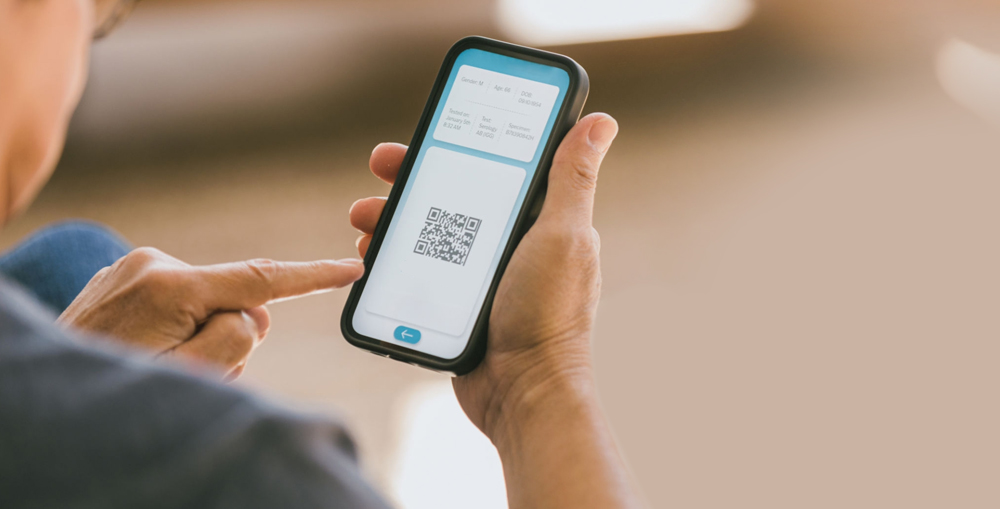
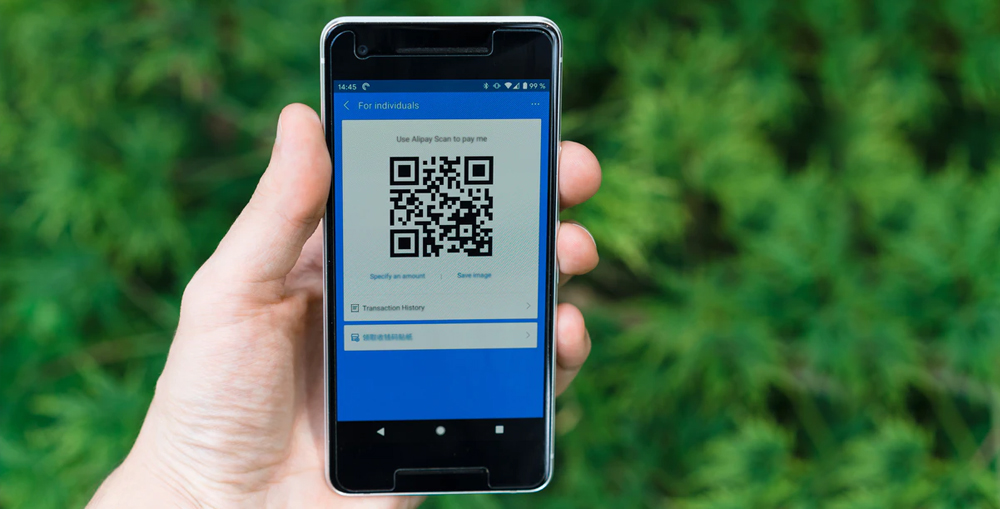
These days the QR Codes and digital interfaces are taking over the usual paperwork and much more. It is extremely crucial that a business tries to offer as many contactless services or service steps and processes as much possible. At least what touch points can be converted to contactless should be converted to contactless. Businesses should seriously think about offering less than least personal contact inside their branch.

Virtual queuing is an excellent technique to control the number of customers inside the branch. It help preventing crowd formation. The virtual queuing is also very helpful in implementing social distancing policies. The virtual queuing also enables the customers to sign-up remotely for the queue and then wait in virtual lines, without being physically present in the actual line inside the branch. The customers can sign-up from SMS, Calls, WhatsApp, Email, Smartphone Apps, Online Portals, QR Codes and much more.

See Also: Important Hardware Components of a Queue Management System

This gives them a sense of trust and confidence. In addition the virtual queuing also prevent long wait time, in fact the customers can directly arrive at the counter when their ticket is called without any wait. Waiting is the most negative factor in customer experience. Less wait and quicker service delivery make customers happy and satisfied. Moreover the virtual queuing also have other benefits such as it empowers the staff and reduce their work load. It automates various process and enables a single agent/server to serve more customers in a single shift. This improve the operational capabilities and increase profitability of the entire branch.

Rise of Self-Service and Interactive Kiosks

Rise of Self-Service and Interactive Kiosks

Another excellent technique used by many businesses in Dubai and all across the UAE is offering self-service solutions and interactive kiosks. The self-service means that a customer is being provided with an automated digital system/interface which allow them to avail the service all by themselves and there is no need of any staff assistant throughout the process. The customers can reach at the self-service stations or portals and avail the service by themselves without any wait time. It enables instant service delivery with 24/7 availability.

See Also: How Queue Management System Helps Maximizing the Efficiency?

Each branch these days should have a dedicated section for the self-service customers which will not only improve the customer experience but it will also be very helpful for the staff and it will reduce their workload. Obviously not everyone is familiar or I would rather say ‘comfortable’ in operating at self-service interactive kiosk, so the regular counters will be there to serve them, this also help businesses to reduce the people in the waiting area and to implement the social distancing and other policies easily.

There are so many different types of the interactive self-service kiosks which are being used to offer a variety of services. We are using self-service kiosks since a long time and almost everyone living in Dubai or anywhere in UAE must have used one once or at least say them. For example the vending machine is a self-service kiosk, the ATM is a self-service cash counter and other such services which everyone uses on daily bases. These self-service interactive kiosks comes with a variety of hardware and software features and functionalities.

Some interactive kiosks also allow customers and visitors to do the registration process from a medium size touch screen interface. Earlier the physical keyboard and track pad were used but now a days on-screen keyboard and touch panels are popular. Moreover the Emirates ID, Printer, Scanners, Passport Scanner, IRIS, Biometrics, Cash Deposit, RFID Scanner, QR Code reader, etc. and many more such devices can be integrated with the self-service interactive kiosks. All these technologies are very helpful and enables the businesses to innovate new and unique solutions for their customers.

See Also: What to Consider When Choosing a Queue Management System

Technologically Advanced Queue Management System

Technologically Advanced Queue Management System

A queue management system manages customer flow and is majorly responsible for the customer journey and customer experience in any branch. The queue management system is very important. As different businesses have different needs and different internal business processes and mechanisms so a queue management system must have to be efficient enough to improve all customer experiences throughout the entire customer journey. We always recommend a tailor-made solution that can efficiently boost overall productivity and profitability of the business.

A queue management can have a variety of software and hardware components however we will discuss some key points that every business should consider while choosing a queuing solution for them. The very important factor that you need to consider is the type of your services. Whether a service can be delivered through a single counter or is your services or some of your services are stepped services that require your customers to get served through multiple counters for a single service deliver. These things will define the type of the queue management system.

See Also: Innovations in Queue Management: The Future of Customer Service

Moreover other factors such as how many counter do you have or your policies such as priority customers, dedicated customers and such other details should be considered. The digital signage are an essential component of a queue management system however the size of the display screen and the placement should be decided strategically that at least one screen is visible from anywhere in the waiting room so that the customers don’t have to get up from their seats or get discomfort to get the view of the screen.

The announcement system and the queuing information should be multi-lingual, at least Arabic and English is must to have. Then the counter plates and other signs should be included in the system as per the requirements. It is better to have remote management, virtual queuing and customer feedback modules in the queue management system. The centralized information center is must to have so the head office can manage and monitor all the connected branches.

Moreover, the queue management system should be able to offer flexible and easy sign-up methods such as interactive self-service kiosks, remote sign-up, virtual queuing and smartphone compatibility. Last but not least, a better queue management system should be able to collect and capture data from various touch points of the customer interaction to compile business intelligence data which can later be useful for decision making and policy making.

See Also: Queue Management System and Predictive Waiting Time

Collect Customer Feedback and Business Intelligence

Collect Customer Feedback and Business Intelligence

Business in Dubai and all around the UAE in fact all around the world often overlooked the importance of customer feedback and business intelligence. However, these two are essential for evaluation and improvements. Business often spend huge amounts in customer satisfaction solutions, products/services, operational improvements, infrastructure and other solutions but how a business will know if their all efforts and investments are going in the right direction? The customer feedback and business intelligence is the only way to know that.

A positive customer feedback is a direct measurement of the customer happiness and customer satisfaction. The customer satisfaction is considered to be the direct measurement of the overall progress and development of a business. That is why collecting customer feedback and gathering business intelligence data from various touch points and employee KPIs (key performance indicators) are crucial to understand the impact and effectiveness of all your efforts and investments.

Moreover collecting customer feedback, gathering data and getting the indicators can’t be beneficial unless actionable reports are compiled from this data. The reports are based on the in-built system analytical engine and statistical processing, which is mandatory to have. It is extremely important that the reports and data collected from various systems and KPIs is completely in-line with the internal evaluation processes. The data has to be compiled in various reporting formats.

See Also: The Future of Queue Management Systems: Trends to Watch in 2025

The corporate reports should be produced for the higher management to let them take decisions and upgrade their policies. The detailed and summary reports should be produced to pinpoint the areas of improvements. The KPIs and employee performance indicators should be collected to assess the employees. The business should have to think critically when planning the reporting and business intelligence modules. That is why we always recommend customized queue management systems which are dedicatedly designed for the very specific needs of the business and are tend to be more efficient.

Conclusion

The year 2020 have completely changed the entire business landscape in the entire world. Business have recovered fairly quickly and are very eager to keep a hold on their existing customers and also attracting more customers to ensure a steady growth. In the new landscape the marketer are focusing more in communication and better customer experience. The customer journey transformation is absolutely necessary. The business will have to abide by the government policies, the regulation and social distancing laws and the safety and health of their customers and the staff is also top priority.

Which is why business are seeking new methods and techniques for branch transformation. As suddenly we all went online and everyone has to interact with the digital services and business and organizations also have to switch to the digital platforms, the acceptance level of the digital and automation got very high among the general consumers. In fact people now expect some kind of digital and technology-backed interaction with their favorite brands and businesses. The customer experience is extremely important, if your customers are satisfied they will be more loyal and if they are unhappy they will immediately switch without any second thought.

The competition in the market is very high, the customers have too many options. But we also understand each business have their own limits, capabilities and a finite stream of precious resources. So we always recommend our customers and readers to think critically and try to minimize the gap between the customer’s expectations and your operational capabilities. The virtual queuing is another great tool to deal with today’s scenarios. It is absolutely necessary that you implement a queuing solution which resonate with your internal organizational structure and add value to both the customer experience and to the management and operational efficiency.

The self-service counters and terminals are also a great strategy to boost customer experience. In order to evaluate all those efforts and investments and the overall efficiency and productivity of the branch the customer feedback collection and business intelligence is a mandatory feature for any branch transformation tool. Businesses are reporting huge gains from the policies and strategies made on the bases of business intelligence data. RSI Concepts is a leading name in Dubai, UAE in branch transformation solutions, queue management systems, customer feedback systems and other customer journey transformation tools, if you need any help feel free to reach us out through our Contact Us page or leave a comment in the comment box below and we will get in touch with you soon.

See Also: Why Performance Management System is a Necessity for Companies in Dubai


What to Consider When Choosing a Queue Management System

What to Consider When Choosing a Queue Management System

Embracing technology and innovation is not always easy. Especially when it comes to a queue management system that is responsible for managing the customer journey and customer experience. A queue management system is also very capable of improving employee efficiency and operational capabilities, which makes it very important for any business’s success. Here in Dubai and other parts of UAE, there are so many different vendors and suppliers with a long list of customized and off-the-shelf queue management solutions, which makes it furthermore difficult for a business to decide which brand or system could meet their requirements.

When installing a new queue management system there are several factors that have to be taken into account else there could be very serious losses in terms of resources and customers. Businesses and organizations have to deal with too many customers on daily basis, which requires an efficient customer flow management platform. Moreover, businesses also need data and business intelligence to make informative decisions for the future. That is why a queue management system is installed. A queue management system can assist in all these areas.

If the queue management system doesn’t have the necessary features it might not be able to improve things much, or in fact, it can worsen the customer experience and cause great troubles for the management and staff too. Customer happiness and customer satisfaction are extremely important for businesses and organizations and better operational efficiency results in better resource management and cost optimization.

There are several factors and components that a business should consider while choosing a queue management system. Some of the most important factors are listed below:

What Types of Services You are Offering?

What Types of Services You are Offering?

That is the first and most important factor to consider while choosing a queue management system. If you are offering a single service then only a few queues will be enough and you can have as many counters as you can. But if you are offering more services then more queues are required and customer journey management is required so each customer reaches the right agent/server. Usually in Dubai and all around the UAE when a business is offering multiple services, they are having multiple counters, some are dedicated for certain services, and so on.

These all details are important. There are two types of service delivery methods, the first method is the single counter method, according to this method the full-service delivery is done through a single counter. The other method is for stepped services, which means a single service delivery requires the customer to get served in two or more steps, the customer will have to visit multiple counters as per the service type to get the full-service delivery.

That is why it is important to first understand your requirements by analyzing your services and services’ types. For a stepped service a different kind of customer journey management is required for a regular service type where a full service is delivered at a single counter a different kind of customer journey management is required and so on and so forth.

See Also: What are the Different Types of Queue Management System?

A Great Customer Experience is Must

A Great Customer Experience is Must

The primary reason for installing a queue management system is to streamline customer service and improve the customer satisfaction. A queue management system should be able to add value at all touchpoints of the customer journey. Here the important thing which most of the businesses in Dubai overlooked is to understand the importance of pre-queue and post-queue customer experiences. The customer interaction starts before even arriving at the branch. Even the traffic on the way, the difficulty in the parking and weather too can contribute to customer experience.

Although the impact of such things is indirect it directly impacts the customer’s mood, which later reflects in their behavior and experience. There are certain things that can’t be controlled, however, the pre-queue experience can be improved with the help of an appointment booking module or a smartphone application, etc. Virtual queuing is a great example of improving the pre-queue customer experience. The virtual queuing, remote sign-ups, and appointment booking modules all are designed to improve customer experience and customer journey.

The post-queue customer experience is usually asking for customer feedback or conducting a survey. Customer feedback and surveys are important and provide extremely reliable business intelligence data. Moreover, the customer feedbacks and survey builds trust and give an impression of importance and priority to the customers.

Now once a customer is inside the branch and is waiting for the queue, the waiting area, the digital signage, the counter displays, the audio-visual announcements, multi-lingual queuing information and announcements, customer routing signs and various markers, and everything else that is somehow contributing to the customer flow and routing the customers will impact on the customer experience.

The agent/server, the service delivery time, and the waiting time are extremely important factors to improve customer experience. A queue management system should be able to provide all possible facilities for the customers and visitors to improve their experience. Which will determine customer satisfaction and customer loyalty.

See Also: Queue Management in Banking: Enhancing Customer Experience

In-built Virtual Queuing and Social Distancing Features

In-built Virtual Queuing and Social Distancing Features

Due to the pandemic, customer behavior and requirements have changed. Each and every business in Dubai or anywhere else in UAE must have to comply with the government policies and social distancing laws to ensure the ultimate safety and hygiene inside the premises. These days’ businesses are eagerly seeking methods and ways to gain the trust of their customers and visitors. Virtual queuing is gaining popularity due to social distancing and COVID-related concerns.

The virtual queuing allows the customers to sign-up for the queue remotely. It means a customer or visitor can sign-up for the queue without being physically arriving at the branch, and they can also virtually wait in the waiting lines. This way the customers and visitors are free to wait outside or in the parking lot or at home and only arrive when their number comes.

There are different methods to enable remote sign-ups and virtual queuing such as calls, SMS, email, online customer portals, websites, smartphone applications, etc. The remote sign-up issues a digital token number. The customer can wait outside while being present in the virtual waiting line. When their call has been made they can directly reach to the counter and get the service done. The customers don’t have to wait in the waiting area neither they would have to stand in physical queues.

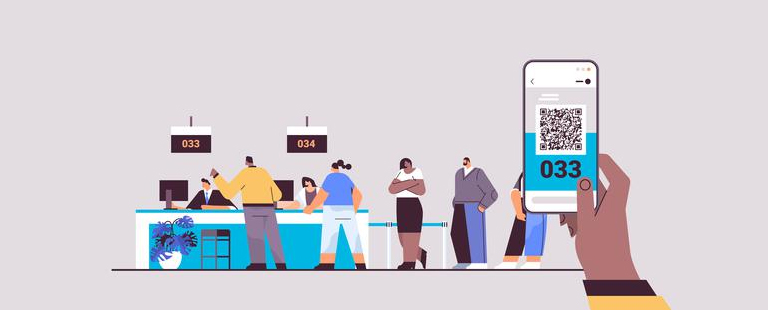
Virtual queuing is very helpful for maintaining social distancing as well. The queue management system should be able to manage the number of customers as per the company policy and capacity. The QR Code is also utilized for virtual queuing and social distancing, the customers can scan a QR Code which is placed strategically either at the entrances or any such place, the customers can scan the QR Code and a digital token number has been issued. The customers can wait outside and when their turn came they can come inside and wait or get served immediately as per the company policy.

See Also: Importance of Queue Management System for Government and Public Offices

Customization, Scalability and System Integration

Customization, Scalability and System Integration

Any good quality queue management system must have the ability to scale easily in the future. As the customers’ demands, expectations, and market trends are ever-changing, it is wise to have a system that can evolve with the evolving needs. Most of the queuing solutions are customizable, however certain limitations are there which are either due to the technology used to build those systems or either could be due to the sales policies of the vendor. Whatever the reason is if any such limitation is there it will be harder and very expensive to update, modify or change any such queue management system.

It is important that the queue management system supports and aids the relevant business processes and IT infrastructure. Customization and scalability are also very important as businesses are expanding and adding new branches all the time, so the queue management system should be able to be supportive for expansion. Sometimes such expansions also require certain changes in features or functionalities of the queue management system which could be very costly, so it is important that the queuing solution you are choosing is already ready to support the expansion, this will save you a lot of time, hustle and cost.

Another very useful feature of any IT solution is its capability and compatibility to other solutions and systems this is often referred to as ‘system integration’. Usually, the businesses are using multiple systems and want to integrate them with each other for certain reasons. Such system integration not only makes the management process simpler but it provides more room for innovation, automation and results in ultimate efficiency.

Usually, businesses and organizations are interested in the system stats, reporting, customer feedback, loyalty program, KPIs (key performance indicators), reporting, and customer data integration. All these are not necessary but important. The important thing is that the queue management system you chose should be able to support such types of data sharing & synchronizations. System integration can boost the efficiency of the queue management system and help transforming the entire business operations.

See Also: Queue Management System for Trucks and Logistic Centers

Reporting and Business Intelligence

Reporting and Business Intelligence

A queue management system is a customer journey transformation tool. It can capture data from various important touchpoints and also other relevant data. Which could be a great help for the businesses. The businesses can easily track records of the busy hours, days and weeks or any such detail. The queue management system can also track and record customer wait time which is extremely important for customer experience and customer satisfaction. The time required by various steps of the customer journey can be measured.

The queue management system can also measure various KPIs (key performance indicators) which are related to customer flow, agent/server’s performance, and much more. These details are very helpful for the business to understand the performance of their business practices and methods. The business can also easily evaluate and measure the performance of the employees and agents. These details are very helpful for businesses to make future strategies and help them easily identify the areas of improvement.

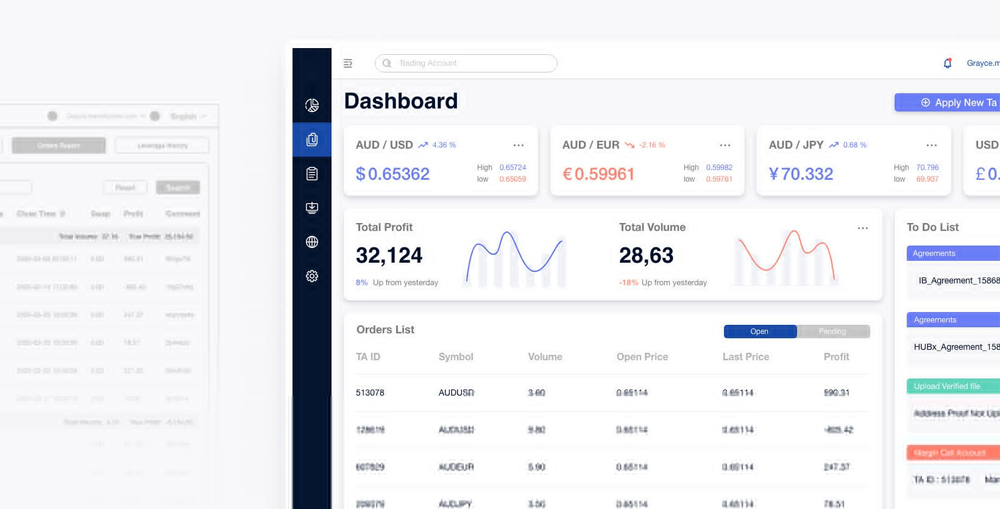
The queue management system can also collect customer feedback directly from the customers. The customer surveys, happiness meters, and NPS or net promoter score are a great measure of the overall performance of the entire queuing process. Businesses can also collect feedback about the behavior of the agents, facility, products, and services, and much more using the queue management system’s in-built customer feedback module. The reporting should be compiled in a dedicated administrative dashboard with the capabilities to link them to other systems and solutions to streamline the data.

Moreover, a good queue management system must have in-built data analytical and statistical engine which should be able to process the raw data into well-prepared compiled reports. These reports should offer different formats such as detailed reports, summary reports or trend reports, and so on. These formats are very helpful for various levels of the management and the policymaker or strategy builder can utilize any convenient type of report while making decisions and making policies.

See Also: The Role of Queue Management Systems in Healthcare Facilities

Real-time Updates and Remote Management

Real-time Updates and Remote Management

Mostly the business in Dubai and all around the UAE have various branches and the upper-level management resides in the head office or headquarter. This raises a need for real-time monitoring and remote management of the system. Any good queue management system must have remote management and real-time update capabilities. The real-time updates enable the head office to view all the connected branches live and they can access the queuing data in real-time.

All the data is stored at a centralized database which is either residing inside the central database of the business or hosted on a cloud. This enables the higher management to monitor all the branches in real-time which makes the management very easy and convenient. Remote management enables the head office to push company policies instantly on all branches or selective branches and it also provides the ultimate control over all the connected branches.

The queue management system must have dedicated dashboards such as the customer interface, where the customers interact with the queue management system, the agent’s dashboard where the agents interacts with the system, and the administrative dashboard where the branch managers or top management interacts with the system. This requires a proper workflow and user authentication mechanism which authenticate each user and provide them with the level of control they are entitled to. The user authentication and access control also make the system more secure and error-proof.

See Also: Why Small and Local Businesses Need a Queue Management System?

Conclusion

A queue management system is a necessity these days for business. Especially in the service-based industries where the business is dealing with daily footfall. There are certain features of trait of a good queue management system that are must have when implementing a new queue management system. For example, the first and most important thing is that the queue management system should be able to improve the service delivery process and customer experience. We always recommend our customers a tailor-made queue management system as it provides more flexibility and control over the business processes and doesn’t require or push any change for the existing business processes and internal infrastructure.

Moreover, a good queue management system should be able to scale and upgrade easily and should have support for future expansions. Usually, the business has a main head office and several regional offices or branches a good queue management system should be able to provide the head office facility to get real-time updates from all the connected branches and also the remote management, which enables the businesses to push company policies instantly to all branches and make the management and control easier. The reporting and business intelligence collection are vital for doing improvements and identifying the areas of improvement.

These features not only transform customer journey and customer experience but also help businesses to improve the overall operational efficiency and help increasing revenue and profitability. RSI Concepts is a leading queue management system provider in Dubai, UAE. If you want to install a new queue management system or want to upgrade your existing queuing solutions feel free to reach us out through our Contact Us page or leave a comment in the comment box below and we will get in touch with you soon.

See Also: 5 Signs Your Business Requires a Queue Management System

See Also: The Future of Queue Management Systems: Trends to Watch in 2025


Why Performance Management System is a Necessity for Companies in Dubai

Why Performance Management System is a Necessity for Companies in Dubai

The performance management system is absolutely necessary for businesses, enterprises and companies in Dubai, UAE. We all are aware that the economy is restoring from the pandemic, the market is getting competitive, the market trends and customer behavior got changed. Huge changes have to be made in business processes and practices to compete in the new environment. This is what makes employee performance more critically important for your growth. In Dubai and all around the UAE the economy is growing on a very fast pace, new competitors are popping up every day. The country is a major market in the entire MENA region and also in the Central Asia.

Competition always raise the quality and standards. The customers and more aware and more demanding than anywhere else, which is why it is crucial for a business that their employees and the entire infrastructure works perfectly to sustain growth. The customer experience, customer satisfaction and customer retention all directly impacted by the employee performance. The quality of product and services doesn’t only rely on the infrastructure and high-tech machinery, in fact the employees who are operating and utilizing those should also have to perform good to ensure the ultimate quality of products and services.

See Also: Why Organizations need Performance Appraisal System in UAE

A performance management system is a systematic framework for continuous performance measurement, which is achieved by allocating the manpower, resources and setting up priorities which are aligned with the goals and objectives of the company. It is a great help and support for the HR department as well. The HR department can easily track KPIs (key performance indicators) and carry out behavioral assessment for the employees to not only identify the areas of improvement but to also help employee development.

A performance management system encourages the employees to perform well and increase their potential, work quality and competitiveness which results in good quality work and better performance. Mostly the business owner, higher management and the HR managers are heavily relying on the performance management system to increase and ensure profitability and growth.

Here are some reasons that why a performance management system is a necessity for companies in Dubai, UAE:

See Also: The Risk of Poor Performance Management and How to identify it?

Performance Management System’s Benefits for the Company

Performance Management System’s Benefits for the Company

The companies and organizations can have so many competitive advantages by implementing an efficient performance management systems. The biggest advantage is that the companies and organizations can easily monitor and improve the performance of different departments. The overall performance of the department is dependent on the individual performance of all the entities that are making that particular department, now in some scenarios some entities may overlap other departments too in such case their overall performance and contribution to each department should be analyzed and then the decisions should be taken to improve the performance by keeping in mind the effects of those decisions on the other departments too.

An effective performance management system helps companies and organizations to efficiently manage resources to maximize the output. This increase the profitability of the business and help in maintaining and attaining growth. Companies and businesses can easily monitor and track the performance of various departments, teams and individual, this help them assessing various levels of the organization. This analysis is also very helpful in making decisions and planning to allocate resources and align key players with the organizational goals and objectives. The data captured through a performance management system can provide precise and very accurate analysis of gaps and deficiencies in the departments, teams and individual employees.

See Also: How Performance Management Systems Enhance Employee Engagement

The business/company can easily make policies and assign resources to fill these gaps to maximize the productivity and profitability. This is a great help for resource management and cost cut. Once the company evaluate all the resources in hand and knows their capabilities then it can easily assign appropriate and adequate resources for a particular task or objective, this way businesses can achieve more by investing less resources. If the company is able to allocate and manage resources with maximum efficiency this will impact the overall performance and progress of the organizations.

For example the production team can perform well and ensure highest quality of the products. The customer service department can promise higher customer happiness and satisfaction, which consequently leads to higher customer retention and loyalty. The loyal customers help business to grow further with less efforts by advocating the brand and by promoting a positive brand image. The brand identity plays an important role in growth and profitability. Collectively all these efforts will result in higher customer loyalty and higher conversion rates, which will definitely help sustaining a continuous growth. Effective resource management ensures efficiency which reduce the cost and increase the quality which results in higher profitability.

See Also: Benefits of Implementing a Modern Performance Management System

Performance Management System’s Benefits for the Management

Performance Management System’s Benefits for the Management

The biggest hurdle any executive level and lower level management reports is the communication barriers, poorly performing accountability methods, poor resource allocation and inefficiency costing management. A performance management system can help in tackling all these problems. It is always hard for the managers to communicate the assessment criteria and protocols to the employees and on the other hand the employee also report that they don’t understand the appraisals very well. However with a performance management system the employees can easily understand and view the criteria and methods for the assessment, which encourages them to work in the right directions to boost their performance.

The employees can also track their own performance continuously and also on regular intervals, this is also very helpful in raising their morals and boosting their efficiency. As the performance management system capture data from various touch points and can have so many different types of indicators which are all automatically analyzed by the system so the accountability methods become more accurate and efficient. One of the primary task of any performance management system is to accurately assess and judge the employees to identify their weaknesses and strengths. If an employee is performing well when he was working on a particular work station or in a particular team or unit, then that means they are the right fit for that particular gig.

See Also: How to Design a Modern Performance Management System?

For example if an employee perform very well while assembling electrical panels for transformers when assigned within a particular team and the same employee perform poorly when assigned to assemble the electrical panels for the generators with the same team, that mean that particular employee’s strength is working at transformer’s electrical panels. That kind of comparisons are very helpful in evaluating the employees and improving their performance. This also highlight that the employee might require more training for the generator’s electrical panels. When an employee is assigned for a job they are good at, they will do more work and their work quality will be better.

However, if an employee is assigned a tasks which they are not performing well whereas the same employee perform better on other assignments, that means if the employee will be assigned to the work they are not good at, the work quality will be decreased and the business might have to assign more personals to finish the job in timely manners. This is how a performance management system can be very helpful in reducing the cost and improving efficiency. Moreover if the employee perform well they will not only reduce the cost by their increased efficiency but in fact they will also produce quality work, your customer service will get better and much more.

See Also: 5 Challenges in implementing Performance Management System

These things directly impact the customer experience and customer satisfaction. Happy and satisfied customers are tend to be more loyal towards the brand, and they also help promoting a positive brand identity. A positive image in the market attracts more customers and help business grow exponentially. Similarly the happy and satisfied employees tend to stick with their employer for long, the company can have a very skilled staff and employees who have sufficient experience and mastery of their respective fields. Which further empowers the business and let the company build a stable platform with higher employee retention and higher customer retention the growth could be very sustainable and long term.

Performance Management System’s Benefits for the Employees

Performance Management System’s Benefits for the Employees

A performance management system is very helpful and beneficial for the employee. It reduce the uncertainty and ambiguities. The communication got better with the employer, the employees can easily and clearly understand their capabilities and can also do self-assessment. The businesses can easily convey their expectations to the employees and the employee can easily compare themselves with those expectations and start trying to improve themselves to meet those expectations. The self-assessment and a clear goal has a very positive influence on the employees and it encourages them to do self-improvements and it also highlights the strengths and weaknesses of the employees which is again very beneficial for the personal development of the employees.

See Also: Choosing a Performance Management System A Buyer’s Guide

The employee can request for certain trainings or in fact the management can also arrange adequate trainings for the employees, which eventually also improve the skills and capabilities of the employees and provide them an environment where they can grow too. Another great advantage of the performance management system is that it can very accurately measure the employee performance under different scenarios. For example if an employee is more productive under tough conditions or is not hardened enough. If the employee perform better with one team and perform not so good when assigned with another team and so on and so forth. Such data is very beneficial for the employees and the management too.

The management can rely on this data and then they can assign the employee to the teams or environments where they perform well or they can also dig deep to understand the cause of poor performance under certain circumstances and then take actions to rectify this. The self-assessment and such details can also define a clear career path for the employees which is very beneficial for both the employees and the company too. The company can have a set of experts and qualified employees and employee will get the benefits of the training and experience which will groom them to be able to progress and grow personally.

See Also: The Impact of Performance Management on Organizational Culture

The employee performance management system also very helpful in reducing the conflicts, issues and other management related problems, for example if an employee is performing well but his team or the overall department is not doing so good, in that case that employee will have more confidence that they will be applauded for their good work and their efforts will still be recognized and acknowledged. This boosts the morale of an employee and encourage them to consistently showing good performance. As all the evaluation and judgment is done through a systematic approach so no employee will think about favoritism or discrimination and the overall work environment will get better.

Performance Management System’s Benefits for the HR Department

Performance Management System’s Benefits for the HR Department

The HR department can take many advantages from using a performance management system. One of the biggest advantage is that it provides very accurate and precise measurement of any employee’s capabilities and weaknesses. It motivates employees and encourage them for innovation and improvements. Most of the time the employee always have concerns about the evaluation process but with the help of a performance management system and it also enables a better communication channel as well. The HR department also got a better platform to accurately evaluate employees and on the bases of evaluation they can easily make decisions related to employee promotion, demotion, dismissal or transfer and such.

See Also: The Future of Performance Appraisals: 6 Innovations and Changes [Quick Guide]

This also help HR to support employees who are facing problems and improve employee trust and happiness. The HR department also have to ensure that all skilled staff and required human resource is available whenever needed. By evaluating the employees and their capabilities the HR department can easily make decisions for new recruitments and hiring. Most of the long-term strategy planning required performance management data and inputs. The performance management system is very helpful for HR strategic planning for long-term human resource and workforce. Another great advantage to the HR is that the employee performance management system significantly enhances the employee experience, facilitate them and increase the level of their satisfaction.

Once an employee is happy and satisfied with the company they will most likely remain working with the business. The employee retention will be improved. A well-trained employees and experienced workforce is a very precious asset of a business, a company can’t grow without having a reliable and efficient workforce. Employee retention also attract more talent and secure the investments of the company that the business made in regard to training and compensations for the employees. The performance management system also help in reducing common evaluation errors. Sometimes the managers are reluctant to judge someone or hesitant while passing any negative feedback amid the consequences of their feedback on the employee.

In most cases the managers do not remember the old ratings or history and their rating is based on the very recent events. There are certain scenarios where the managers or supervisors rate an employee either very good or very bad on the bases of only their high competency or incompetency in only a particular area whereas the employee is very balanced and good on so many other tasks as well. Sometimes there is negligence at the manager’s side and they failed to collect required information to rate an employee, sometimes the managers are biased and show favoritism which also reduce the accuracy of their feedback. With the help of the performance management system the HR department can easily identify such problems and take actions or plan training for the raters to improve their overall appraisal capabilities.

See Also: Importance of Display Devices in Queue Management System

Conclusion

A performance management system is a necessity for companies in Dubai and all across the UAE. It is extremely important for a business to utilize their resources at maximum potential either human resource or otherwise. The performance management system not only measure the KPIs and performances of the individual employees, but it can evaluate and assess the individuals, teams, departments, business units and multiple level of hierarches. The business can gain a huge competitive advantage by simply utilizing the resources in hand with efficiency. There are certain factors that results in under-utilization or mismanagement of the resources. All such factors can easily be identified and rectified using a performance management system.

The performance management system help business and management in improving communication, building trust and accurately evaluating the capabilities of the employees. The HR department can easily identify the strengths and weaknesses of the employees and take actions to make sure the company always have a skilled and professional workforce. The performance management system also help the employees to communicate better with the employer, they can also evaluate themselves and there are so many other factors that encourages the employees to do self-assessments and improve themselves to support the organizational goals and objectives.

The employee can also set their personal goals which synchronize with the organizational goals and the management can evaluate each resource to determine whether it is in-line with the organizational goals or not. This way businesses can improve their profitability and efficiency. RSI Concepts is a leading Performance Management System providers in Dubai, UAE. If you need a performance management system or seeking a customized performance management system for your specific needs, feel free to get in touch with us. You can reach us through our Contact Us page.

See Also: 5 Signs Your Business Requires a Queue Management System


5 Signs Your Business Requires a Queue Management System

5 Signs Your Business Requires a Queue Management System

Every business has its own set of challenges, needs, and ways to handle problems. This sets them apart from others. Businesses in Dubai and all across the UAE invest heavily in improving their products, services, communication, brand promotion, and infrastructure, but often overlook the importance of queue management. This is why most of the customers and visitors end up unhappy or unsatisfied after having an interaction with their brand. When a customer or visitor arrives at the business they want to get served instantly, only a few customers are willing to wait, the majority of them get annoyed if they have to wait for a long time.

People usually don’t like being stuck in busy and crowded places. People don’t like to wait which impacts the customer experience. A bad customer experience will harm the business reputation and identity. If people are getting bad experiences more often they will start talking about it with their friends, family and colleagues, even some customers also post on social medias. Which is very bad for a business’s reputation and it could completely ruin a brand.

The queue management and customer flow management and customer journey management problems are not new neither these problems are associated with only certain types of businesses. All types and size of business and organizations are facing queue management and customer flow management problems and having difficulties with managing customer journey.

Businesses often assume that their sales are going up, the growth rates are good, so everything is perfect, but in reality that is not the case, there could be hundreds of factors that could give a pump to your sales for the time being, but in longer run if you are oblivion to the problems your customers and visitors are facing, eventually you will end up with a very bad reputation and your revenue and sales will decline.

How a business will know if they need a queue management system? Here are the 5 signs that your business requires a queue management system:

Sign No. 1: Crowded Waiting Areas and Long Queues

Crowded Waiting Areas and Long Queues

That is the very first and most visible sign. If your service centers or offices are reporting crowded waiting areas and long queues you must need a queue management system. When a large number of customers and visitors are waiting to get served by the agent/server, then that means there is some problem. People who have to wait for long time get frustrated and sometimes leave without getting the service. Customer and visitors who have to wait for long time are most likely to have a bad experience with the service agent as well.

If you are having long queues in the customer service center that means your customers and visitors will have to wait for a long time and they will also face all problems related to waiting in long line such as line jumpers, customer getting lost, customer ending up at wrong counter, etc. All such problems are causing negative impact on customer experience and customer journey which will eventually ruin your brand reputation as well.

See Also: The Concept of Queue Management and Crowd Control

Sign No. 2: Customers Complaints

Customers Complaints

Some business and organizations in Dubai and all around the UAE thinks that the queues and customer waiting in long lines is a natural mode of customer flow, however there is a threshold between acceptable and unacceptable waiting conditions and wait time. And it gets unacceptable when your staff getting complaints and start noticing unhappy customers who are talking about long wait time or complaining about mismanagement and such things. The customers and visitors will also express their opinion with the service agents.

But such customers will be less in number, and in fact there will be only a very few who will ever bother to go through filling a complaint by due process. Mostly the customer will either verbally complaint to the staff who are managing the queues or to the service agents. Only a very few of those verbal complaints will make up to the top management and mostly the staff and employees will try to deal with them by themselves or either discuss with their supervisors and that is it. This is another reason why business often failed to understand the severity of the problem.

See Also: Streamlining Customer Service: The Power of a Modern Queue Management System

Sign No. 3: Increased Customer Churn Rate and Lower Customer Retention

Increased Customer Churn Rate and Lower Customer Retention

The long queues and crowded waiting areas always increase customer churn rate. The customer churn rate is the measurement of the customers who made their mind to purchase or acquire a service and arrived at the branch but leave without doing so. There could be several reasons but almost 90% of the time the customer churn is caused by the long waiting lines and crowded waiting areas. There are studies suggesting that acquiring a new customer could be 8 to 22 percent more costly than retaining an existing customer.

If you start noticing lower customer retention rates, or if you are not getting repeated business from your existing customers, you should have to worry. Because the lower customer retention will impact your profitability it will increase the cost of new conversions. Increased customer churn rate and lower customer retention also earn negative brand reputation. The customers who have already reached to the business but leave without purchase or getting served are the most annoyed customers, the customer who don’t do repeated business are also unhappy and unsatisfied.

See Also: How to Reduce Customer Churn Rate with an Efficient Queue Management System

Sign No. 4: Poor Employee Performance and Unbalanced Workload

Poor Employee Performance and Unbalanced Workload

If you start noticing that your employees are performing poorly or serving less customers than anticipated. Or if you employees are serving less customers than before, or if your employees are also complaining about the work load and the management is also noticing unbalanced work load, some employees are busier than the others and other such issues, then you should seriously consider a queue management system. Mostly business in Dubai and all around the UAE invest heavily in employee training and employee performance management solutions, however very few business take steps to improve employee performance.

It is a general believe that if an employee is performing bad then they must need more training, however this is not applicable all the times. Sometimes the employees are skilled enough but they are lagging support they need. That is why sometime the employee too complaint about the unbalanced workload or request for assistance from other employees and so on. It is extremely important that your all employee work at their full potential and are happy and satisfied as this will directly impact on customer experience and service quality.

See Also: Maximizing Efficiency: The Benefits of Implementing a Queue Management System

Sign No. 5: Lack of Business Intelligence Data

Lack of Business Intelligence Data

Business intelligence data is a broad term used for a variety of different data types which are relevant to the businesses and are very helpful in decision making and future planning. In Dubai and all around the UAE the markets are very competitive and the customers are very up-to-date. It means the market trends and customer’s expectations are also continuously evolving. In order to deal with such scenarios business often require to update their policies, strategies and business processes. When it comes to customer journey and customer satisfaction related policies and strategy the business require very precise and accurate data to understand and evaluate their current business processes and current strategy.

Which is not possible without having a system in place. It is very hard to track customer churn without having a record of the customers and visitors who have signed up for the queue. It is impossible to track the service delivery time accurately without any system in place. The employee KPIs (key performance indicators) can’t be measured manually with optimum precision and accuracy. There are so many different variables that impact customer satisfaction and customer happiness, which all are required when making a decision or making policies and planning for future.

See Also: The Importance of Actionable Data in Queue Management System

How a Queue Management System can Help?

How a Queue Management System can Help?

A queue management system can streamline customer flow and help the employee in managing queues. The automatic queue management and customer flow eliminate the human intervention which rectify all major problems and significantly reduce the wait time. The queue management system facilitates various business processes and automate customer journey which reduce the workload of the staff and employees. The employees can easily focus on their primary tasks and all their efforts which was consumed in managing customers and queue will be preserved.

This way the employee can provide better quality service and their capacity to serve customers in a single shift also increased. Which help the business in reducing the staff and improving branch profitability. As the customer flow and the entire customer journey can be managed through the queue management system it is easier for business and organizations to implement new rules and policies. The queue management system manage and route customers and visitors as per these policies and pre-set configurations, which further improve customer experience and reduce the customer journey.

This increase customer happiness and customer satisfaction and reduce customer complaints. A better environment and good management reduce the customer churn rate. Once customer start getting good and happy customer experience they become more loyal to the business. Loyal customers are easy to retain and business can easily get repeated business from their existing customers. The loyal and happy customers are tend to be good brand advocate and they promote the business which improve brand reputation and help business in promoting a positive brand identity.

A positive brand identity, loyal customers and efficient operation attracts more customers and also improve conversion rate form marketing efforts. Altogether these all factors increase the profitability and revenue. Another great advantage of a queue management system is that it provide intensive business intelligence data. It can capture data from all touch points, KPIs and system stats also provide great business intelligence data.

These days most of the modern queue management system also collect customer feedbacks through an in-built customer feedback and survey module which also provide great insight on customer journey, customer experience and their needs and expectations. The business intelligence is extremely crucial for policy making, strategy building and identifying the areas of improvements. The management can easily take good decision on the bases of such data.

See Also: Importance of Display Devices in Queue Management System

Conclusion

Business and organizations in Dubai and all across the UAE are very keen to improve their products, services, quality, communication and what not, but unfortunately mostly the queue management is over looked. In fact most business believe that having long queues and crowded waiting areas is a normal way of the customer flow. However, the long wait time, poorly managed queues could have the most devastated impact on customer experience. A bad customer experience results in lower customer retention and lower customer satisfaction.

Unsatisfied customers results in negative brand reputation and distrust among the targeted audience which also results in poor conversion rates of the marketing efforts. Whereas the positive brand identity and good brand reputation build trust, help businesses in improving customer retention and higher conversion rates. If you are witnessing long queues and crowd in your waiting area, which means the customer flow is not good.

If you are getting more complaints from the customers and visitors and your customer churn rate is increasing and customer retention and repeated business is decreasing that means your valuable customers are going to the competitor. If employees are showing signs of unbalanced workload and performing less than expectations, it means they are not satisfied and/or having too much workload.

If you are finding it difficult to understand your queuing situation and business processes or if you are finding it difficult to identify the areas of improvements, it means you are lacking sufficient business intelligence data. For all those problems there is only one solution and that is a queue management system. RSI Concepts is a leading name in providing most efficient queue management systems in Dubai and all around the UAE. Feel free to reach us out through our Contact Us page or leave a comment in the comment box below and we will get in touch with you soon.

See Also: Qualities of Top Queue Management System


Importance of Display Devices in Queue Management System

Importance of Display Devices in Queue Management System

A queue management system is a very powerful customer experience and customer journey transformation tool. Businesses in Dubai and all around the UAE are heavily relying on queue management systems to manage and improve their customer flow and customer satisfaction. There are several different parts and features of a queue management system however the display devices are one of the most important components of any queue management system. No matter what type of queue management system or queuing you are using the display devices will always dominate. The human brain reacts well to visuals than any other information. The display devices provide helpful information, data and help customers in routing them throughout the entire customer journey. That is why display devices are extremely important. A queue management system is a combination of a lot much different software and hardware components, which is why learning about those components will help you selecting the most suitable queue management system for you.

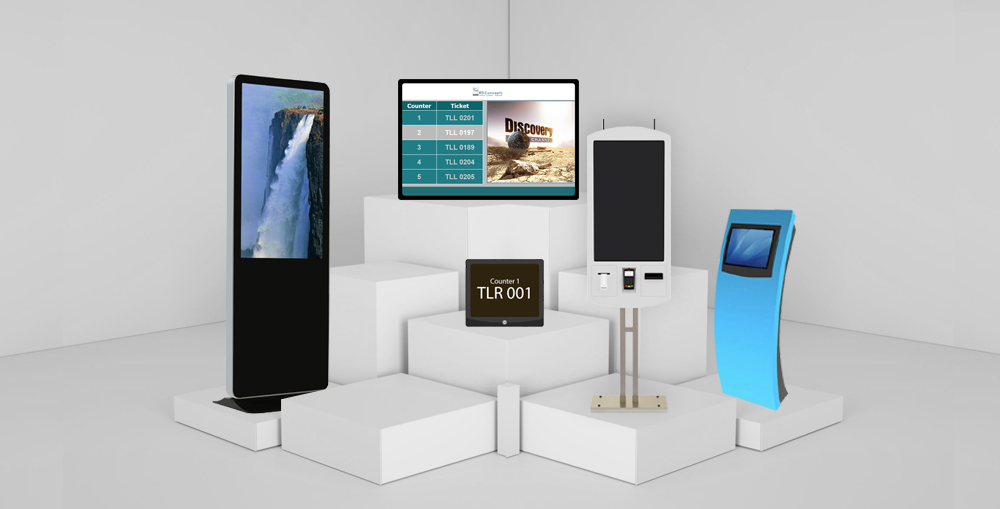
Let’s begin with a list of the digital display devices used in a standard queue management system:

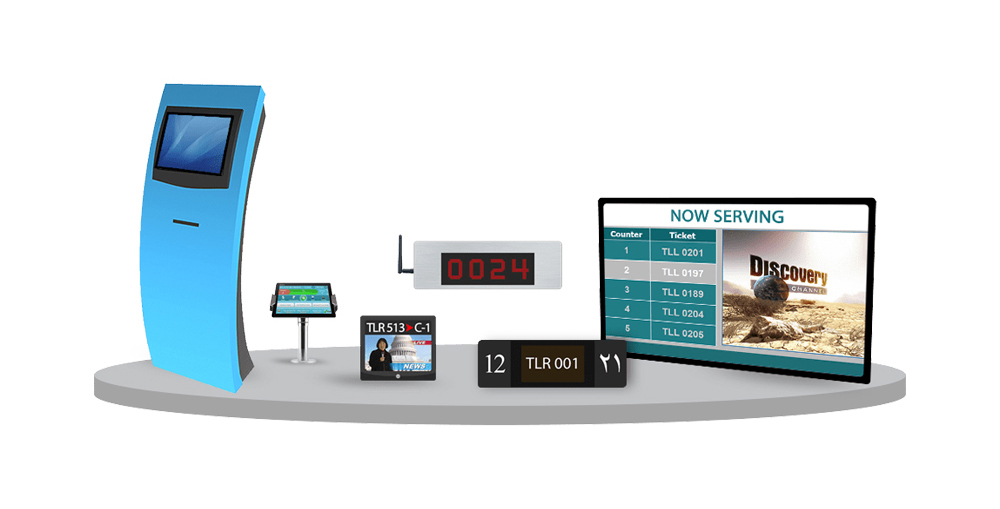
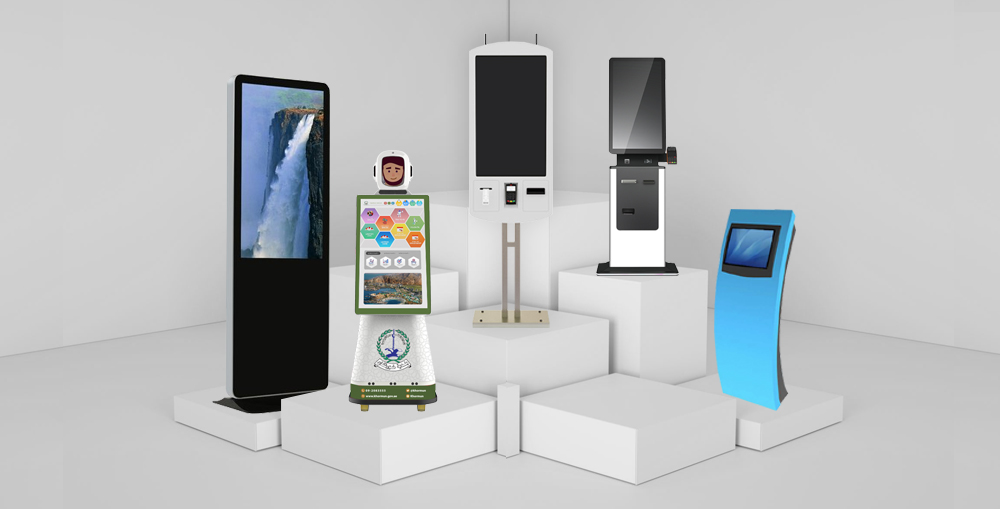
  1. Interactive Touch Screen Kiosk
  2. Digital Signage Screens
  3. Counter Plates
  4. Digital Signs (for directions and routing the customer flow)

All the above-mentioned display devices are used in a standard queue management system. There are different types of queue management systems available in the market. Here in Dubai and across the UAE there are two classifications of queuing systems, first is generic which can be used in any scenario, the second one is dedicated or purpose-made queue management systems. No matter which type of queuing solution you want to use the display devices will be a part of it.

Here are the details of all display devices and their application:

Interactive Touch Screen Kiosk

Interactive Touch Screen Kiosk

The very first interaction of a customer or visitor with the queuing process is the sign-up for the queue. The ticket dispensing kiosk is usually a touch screen, which lists a number of services and the customer or visitor can chose any of the list as per their needs. The customer/visitor registration and many other tasks can also be done at the queue management system’s interactive kiosk. Usually the smaller kiosk are used such as 14 Inch, 15 Inch and even smaller are also popular in Dubai and other emirates of UAE. However, for certain applications where the user interface requires to offer certain features and functionalities bigger screens can also be used. The main objective of the interactive kiosk is to minimize the customer efforts and to make the process automated and more managed.

Usually TFT LCD screens are used with different touch panels. There are different touch panel technologies such as IR touch, ultrasonic touch, and capacitive touch and so on. All have different applications, the capacitive touch is the most accurate and highly responsive. Whenever some data entry or slightly longer than usual customer interaction is required, capacitive touch is the preferred choice. The capacitive touch is very sensitive and it also have in-built multi-point touch capabilities. It entirely depends up on the application, for example if the customer or visitors are required to choose an option from a pre-defined list, then the IR touch or any other touch will also work and suggested as the capacitive touch is more costly than any other touch technologies.

The interactive touch display devices are critically important, as they will be the very first interaction of the customer with the brand. If that display fails to satisfy the customer the customers will be unhappy, unhappy customers are harder to satisfy and they could get annoyed quickly, they will be impatient while waiting and will be less understanding with the servers/agents. This will impact the overall customer experience and will have a very negative effect. So, the interactive touch screen kiosks should have excellent display devices and high-end technology that work flawlessly and meet the expectations of your customers and visitors.

Digital Signage Screens

Digital Signage Screens

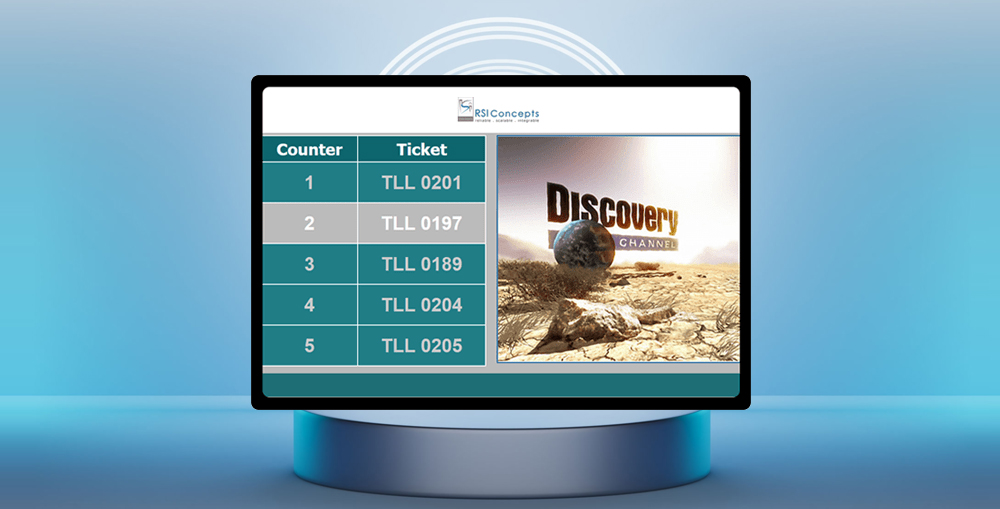
Once a customer or visitor signed up for the queue the very next interaction they will have will be with the large display screens. Usually these screens are used to display the queuing information and provide live updates and status of the ongoing queues. These screen also help with the announcements and customer calling. The very common mistake that business made with these screens is either they install less screens or even if they install adequate number of screens the displays are out of range, too far or too close. Here the business will have to think critically to choose appropriate places for digital signage screens. The screens should not be too high, neither too low, instead should be on medium height somewhere around 8 to 10 feet. The quantity and the size should also be reasonable.

Remember these screens will be viewed by each and every customer and visitor so the display quality should be good, the screen size and placement should be appropriate. The cabling, media players or any other device which is linked with the screen should be hidden or if it is placed in view then it should be installed nicely and cleanly. These are minor things which most businesses don’t consider but these things have psychological effects on customers and visitors, these minor things will impact the impression of the business in minds of the customers and visitors. Moreover the customers and visitors will focus on these display devices throughout their entire waiting time in the waiting area. So, these screen has to be of good quality, proper size and should be placed on strategic positions where each and every person in the waiting area should be able to view at least one screen without any difficulty.

The digital signage screens not only provide queuing information but they keep the customers and visitors busy and engaged which improve their waiting experience. Business also use large display screens to display queuing data alongside multimedia content or adverts. The multimedia content, adverts and videos boost customers’ interest and make their waiting experience more relaxing and engaging. If a person remains busy then they feel less stress while waiting for something. Several studies have suggested that an average customer starts getting bored after just 13 minutes of wait time. So the multimedia content can be very helpful in improving the waiting experience and as it also displays the queuing information and announcements, so it is easier to announce next ticket.

Counter Plates

Counter Plates

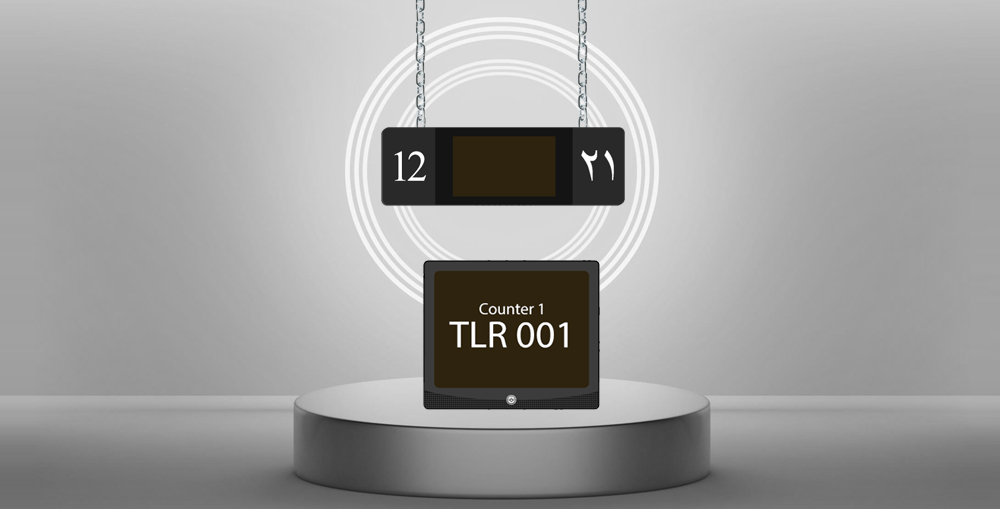
Counters plates are equally important for all scenarios. It doesn’t matter if you have 2 counters or 80 counters the counter plates are still very important. Some businesses often use static signs or markings for the counters, however the counter display devices or dynamic digital displays can be very helpful for the management as well as for the customers and visitors. As most of the modern day queue management systems automatically manage customer routing and direct customers to different counters as per the predefined policies, the digital dynamic display devices as counter plates can further help in improving the process.

The agents or the queue management system can push several different information on digital displays or digital counter plates which can further improve customer flow and reduce the chances of any confusion or delay. The agents can push simpler instructions on the digital display devices as well, such as displaying a message ‘please wait a moment’ when the agent accidently hit the next button, or in case a customer who got served had another query or immediately return to clarify something and so on. The agent can display a very simple message such as ‘welcome’ which suggest that the next customer can come now and a lot many such things which help improving the customer experience.

Digital Signs and Markers

Digital Signs and Markers

Digital signs and markers are also very important for managing customer journey and routing customers. Not all queue scenarios are simple, some are complex, in fact if a business has more than 20 counters, then the customer flow management could get complex, implementing and installing a queue management system could also be trickier. Then there are certain scenarios where some counters are dedicated for certain services or tasks, and there are certain scenarios where a single service delivery require a customer to visit multiple counters, sometime all those counters could be in a single hall or area, but mostly in different areas. These all real-life situation makes it difficult for the customers and visitors as well as for the management and staff.

That is why dynamic digital signs and markers are used which can direct customers and visitors through different steps of the customer journey such as corridors, stairs, lifts, etc. The purpose of using dynamic digital display devices is that these devices can be controlled through the queue management system software either from the agent dashboard or either from the administrative dashboard. So, it is easier to manage situations in different scenarios. Businesses can manage different scenarios for example if they want to change the customer journey in any way they can easily do that by setting up customer route and pushing new direction on the digital display devices, signs and markers.

Conclusion

A queue management system is a very powerful tool to transform customer journey and to improve customer happiness. Customer satisfaction ensures more customer loyalty and customer loyalty help building brand reputation which is necessary for a steady growth. A queue management system have very direct and long term effects on a business. It help increasing customer retention, building brand reputation, improving conversion rate and generating revenues. That is why it is extremely important for a business to choose a right queuing solution and in order to do so, you must have at least basic understanding of the components and operation of a queue management system. The display devices are the most important part of any queue management system, whether it is interactive touch screen kiosk for the sign-up and/or registration process, the digital signage, counter plates or digital signs, all display devices are very helpful in managing customer flow and facilitating them throughout the customer journey, which enhances customer experience and increase customer satisfaction. RSI Concepts is a leading name in queue management system providers in Dubai, UAE. If you want to learn more or if you want to improve your queuing process feel free to reach us out through our Contact Us page or leave a comment in the comment box below and we will get in touch with you soon.

Check out this: Qualities of Top Queue Management System


Qualities of Top Queue Management System

Qualities of Top Queue Management System

A queue management system is a vital component of a customer satisfaction strategy. Everyone living in Dubai or any other part of UAE has experienced a queue management system at any point in their life. The main objective of any queue management system is to improve customer experience and increase customer satisfaction. The simplest process of a digital queue management system is that a customer or visitor prints a ticket and then waits for their call and then gets served. However, it is not that simple at all. There are certain types of queue management systems based on their features and those features distinguish a good queue management system from an ordinary queue management system.

Many market studies have suggested that an average customer start getting annoyed after only 13 minutes of waiting, which is why business are investing heavily in queuing solutions to reduce the wait time. As the technology is advancing the market is witnessing major changes in the customer behavior and market trends. It is extremely important to keep up with those changing trends and demands from their customers. Earlier the queue management systems was only used to handle long lines, instead of waiting in lines customers can wait comfortably in the waiting area, but now things have changed, now a days the customers expect from the business to serve them instantly, no one wants to wait in the waiting area either.

This is why the modern queue management systems has also evolved with tons of new features and technological solutions that help business to improve the customer journey and customer wait time. In this blog we will cover some important qualities and features of a queue management system that will make it the most efficient and most impactful.

See Also: The Role of AI in Enhancing Queue Management Systems

Here are some qualities of top queue management system:

Virtual Queuing

Virtual Queuing

Due to the COVID 19 pandemic the customer behavior, market trends and needs have been changed completely. Customer expects a bit quicker and contactless type of queuing experience from their brands. Whether it is a public office, government office, bank, hospital or any other place where the daily footfall is high, the customers expect the business and organizations to offer a better, quicker and safer queuing experience. This suddenly give rise to the virtual queuing and businesses who were not using or not needing any queue management system before are now using queue management systems. The virtual queuing enables a queue management system to manage customer flow through virtual waiting lines. It means that a customer can sign-up for the queue remotely and doesn’t required to wait in an actual physical queue or line.

This also enables the customer to wait outside the premises and come only when their turn came. There are many different methods used for virtual queuing, the most common are remote sign-up through SMS, Calls, Email, WhatsApp, Appointments, Smartphone Apps, QR Codes, etc. The customer sign-up using any method and then they can either wait outside the premises or come at exactly the same time when their ticket number is being called. As the customer identifier or ticket has been issued prior to their arrival and their place is secured in the queue so the customers don’t have to wait physically in the line instead they can wait outside to minimize the contact and interaction with other people.

The virtual queuing is not only give confidence to the customers and visitors but it literally completely remove the need of waiting in the waiting area or inside the premises, which means the customers and visitors can get served immediately after their arrival. It improves the customer experience and also maximize the employee efficiency which has double effect on the overall productivity of the branch and increase profitability.

See Also: From Chaos to Control: How Queue Management Systems Can Improve Your Business

Automatic Customer Journey Management

Automatic Customer Journey Management

Although this is a basic feature of modern days queue management system in Dubai, UAE. But this feature has enhanced a lot in past few years. Any queue management system provides some level of customer journey automation, but a top queue management system should enables the management to configure the customer journey and to make them able to implement the new or temporary company policies instantaneously. This feature position queue management system as the most important tool in modern queuing. As businesses often require to change their policy or to change the customer routes. It could be either due to a temporary scenario or a special occasion or for a certain need.

But business often require to modify their queuing policies. A top queue management system should be very flexible and helpful for the management in dealing with such scenarios. The customer journey automation is also mandatory to minimize the customer wait time and to improve the customer flow. The automatic customer journey feature enables the queue management system to automatically route the customers and visitors to their dedicated counters/server and agents. For example, usually a business is offering multiple services in a single branch having multiple counters.

Even in some cases a single service delivery require a customer to go to several counters. Certain agents and servers are trained for certain services and some agents perform well for certain services. This is why in order to maximize the operational efficiency and to maintain the ultimate customer experience the business require a queue management system that can handle all these variables automatically.

See Also: 5 Challenges and Solutions of Queue Management System in Banks

Queue Management System Smartphone Apps

Queue Management System Smartphone Apps

Smartphone apps have been integrated too deep within our society. In Dubai and all other emirates of UAE the smartphone apps are very popular. The government is stressing on the importance of going green and digitalization. There are tons of government services that are being offered through the smartphone apps. Another reason of smartphone apps getting popular is that in the entire UAE almost everyone owns a smartphone and have access to the internet. People love to spend time on their smartphone, in fact there are certain clusters of society who spend more time on their smartphones than on the laptops or traditional computers.

Which makes them even more important for the marketers and business belongs to the service based industry. A queue management system smartphone app added value to both the customers and the management. The queue management system smartphone apps enables the customer to sign-up remotely from their mobiles, it improves the virtual queuing and help management to minimize the wait time which enhances customer experience and improve customer journey.

The smartphone applications can offer a lot of features which enhance customer experience and customer journey. The customers can book an appointment from the apps. The customer can search for the nearest branch, and also find data for those branches which help them planning their visit. The customer can learn about the busy branches, current queuing details and much more. The real-time updates, notifications and support for virtual queuing also add value to the customer journey and customer experience.

See Also: The Future of Queue Management Systems: Trends to Watch in 2025

Dedicated Agent Dashboard

Dedicated Agent Dashboard

Dedicated agent dashboard is very helpful in improving employee efficiency and making service delivery process easier which also impact customer satisfaction and customer journey. The agent/server can monitor and control the queues from this dashboard. Each agent will have to login to their dashboard at the start of their shift, this way the queue management system will be able to identify the agent/server and then the system can collect stats, capture various data inputs, and measure employee KPIs (key performance indicators). The dashboard can capture different types of data such as the agent’s progress, how many customers are being served.

How much time consumed for each service delivery, what is average time for a single service delivery. What services are delivered quickly and what services took longer. Comparison can be done. The services can be easily identified at which the agent/server is good and vice versa. This way the management can manage the agent’s position and their tasks to improve efficiency. The agents can also utilize the dashboard to aid their service delivery process. The agent dashboard can offer a variety of standard and customized features which can be designed to aid the service delivery process.

For example the customers data can be pushed to the agent dashboard easily or from the agent dashboard to customer repository or it can be linked to the centralized information center. This could save a lot of efforts which reduces the service delivery time, improve customer experience and increase employee efficiency. The agent/server dashboard can be completely customized to add features and functionalities that can facilitate the service delivery process and it also collect important statistical data which help the management in decision making and planning for the future strategies.

See Also: Key Tips to Improve Service Quality through Queue Management System

Real-time Monitoring and Remote Management

Real-time Monitoring and Remote Management

Any top queue management system must have this quality. The real-time monitoring and the remote management is very helpful for the management. The queue management system allows the top management at the head office to be able to access any or all connected branches. The head office can push new policies, extract data, assign new job roles for the staff and branch management and they can also control various other aspects of the queuing process. Which is very helpful for the head office and it also prevent any additional work and cost of manually implementing company policies and strategies to each location.

In order to enable this feature the queue management system must have a dedicated server or server side application. This queue management system server connects with all branches and mostly all the computing and processing is done at the server. This enables remote monitoring for the head office as all the data and stats are being stored at the server which can be accessed from the head office. This connectivity also enabled the remote management. The head office can remotely monitor and manage the entire organization from the head office. The head office management can access any branch at any time and monitor the live feeds from the queuing process.

The head office can push new rules and policies to any branch or to the entire organization. The head office can extract statistical data, KPIs and they can generate reports from any branch. The real-time monitoring and remote management provides a great advantage to the top management. Everything can be accessed remotely which save a lot of time and efforts as well. If the head office has data from all the branches they can understand the trends, customer behavior, agent/server performance and much more with more clarity and accuracy.

See Also: What is Queue Management? Beginner’s Guide to Queuing Systems

Customer Feedback

Customer Feedback

Any queue management system these days is incomplete without customer feedback features. The Dubai and all other parts of UAE have a multi-cultural societies which comprises of people from each and every nationality and ethnicity. This is why the UAE market acts and behaves slightly differently and are considered to be more customer/consumer friendly too. The economy is growing rapidly, the competition is increasing day by day. Businesses are investing a lot in innovation and modernization, in fact businesses keep updating their IT infrastructure after a few years only. This makes things tougher for the marketer and the management.

It is extremely important to understand your customers to ensure a sustainable and continuous growth. The customer satisfaction and customer retention are crucial for growth. A Customer Feedback system is the only tool that can provide a very direct and unfiltered customer opinion. I think whoever is living in Dubai or any other part of UAE for some time must be familiar with the small touch screens, or tablets or kiosk placed next to the serving counters. Which ask the customers and visitors to provide their feedback. A top queue management system must have this quality.

These days all modern queuing solutions comes with an in-built customer feedback module. Which enables the business to collect vital business intelligence. The customer feedback data is critical for improving your products and services, enhancing customer experience and customer journey. The business can also accurately measure several different KPIs with the customer feedback module. Which are very helpful for the management in making decisions and taking actions to improve customer interaction. The customer feedback also build trust among the brand and its customers and it improves business’s reputation.

See Also: What are the Basic Components of Queue Management System?

Business Intelligence Gathering

Business Intelligence Gathering

Business intelligence is not a particular data, in fact it is a blend of several data feeds coming from various touch point throughout the entire customer journey. Any top level queue management system must gather and provide business intelligence data in the form of actionable reports. This requires a very smart software engine with capabilities of data analytics and data processing. Collecting data is extremely important, but creating actionable reports from that data is also equally important. If a queue management system is collecting tons of data but failed to provide comprehensive and summary reports in an easy-to-understand formats, it could cause problems rather solutions.

The top management or head office can rely on the business intelligence to form their future strategies and policies. The reports, stats, KPIs, system usage data and other indicators will help the management to identify the areas of improvements whether it is the customer journey, or agent/server, or product/service quality itself, the business should be able to easily identify and rectify the problems by relying on these reports and statistical data. A good queue management system should be able to meet all those needs. There should be customizable reporting module, which allows the management to extract data and generate reports as per their needs, rather only daily, weekly or monthly reports.

The data should also have to be presented in several visual formats which are easy to understand for the top management. These days we are also witnessing that modern queue management system allows intensive system integration and data synchronization with other enterprise tools and software. Which makes it easier for the management to prepare and compare data from various sources. Such features are very helpful or the management in taking actions, making new policies and identifying the areas of improvements to ensure ultimate customer experience.

See Also: Advancements of Queue Management System Expected in 2022

Conclusion

A queue management system have transformed into a powerful customer satisfaction solution instead of a simple customer flow management tool. Each business and organization have different goals and objectives but still the basic remains the same. Everyone wants to improve customer journey and customer experience to achieve higher customer retention and customer satisfaction rates which ensures steady growth and high profitability. A queue management system must have above mentioned features in order to help business and organizations to achieve their goals and objectives.

Virtual queuing, customer journey and business process automation, integration with other enterprise solutions and business tools, customer feedback collection, real-time monitoring, remote management, reporting module, business intelligence collection and KPIs are the basic necessity of any modern day queuing solution. RSI Concepts is a leading queue management system provider in Dubai, UAE. If you need to improve your customer experience and customer journey, feel free to reach us out through our Contact Us page or leave a comment in the comment box below and we will get in touch with you.

See Also: 5 Techniques to Integrate Customer Satisfaction Survey with Queue Management System


5 Techniques to Integrate Customer Satisfaction Survey with Queue Management System

5 Techniques to Integrate Customer Satisfaction Survey with Queue Management System

In this blog we will discuss 5 techniques to integrate customer satisfaction survey with the queue management system. The queue management system and customer satisfactions surveys and feedback system both are very powerful tools used to improve customer journey to increase customer retention. However, these days both systems are integrated to improve the efficiency. The customer satisfaction survey and queue management system plays an important role in improving customer satisfaction and happiness. There has been so many studies and researches which suggested that a bad experience can have devastating long term impact on the business growth. Almost 75% to 80% customer switch to other service providers after having a bad customer experience. That is the reason businesses in Dubai and all around the UAE are eagerly seeking best practices and techniques to effectively collect customer feedback to prevent bad customer experiences.

A customer satisfaction survey is a set of questions that businesses ask to their customers to understand their opinion about various steps of the customer journey. This will help them highlighting the areas of improvement and also help them to rectify such problems which are hampering the smooth customer journey. A queue management system is used to manage control and improve customer flow and customer journey. It allow businesses to control and manage various touch points and also capable of capturing different type of data which also help businesses to identify and rectify customer journey problems.

When both customer satisfaction survey system and a queue management system is integrated, it can improve the efficiency of the both and it provides more accurate and precise data which help business in making decisions and taking steps to improve customer experience and customer journey. This is what makes this integration essential for the modern queuing needs. Here are 5 techniques to Integrate customer satisfaction survey with queue management system:

1. Integrate Customer Satisfaction Survey with Queue Management System via Tablet & Touch Screen Kiosks

Integrate Customer Satisfaction Survey with Queue Management System via Tablet & Touch Screen Kiosks

Integrating customer satisfaction survey with queue management system is very beneficial. It help businesses gather better customer feedback and business intelligence. In Dubai and all around the UAE the most common method used to integrate customer satisfaction survey with queue management system is tablet and touch screen kiosks. Tablets and touchscreen kiosks are very cost-efficient and easy to deploy and manage. The integration is done by a web-based interface or an application. The tablet kiosk or tablet stands are usually made up of an Android or Apple tablets. The customer satisfaction survey includes applications for these two platforms and the same can be built within the queue management system smartphone application. These applications provide a customer satisfaction survey interface where the customers can submit their feedback and then the apps store the feedback data on the customer satisfaction server.

The work flow is very simple. For other touch screens such as Windows OS based industrial grade touch screens usually a web-based interface is used to offer customer satisfaction survey which directly communicate with the server. There are dedicated customer satisfaction survey systems and some advanced queue management systems also comes with an in-built customer satisfaction survey module. For any case the system can take feedbacks from various devices and then store it on the server.

See Also: 5 Challenges and Solutions of Queue Management System in Banks

2. Integrate Customer Satisfaction Survey with Queue Management System via SMS and Email

Integrate Customer Satisfaction Survey with Queue Management System via SMS and Email

Integrating a customer satisfaction survey with a queue management system via SMS and Emails is also very simple and very popular technique. As all modern queue management systems are already integrated with the central information center so it can have access to the customer’s mobile number and email. The alternate method is when a customer sign-up for the queue the ticket dispensing interface can request them to provide their Email or SMS / WhatsApp as per the system’s configurations. In either case the queue management system link the customer with the ticket number, when a ticket got open at a counter, the queue management system relay that information to the customer satisfaction survey system or the module and when the ticket is closed by the agent, the customer satisfaction survey system/module can automatically push an online survey link to the SMS or Email of the customer.

For the emails, either a link for an online survey is sent. From that link the system can identify the customer hence no need to ask them to fill in their data again, so they directly starts from the questions. Once they are done with the feedback, the system store the feedback and the customer details in the system. In case of a SMS either a link for the online survey is shared via SMS which also work exactly the same as that of the email link. Another method is to take feedback via the SMS itself. For example the SMS sent to the customer is with a short question and a set of answers and the customer replies with the desired answer number. The system automatically store the answer and customer details in the system.

See Also: What are the Different Types of Queue Management System?

3. Integrate Customer Satisfaction Survey with the Queue Management System via QR Code

Integrate Customer Satisfaction Survey with the Queue Management System via QR Code

Integrating customer satisfaction survey with queue management system via QR code is a slightly new trend. The QR Codes, the Customer Satisfaction Survey and the Queue Management System all three are completely independent applications. However, the QR Codes can easily be used to work with other IT solutions. A QR Code actually contains a small chunk of data which is in the forms of bits, these days, almost all modern smartphones have in-built QR code scanning feature, the QR codes are scanned with a smartphone camera and the smartphone can extract the instructions from the QR code, in our case the information will be a link to an online customer satisfaction survey. The customer can submit their feedback and the system can store the feedback to the database with all required details such as the customer details, the agent/server details and the service details which the customer have availed.

All these information are required to process customer satisfaction survey feedback data and extract actionable reports from that data. The QR code is pasted on each counter, and each counter have different QR code, which contains the information of the counter and the agent who is working on the counter at the time of accessing the survey. The customer information and the service details can also be pulled out of the queue management system. Usually for QR Code based customer feedback systems, the customer details are being asked again when the customer go the survey, as the time of the service and ticket closing could differ from the time of submitting the survey. The QR code based customer satisfaction surveys are usually slighter longer than usual and contains a few more questions to get more details.

See Also: What Is Virtual Queuing? A Guide to Virtual Queues

4. Integrate Customer Satisfaction Survey with the Queue Management System via Smartphone Apps

Integrate Customer Satisfaction Survey with the Queue Management System via Smartphone Apps

Here in UAE the smartphone apps are very popular, people love to access various services online via smartphone applications. Everyone has at least one smartphone and access to the high-speed internet. Which makes the smartphone applications an ideal medium for communication and digital services. Several researches shows that people use smartphone more than traditional computers/laptops. Which makes them even more important for businesses. These days all sort of businesses and enterprises even SMEs are offering smartphone applications to their customers. The modern day queue management system comes with in-built support for smartphone applications. The smartphone applications are a great medium for personalized communication with your customer. These days virtual queuing is also gaining popularity and almost all virtual queue management systems come with a smartphone application.

When a customer sign-up for the queue they are being asked about the service they want to avail, then in the next step when they arrived at the counter, the agent pull all their details into the agent dashboard, which can be linked to the customer satisfaction survey system or module. Later when the ticket got closed the system automatically match those details, identify the customer and the service they have availed, it also identify the agent/server who served the customer and then for that customer in their smartphone application a customer satisfaction survey appears. The customers can be encouraged to submit the feedback by in-app alerts and notifications too. Once a customer submit a feedback then it can be stored in the system with all the required information linked to it which can be captured from the agent dashboard, queue management system and central information center of the enterprise.

See Also: Key Reasons Why Queue Management Systems are Essential for Customer Loyalty?

5. Integrate Customer Satisfaction Survey with Queue Management System via Customer Portal

Integrate Customer Satisfaction Survey with Queue Management System via Customer Portal

Online Customer Portals are not a new thing, they are being used by the businesses to enable a very personalized communication channel for their customers where they can manage a lot many business processes. Customers frequently visits their portals to either perform a task or to learn about the updates or to check the status of various things. Online customer portals are a great medium for customer satisfaction feedback as well. Businesses can link the queue management system with the online customer portals and the customer satisfaction survey to make a very personalized customer experience. Such setup boosts the survey completion rates. Customer feedback coupled with inputs from various other systems could be a great source of valuable business intelligence data.

Whenever a customer sign-up for the queue, and then get served on the counter, the queue management system can collect various information such as customer details, agent details, service details and various other parameters and after that it enables a customer satisfaction survey link in online customer portal dashboard via the in-built module or a third party customer survey system. When the customer submit their feedback it get stored on the server along with all required parameters coming from queue management system and various touch points of customer journey.

See Also: The Role of AI in Enhancing Queue Management Systems

What are the Advantages of Integrating a Customer Satisfaction Survey with the Queue Management System?

What are the Advantages of Integrating a Customer Satisfaction Survey with the Queue Management System?

There are certain behavior and trends for the customer satisfaction survey. People mostly don’t like to spend more time on such things. Which is why all the marketers seeks methods and techniques to reduce the customer satisfaction survey size. The businesses should always have to be very creative and innovative to ask setup customer satisfaction surveys in a way that it require very less time to submit the feedback but it return more data for them to have better understanding of their subject. This is the reason when customers are asked to fill in their contact details and other information before submitting a customer feedback, most of the customer leave without completing it. Only a few customers will take time to submit their feedback with such a long process and most of them would be due to a very bad experience. This completely defies the purpose of the feedback and business can only get a limited vision of their business processes.

However, when a customer satisfaction survey is integrated with a queue management system, business don’t have to ask their customers to fill in long forms and their details before attempting the survey. The customers can directly sent to the question page, and the remaining information can be collected automatically from integrated systems. The businesses can easily get following data automatically:

  1. Customer Identity & Customer Contact Details
  2. Service Details
  3. Agent/Server Information
  4. Date and Time of the Service
  5. Queuing Data
  6. Customer Journey KPIs

If the business, marketer and the system providers are creative they can even link other inputs with the feedback data, for example, if it was their first negative feedback, or the same question got negative response in past, or if the same agent/server is getting negative feedback for a particular service and so many more details. Such details further refine the business intelligence and provide the management a broader and wider prospective of the customer interaction with their brand. The businesses can take more discrete and impactful decisions, form policies and make new strategies to improve everything.

See Also: The Future of Queue Management Systems: Trends to Watch in 2025

Conclusion

Businesses in Dubai and all around the UAE are using customer satisfaction surveys and queue management systems but very few knows the importance of integrating the two systems. However, the latest queue management systems are coming with in-built customer satisfaction survey module and the queue management systems can also be configured easily with the customer satisfaction survey system. The main idea to integrate the two systems is to increase the completion rate and to collect more in-depth business intelligence. The precise and detailed data collected from such system can be utilized to easily identify the areas of improvements.

And business can also rely on the feedback data and business intelligence for improving future policies and making new strategies to improve customer happiness and customer retention which aid continuous business growth. The above mentioned integration techniques will help you understand the integration process and its benefits. If you want to integrate a customer satisfaction survey system with queue management system, feel free to reach us through our Contact Us page or leave a comment in the comment box below and we will get in touch with you.

See Also: Advancements of Queue Management System Expected in 2022


Advancements of Queue Management System Expected in 2022

Advancements of Queue Management System

The queue management systems and queuing solutions are very effective and impactful on the customer journey and customer experience. Basically, technology is evolving rapidly. The very basic technology-based items that we used on daily basis such as computers, laptops, and smartphones, televisions, etc. are being replaced with newer more powerful, and better gadgets. Similarly, the other technologies are also evolving. The queue management systems are made with a very basic computing technology that is integrated with a variety of hardware to innovate advanced features and functionalities. The queue management system software tool is also a very powerful component of the solutions, mostly here in Dubai, UAE the queue management software is basically designed to be run on a server, then additional interfaces are provided for customers, agents/servers, and the administrations. The programming tools and technologies used to build such software programs are also evolving and upgrading. This provides a great advantage to the vendors and manufacturers to keep the cost acceptable and provide advanced features as well.

The year 2020 was the year of a complete transformation in the overall customer behavior, businesses and brands operating locally or internationally have never witnessed such a huge shift in such a short period of time. In the year 2021 the queue management system manufacturers and vendors are struggling really hard to meet the new requirements, the year 2022 will be the year of real progress and unprecedented advancements in the queue management system industry. The general public behavior and interaction have been changed completely. The customers demand and expect a lot from their brands and businesses. The market trends have been changed, as now we are more integrated with digital solutions than ever before. The adaptation and acceptance level for digital solutions and systems is at an all-time high. Businesses can experiment a lot with new and innovative digital solutions. The queue management systems are not different either. Here are the advancements of queue management system expected in 2022:

Virtual Queuing

Virtual Queuing

Virtual queuing is not a brand new feature, however, the way it is being utilized is a completely new concept. The main difference between virtual queuing and traditional queuing is that virtual queuing allows the users to virtually sign up for the queue. It means that the customers and visitors can sign up for the queue being away from the business. The virtual queuing sign-up can be done with various means, such as website, online customer portal, appointment booking module, call, SMS, email, etc. The virtual queuing is very helpful for the staff too. As the customers and visitors can sign-up without being physically present at the branch, so there is no chance of getting a crowd or a large number of customers inside the waiting areas. Which also requires additional staff for the management.

Virtual queuing is a great boost to the customer experience and customer journey. As the most annoying thing in any customer journey is waiting. If there is very less wait time the customers can plan to reach the branch at the very exact time of their turn. The customer calling and announcements can also be made using virtual methods/digital mediums. Which makes it even easier for the customers to monitor the queues. Virtual queue management systems are gaining popularity. More often businesses in Dubai and other emirates of UAE are asking for a traditional queue management system with virtual queuing features enabled so that whenever they want to switch to the virtual queuing mode they can do it easily.

Mobile Queuing

Mobile Queuing

If you are living in Dubai or any other part of UAE you must be aware of the usage of smartphone applications. Our society is heavily relying on mobile apps for various daily life gigs. Moreover, the government is also focusing on digitalization for the sake of convenience of the users and to make the services available instantly. There are tons of government services that residents are using via their smartphone applications. This makes society more welcoming for mobile-based solutions. The year 2022 will be the year of the smartphone revolution. I believe the UAE must be at the first place in the list of countries with the most internet access with almost its entire population have access to high-speed internet. This makes smartphone applications even more convenient and effective.

The mobile queuing or a smartphone application integrated with a queue management system is by default a virtual queuing. Mobile queuing is more useful than any other traditional queuing. The customers and visitors can sign-up for the queues from their smartphone applications. The real-time updates and queuing information can be viewed on smartphone applications. The customers can be informed by alerts and notifications. This saves a lot of time and provides a lot many other useful features. For example, the customers can easily search for the nearest branches, they can also lookup for the least busy branches near to them, they can navigate to those branches and much more.

Mobile queuing also provide businesses a direct and personalized communication channel. The business can ask the customers for their feedback after their visit via the queue management system smartphone applications. The customers can also plan and schedule their visits with an integrated appointment booking feature. The queue management system smartphone application also provides additional data which helps the customers to plan their visit such as the information of the busiest hours, days, or branches, etc. The branches which provide additional services or the list of the services, etc. And much more. There is literally no limit. Businesses can get more creative and innovative to improve customer journeys and customer experiences through smartphone applications.

Queue Management System Integration with Software and Hardware

Queue Management System Integration with Software and Hardware

That is obviously not a new trend but we are expecting the queue management system integration with software and hardware to get more intense. Currently, only a few basic software and hardware integrations are commonly used, such as the Emirates ID Card scanning or QR Codes. However, in the year 2022, we are expecting that businesses in Dubai, UAE will start relying on intense software and hardware integration with their queue management solutions. Businesses are always looking for methods and ways to maximize their customer’s experience while also focusing on minimizing the workload of their employees and resource consumptions. The integration is the solution for that.

The integration leads to automation, which not only improves efficiency and makes the process fast but it also increases profitability. Another most efficient way to achieve higher efficiencies is by using a centralized information system that is effectively integrated with all of the IT infrastructures to form up a communication grid. Whether it is a machine to machine communication or a human to human communication, the availability of information at the right time and at the right place is crucial. This is why we are expecting that in the year 2022 businesses will demand more interconnected solutions. This will allow them to not only improve customer experience and customer journey but will also enable them to boost their employee performance and to achieve more effective controls and administration.

The queue management system should be able to effectively manage customer journeys automatically, for that may be new hardware will be needed to enable the system to identify the customers, then the system can prioritize them, and route them to ensure quicker and quality service delivery. On the other hand, if the queue management system is connected to the customer database, it can automatically fetch the data and information required by an agent to serve the customer and to deliver the required service. This makes the process very fast and reduces the service delivery time as well. These are just examples, there is an endless list of software and hardware which can be integrated due to the technological advancements in the queue management system technology.

AI-based Queue Management System & IoT Integration

AI-based Queue Management System & IoT Integration

The AI stands for Artificial Intelligence and the IoT stands for Internet of Things. Both are very latest technologies and a few years ago was considered to be Hollywood stuff. Thanks to the chip advancements and R&D done in the past few years, the two have become a reality. And all technology solution providers are gazing their eyes on the two sectors. If Elon Musk’s future depiction of Artificial Intelligence turns out to be another false speculation, we will definitely witness all sectors of our life flooded with artificial intelligence-based solutions within a couple of years. Here I would also like to mention that artificial intelligence is not only the Terminator but in fact, it is just a highly advanced software with extremely sophisticated programming and currently, Google, Facebook, IG, and tons of platforms that we use daily are running on one or another kind of Artificial Intelligence. The smartphone before getting smart was just the phones, but with Android and iOS, the smartphone has become smart and is ever getting smarter. Similarly, the artificial intelligence integration will improve the queue management systems and each and every aspect.

The artificial intelligence-based software engines will help the businesses to manage and monitor their queues and relevant systems in a more organized and automated way, where most of the automatic decisions will be done through the artificial intelligence-based software engine, which will rely on machine learning and will keep improving itself over the time. This will not only help businesses in effectively managing the customer flow, but the real magic will be done at data capturing, monitoring, KPIs, and reporting sides. The artificial intelligence-based queue management system can provide extremely effective business intelligence and will be able to process various feeds more effectively. Which will make the decision-making even more effective and risk-free.

The IoT is a modern revolution of electronics. With the easy availability of high-speed networks, cloud, 4G/5G, broadband internet access the IoT is not only the future but developed countries like UAE have already started implementing IOT based solutions. The IoT allows various electronics devices to communicate with each other and with a management program that gives them instructions to act accordingly. You must be thinking how will this improve the queue management system? Well, the IoT devices will not only allow easy system installation process but remote monitoring and management of each node and connected device will be possible, such statistical data will be relayed to the AI-based software engine which will utilize it to make real-time decisions to improve the customer flow and much more.

Purpose Made Queue Management Systems

Purpose Made Queue Management Systems

The purpose-made queue management systems are not a new trend, however, these days almost more than 80 percent of the queue management system installation in Dubai and other parts of UAE are generic or general-purpose queue management systems. However, businesses are gaining awareness and are demanding more subjective solutions rather than general-purpose queue management solutions. This is why the year 2022 will be the year of purpose-made queue management systems. Each and every industry will prefer to opt for a purpose-made queue management system rather than altering or customizing and general-purpose queue management system to be able to achieve their desired results. The purpose-made queue management system once in the market will get improved very quickly as more data and studies will be available for the manufacturers and vendors.

The purpose-made queue management system trend will take over the traditional queue management system by the year 2022. And there is another big reason to believe in that which due to the different work processes and different customer journeys at different businesses. This will give rise to the demand for purpose-made queue management systems.

Read this: Pros and Cons of Queue Management System

Conclusion

The queue management system is a very powerful tool for customer journey transformation. It is considered to be essential for the modern customer journey. There has been several improvements and advancements in the queue management systems in past few years, but the way the customer journey and customer interaction with the brand have been transformed in the past few years, the queue management systems are going to take the customer journey to the next level in coming years. The year 2022 will be the year of great innovations in queue management systems. As the customer’s demands and expectations are also evolving at a very rapid pace, this will give rise to the integration of the queue management systems with AI and IoT. The businesses will look to improve the system efficiency and gain more control and better administration in the coming years. This is only possible if the AI and IoT work with the system integration of other organizations’ tools and IT infrastructure. RSI Concepts is a leading queue management system provider in Dubai, UAE. If you need an advanced queuing solution that can boost your work efficiency and improve customer loyalty do let us know. We are here to help, you can reach us through our Contact Us page or leave a comment in the comment box below and we will get in touch with you soon.

Check out this: How to Achieve the High ROI using Queue Management System


How to Achieve the High ROI using Queue Management System

How to Achieve the High ROI using Queue Management System

Achieving the high ROI results with a queue management system is comparatively easier, as the system itself is very capable. Here in Dubai and other parts of UAE businesses prioritize their customers, the markets are growing, every day the competition is increasing. Studies showed that around 90% of the customers are willing to go to another service provider rather waiting in the long queues. Every single minutes added to customer wait time could cost you potentially tens of hundreds of sales on daily bases. That is the reason businesses from all sectors in UAE are rapidly adopting to the digital queue management systems and queuing solutions.

The customer experience and customer journey is extremely important. If a business is not using a queue management system to manage the daily customer flow, they will eventually end up losing a huge chunk of their sales. That is the reason these days we can find queue management systems everywhere, from banks to government offices, schools to hospitals and clinics, food courts & restaurants to HR Offices, everywhere were we go we find a queue management system. This also results in a lot of vendor and supplier of the queuing solutions.

However, there are only a few vendors who are offering a modern queue management system to ensure higher ROI results for you. RSI Concepts is a leading queue management system vendor and supplier, with exceptional range of different queue management systems. A queue management system in Dubai, UAE is considered to be a long term investment. When it comes to a queuing solution the businesses are concerned about the ROI, as it is a long term investment to calculating the ROI is also not as that simple.

See Also: Why Queue Management Systems Are Essential For Modern Businesses?

In this blog we will focus on the features which can boost the profitability of a business and we will also explain a business can easily quantify the ROI of a queue management system.

How a business can increase profitability with a queue management system?

How a business can increase profitability with a queue management system?

A queue management system has a lot of benefits and it can improve a lot of areas related to the customer journey and customer experience. On top of that the queue management systems are also very helpful in improving subsequent business processes and policies. Here are some traits of a queue management system that help businesses in improving their profitability:

Reduce Wait Time

Reduce Wait Time

The wait time had different impact on different industries and sectors. But one thing is common, it always have a negative impact on customer journey and customer satisfaction, which results in decline in sales, in some cases this decline could be huge, it is an estimate that worldwide retail sector reported almost 70% of sales drop when the wait time is too long. With a queue management system businesses can avoid such losses, as the queue management system automatically manage and streamline customer flow, which reduces the wait time and improve customer experience. This help brands to retain more customers and improve customer loyalty and get repeated business. Which directly contributes to generating more revenue and profits.

Offer Virtual Queuing

Offer Virtual Queuing

The virtual queuing is the most modernized form of a queue management system. The main idea is to let the customers sign-up for the queues remotely/virtually. The customers can issue a mobile ticket or sign-up for the queue without being arriving at the branch. This allows them to wait outside, or utilize the wait time in some other activity, which in terms of customer journey results in literally no wait time. This not only improve the customer journey and customer satisfaction but it also help employee to improve their work efficiency and the overall productivity of the entire branch. Good quality customer journey makes your customers and visitors happy and satisfied. Happy customers give repeated business and also advocate for the brand.

See Also: What Is Virtual Queuing? A Guide to Virtual Queues

Improve Employee Performance

Improve Employee Performance

In case of a manual queue management, the employees will have to do all the work manually. They will have to manage the queues, they will have to ensure the smooth customer flow, and they will have to handle the line disputes among the customers and much more. Which distracts them form their primary tasks and result in poor work efficiency. A queue management system eliminate all these problems and automatically handle the entire customer flow, which results in a very smooth and quicker customer journey.

This allow the employees to focus only on their primary tasks, and they can easily serve more than twice customers in a single shift or even more. This allow the businesses to reduce the resources which help reducing the cost. And with the improved employee efficiency good quality work increase customer happiness. Which positively impact on the overall business growth.

Automate Customer Journey

Automate Customer Journey

A queue management system allows businesses to automatically manage all touch points and interactions of the entire customer journey. On one hand it saves a lot of time and makes the process fast, on the other hand it improves the customer experience as well. Especially for businesses who have stepped services which require multiple counters for a single service delivery. A queue management system also significantly improve the customer flow in scenarios where multiple services are being offered and certain counters are dedicated for certain services.

The queue management system also help managing and routing the VIP or premium customers and the customers with special needs. This improve customer experience a lot and it portrays a very positive brand image. Which help attracting more customers and also good for customer retention. These factors directly impact the business growth and profitability.

See Also: The Future of Performance Appraisals: 6 Innovations and Changes [Quick Guide]

Improve Service Quality

Improve Service Quality

The customer interaction with the business can heavily influence their service experience as well. If a customer or visitors had to wait for too long under mismanaged or poorly managed conditions, when they will reach to the counter they will be annoyed or upset. This will also impact their interaction with the service agent/server. If the customers and visitors got an excellent experience before reaching to the counter, they will be happy or at least they will not be angry or upset. This will make them more open and understanding towards the agent. Satisfying such customer is a lot easier than satisfying annoyed customers.

Moreover the queue management system also reduce the unwanted work load from the employees, which make them more efficient too. The employees will be highly focused and can deliver good quality service as well. The queue management system also have ability to route customers with different needs towards different counters. If agents are delivering only one or a few services, they could easily build expertise for that. Which also improve service quality and customer experience. Good quality services build good brand identity which help increasing conversion rates and customer retention and these all things contributes to business growth.

See Also: Maximizing Efficiency: The Benefits of Implementing a Queue Management System

Improve Customer Retention

Improve Customer Retention

Customer happiness and good customer journey is a key to customer retention. If your customer are happy and satisfied they will remain loyal to your business. If they are unhappy they will immediately move to a competitor. The customer retention is extremely important for business growth. As if you keep focusing on marketing and other efforts to increase your new sales, but failed to retain the existing customers, then your overall profitability will decline. It totally depends upon the number of new customers coming to your brand and the number of customers who are leaving your brand. Eventually it will act like a death trap.

But if you manage to retain your existing customers, you will not only get repeated business from them but you will be able to keep adding more customers who will contribute in the growth of your business. A loyal customer base act as a foundation for a business, without that a business could crumble anytime. A queue management system ensures your customer leave happily and satisfied. Happy customers are tend to be the most loyal to the brand. They also promote the brand within their circles. Which attract more customers and build a strong brand identity. Brands with positive brand identity tends to have higher conversion rates from their marketing efforts comparing to the average brands or brands with poor brand image.

See Also: 5 Signs Your Business Requires a Queue Management System

Improve Communication with Customers

Improve Communication with Customers

A queue management system with its advanced features enables direct communication between the customers/visitors and the brand. The customer interfaces can be designed with multi-lingual support to further improve the communication. Moreover the business can also collect customer feedback using the additional queue management system modules. Business can conduct online surveys and request for their opinion or suggestions. With the integrated smartphone applications or online customer portals, the businesses can enable a direct and personalized communication channel between them and their customers. The customer feedbacks and survey data can be utilized further to assess business practices and various other aspects of customer journey.

Collects Stats & Business Intelligence

Collects Stats & Business Intelligence

A queue management system is a great source of various types of valuable business intelligence data. It allow businesses to capture data from all touch point throughout the customer journey. The customer feedbacks also help evaluating various business processes, employees and customer experience. The queue management system has built-in KPIs (key performance indicators) to measure the performance of various active components, such as relevant systems, customer flow, and employee performance.

The employee performance indicators help business to accurately quantify the performance of individual employees as well as of teams and branches. The management can easily take actions and make decisions to improve employee performance which will also help improving the service quality. The system usage stats, advanced queue analytics and customer feedbacks help business in making policies and strategies to improve performance, products & services, and quality of service. Which will later help businesses in increasing sales and revenue.

See Also: Unlocking Business Potential with AI-Powered Advanced Analytics

How to Calculate the ROI of the Queue Management System

How to Calculate the ROI of the Queue Management System

As whenever a new system is acquired every business set their goals and objectives and then evaluate the system by various aspects such as system usability, utility, scalability, estimated outcome, cost, and other financial aspects. On the bases of these an overall ROI (return over investment) is calculated. Every system is eventually evaluated on the bases of its ROI. If the ROI is good the business can commission the system with confidence. If the ROI is not satisfactory then the business will be hesitant to invest in such system. For queue management systems the ROI calculation is very simple and easy.

Without a queue management system the business will have to allocate more employees to handle the customer flow, usually the employees are assigned by keeping in mind the busy hours and the regular foot fall. So, usually the most of the branches are either overstaffed or inefficiently staffed. This put a lot of expense on businesses. With the help of a queue management system the system take care of most of the intermediary processes and automate various steps of the customer journey, which entirely eliminate the need of additional staff. The customer flow and the entire queues are managed automatically by the queue management system, this also improve the work efficiency of the agents/servers.

See Also: AI Agents Revolutionizing Finance: Tailored Solutions for Investment and Risk Management

With the help and benefits of the queue management system the employee performance is also significantly improved, which make them able to serve more customers in a single shift. That is how the business can easily calculate how much agents/server or employees will be required to server a certain number of customers and visitors. Another very accurate ROI can be the estimation of the cost per customer or per service delivery. This is also very easy to calculate.

The businesses can easily calculate the service cost per customer before the queue management system and after the queue management system. All you need is the quantity of the customers they have served last year or more precisely the number of serving customers as it could also include the customers with the repeated service delivery. Then the cost on each service, and the value of the each service. Then the ROI can be calculated by including the queue management system into the equation and both results can be compared.

Other non-financial benefits are also there. The biggest benefit of a queue management system is that it significantly improve the customer journey and customer experience. Which exponentially increase the customer satisfaction score. The customer satisfaction score drives the opinion about the brand and help building a positive brand image. A good brand identity attracts more customers and also plays important role in conversion and lead generation through various marketing efforts. So, in longer run with or without the non-financial or non-quantifiable benefits of a queue management system the ROI is excellent.

See Also: AI Agents in Logistics: Customized Solutions for Supply Chain Optimization

Conclusion

Obviously whenever a business plans to acquire a new system or infrastructure the one thing that counts the most is the ROI (return over investment) rates. In case of a queue management system the ROI is always excellent. As any queuing solution comes with certain benefits such as reduction in wait time. The automation and functional improvement in business processes lead to an excellent customer experience and a smoother customer journey. The less work load on the employee lead to their performance improvement. With the help of a queue management system a single employee can handle more customer in a single shift.

The cost and expenses can be reduced, the output can be maximized. Which significantly improve the ROI of a queue management system. At RSI Concepts we have a dedicated team of technical experts and business analysts who can help you with your queue management system project. You can easily reach us out through our Contact Us  page or leave a comment in the comment box below and we will get in touch with you soon.

See Also: Pros and Cons of Queue Management System

See Also: Integrating AI Agents into Core Business Applications for Operational Excellence


Pros and Cons of Queue Management System

Pros and Cons of Queue Management System

A queue management system is considered to be a necessity these days. As almost all sorts of industries are adopting it in Dubai and other parts of the UAE. Do businesses most often think what are the pros and cons of a queue management system? The purpose of this blog is to provide a detailed overview of all the advantages and disadvantages or limitations of a queue management system. Generally, a digital queuing solution is very beneficial for a business. Any queue management system is used to achieve two primary objectives, one is customer satisfaction and the other is to improve employee performance.

Customer satisfaction and improved employee efficiency are important for building a positive brand image that attracts more customers and also improves conversion rates. Businesses can easily achieve their goals and increase their profitability by simply implementing a queue management system.

Here are the pros and cons of a queue management system:

Pros of a Queue Management System

Pros of a Queue Management System

There are several pros of a queue management system, such as:

1. Efficient Customer Flow Management

Efficient Customer Flow Management

With the help of a queue management system businesses can easily manage and streamline their customer flow. The queues are well-organized, automatically controlled, no or very limited human intervention in managing the queues, no line jumpers, no disputes and troubles inside the waiting lines. The businesses had to keep a lot of staff to manually manage the queues and to cope with the problems occurring in manual lines. This was not causing troubles for the staff but such problems also affect the customer experience and delay in the customer journey.

A queue management system can automatically manage all these things, there is no human intervention, so people don’t complain much about their positions in the queues, there are literally no disputes as everyone knows the lines are controlled by the computer program and not by a human being. This is why a queue management system can not only improve the customer experience and customer journey but it also reduces the workload on the employees, the business can manage massive queues with only a few staff members.

2. Reduced Wait Time

Reduced Wait Time

One of the biggest advantages of a queue management system is that it can significantly reduce the wait time of the customers and visitors. Several studies and various market researches have suggested that an ordinary customer or visitor can happily wait for 13 minutes, any time longer than that starts bothering them, if your customers get annoyed before even reaching the service counter, the chances are they will going to have an average or maybe bad experience with the agent too.

No matter how hard the agent tries to satisfy them, if they had to wait for a long time, they will eventually end up leaving the premises unsatisfied and unhappy. So a reduction in wait time is extremely important to improve customer experience and customer journey. The queue management systems can easily reduce the wait time by a significant margin comparing to manual queuing.

3. Organize and Automate Customer Journey

Organize and Automate Customer Journey

A queue management system not only helps to reduce the wait time but also helps to organize and to automate various processes throughout the customer journey. Most businesses have various different services and different service delivery practices. Each business tries to make its customer journey unique, convenient, and easiest. All businesses have their own policies, priorities, and objectives. Some services are popular and some are not, some services require specially trained staff and so on. In some cases, a single service could take multiple counters to get the process done.

All these situations make the customer journey complex and difficult to manage manually. However, with a customized queue management system businesses can program it as per their policies and the system will do the rest. The queue management system can easily identify the required service during the signing-in process. Then it issues the ticket for the respective counter(s). The queue management system can also take the customers and visitors through the stepped service delivery process in which multiple counters are involved in a full-service delivery. The queue management system can also identify the priority customers and direct them to their dedicated counters.

All this happens automatically and instantly. Moreover, the queuing systems can automatically reroute the customers to the vacant counters and to the counters with smaller queues. The management only has to configure the policy one time and the queue management system automates the business process and handles the customer journey automatically. This not only makes the journey fast but also completely eliminates the errors and problems that are common in manual customer journey management.

4. Improve Employee Performance and Increase Service Quality

Improve Employee Performance and Increase Service Quality

Without a queue management system, the most of the employee’s efforts are consumed by managing the customers and visitors. However, with a queuing solution, the customer flow and many other things can be automated and managed by the system, which leaves very little work for the agents/server. The employees can focus more on their primary tasks. This boosts employee performance and makes them able to serve more customers in a single shift. Above all, each employee can easily focus on serving the customers so the service quality also improved and the customers get a better experience. This is how the queue management system helps businesses in improving their employee performance KPIs.

As the customer journey and various touchpoints are being managed by the queue management system, automation makes the processes simpler and quicker. It also reduces the workload of the employees and the employees focus more on serving the customers. Not only that, with the less wait time, automation and well-organized queue management, the employee also got a good experience and when they reached to the counter they are not stressed or annoyed, this let the agent communicate well with the customers and visitors. Which also improves the service quality. The customers who are calm and happy are much easier to satisfy than the customers who reached the counter after hours of wait and going through a bad wait time experience.

5. Reduce Cost, Increase Customer Loyalty and Increase Profitability

Reduce Cost, Increase Customer Loyalty and Increase Profitability

A queue management system is far cheaper than having employees managing customer flow manually. The queuing solution also reduces the workload of the agents/server which means a single agent or server can serve more customers in a single day, which reduces the number of required agents/server and allow the business to cut the cost. Excellent customer journey management and great customer experience ensure customer satisfaction. A happy customer tends to be more loyal than an unhappy customer. Some of our customers have witnessed a huge rise in customer loyalty and returning customers after deploying a queue management system in Dubai, UAE.

A happy customer will be more loyal to the brand. The customer loyalty help business to improve customer retention. And it directly impacts growth and revenue. If a business has a stable foundation of loyal clientele, they can expect higher conversion rates too. Which ensures steady growth. The happy customers not only give repeated business but also help brands in building a positive brand identity. If a customer has a great queuing experience they will tell their friend, family, and colleagues, and become brand advocates which is great for brand image building.

If a brand has a positive brand identity, it tends to attract more new customers and its marketing efforts also return good results only due to its positive image and good brand identity. A queue management system plays a vital role in improving customer happiness and customer satisfaction.

Cons of a Queue Management System

Cons of a Queue Management System

There are only a few cons of a queue management system, such as:

1. High Initial Investment

High Initial Investment

The initial investment is relatively higher. That is also a big reason why businesses are so skeptical when making a decision on a queue management system. As the queue management system contains several hardware components and several software features, which increases the project cost. It is usually the hardware that costs you more. There are multiple digital signage and display devices, interactive kiosk or ticket dispensing machines, customer announcement system, counter plates or counter displays, networks, etc. These all hardware components are just a bit expensive but are long-lasting and comes with a longer lifecycle and warrantees.

2. Regular Maintenance

Regular Maintenance

As there are so many hardware components involved so regular maintenance is mandatory. It is a common practice in Dubai and all over the UAE that whoever is acquiring a queue management system also sign-up for an annual maintenance contract. This also impacts the overall cost and ROI. Usually, regular maintenance is required to solve network-related problems or less often the ticket dispensing machine or interactive kiosk requires maintenance. It also requires regular paper role filling at which it prints tickets. That is why regular maintenance is required.

3. Local Hosting or Online Hosting /Cloud

Local Hosting or Online Hosting /Cloud

As the queue management system comes with queue management software too. Which has to be hosted on a server. Usually, businesses prefer to host the software in their on-premises data centers, which is costly and requires regular maintenance and management too. In the case of online hosting or cloud-based solutions, the business will have to sign-up for the annual maintenance services. Which also increases the overall cost of a queuing solution. Either way, additional cost, and regular maintenance are required.

4. Expensive Software System Integration

Expensive Software System Integration

Most of the time the queue management software integration with other corporate tools and enterprise solutions is not that costly. But in some cases where customization is required, the businesses might have to pay extra to all the parties involved. For example, if a particular feature is needed with the queue management system that requires integration with the ERP or Customer Loyalty Program and CRM, then either a middleware is built to synchronize both the systems or modifications are required at both ends. Either way, the business will have to bear additional costs for the system integration.

5. Limited & Expensive Hardware Customization/Upgrade

Limited & Expensive Hardware Customization/Upgrade

Although the software customization and upgrade is a bit less costly the hardware upgrade, customization or modification is a bit expensive. There are only a limited number of hardware devices that can be integrated into the system to build useful functionalities. For example, if your sign-up process needs the customer or visitor to scan their Emirates ID card, and later you realize that rather than Emirates ID card or even along with that you also need Facial Recognition. In order to build this feature, the interactive kiosk must have to be modified or customized.

Once a kiosk design is built it is very hard to customize it, in most cases, the businesses end up buying altogether a new kiosk model. Which not only increases the cost but also wastes the older kiosks. That is why hardware customization and upgrades are difficult and expensive.

Conclusion

When we talk about the pros and cons of a queue management system we should think about the long-term return over the investments rather than just the initial cost and expense. A queue management system’s initial cost is a bit higher but in long term the benefits are staggering. With the improved customer experience and quicker customer journey with improved service quality and boosted employee performance, the business can achieve a great competitive edge over their competitors. So, I would suggest rather than considering the short-term expense the business should focus on the long-term goals and profitability that is only possible with a queue management system.

The queue management system helps businesses in improving customer loyalty and customer retention, which leads to positive brand identity. The positive brand image attracts more customers and improves the conversion rates. So in longer terms, a queue management system can offer a great ROI. RSI Concepts is a leading Queue Management System brand, we offer very cost-effective customized queuing solutions. Feel free to reach us out through our Contact Us page or leave a comment in the comment box below and we will get in touch.

See Also: Difference in Wired and Wireless Queue Management System